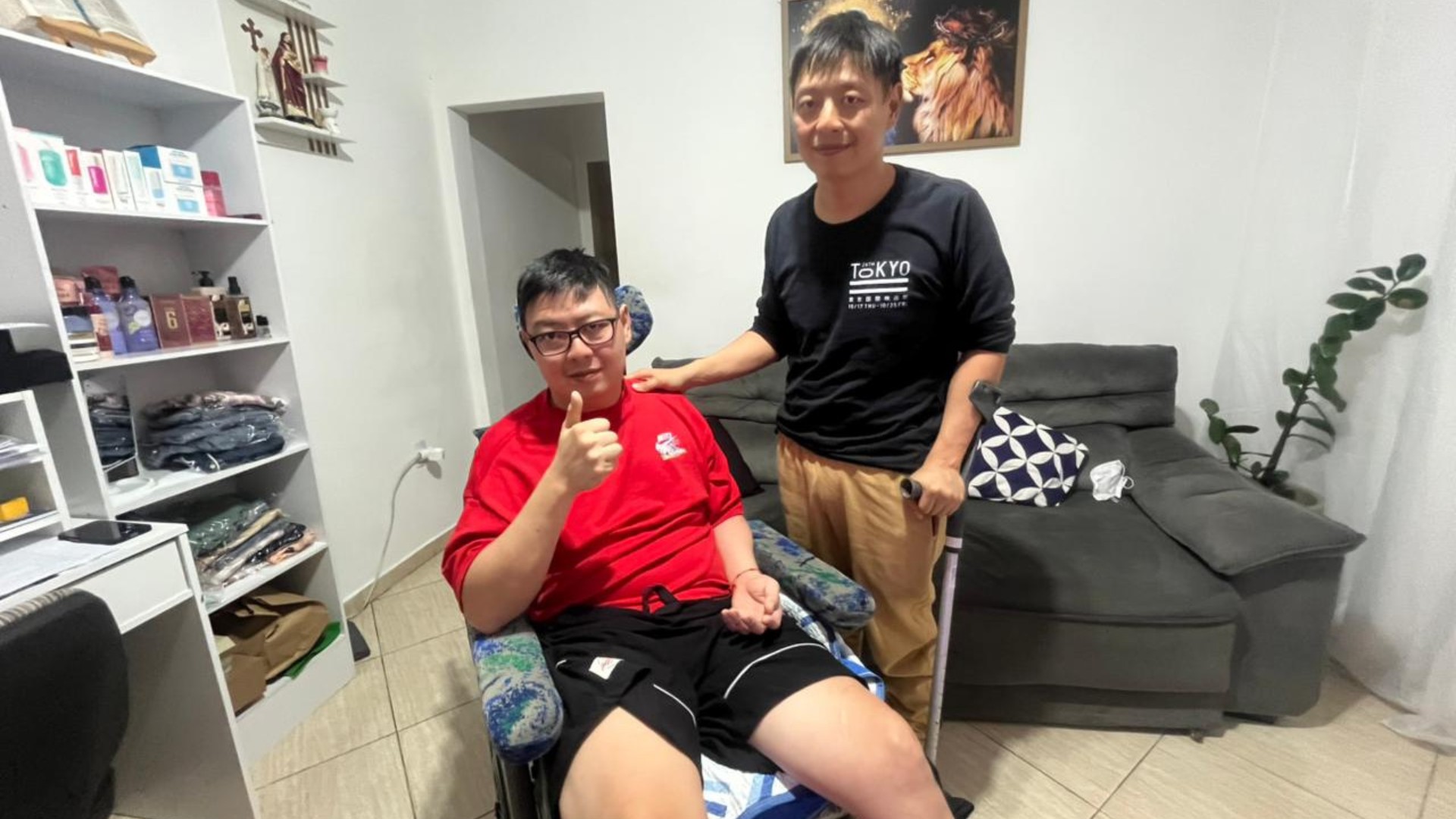
Twin brothers from Sorocaba mobilize campaign for bone marrow donor
⚡ Quick Summary
What started with knee pain turned into a fight against a rare and degenerative genetic disease.
What started with knee pain turned into a fight against a rare and degenerative genetic disease. Twin brothers Everton and Wellington Fugita, from Sorocaba (SP), were diagnosed with Adrenoleukodystrophy (ALD), a condition that compromises the nervous system and causes progressive loss of motor and cognitive functions.
As the disease progressed, the family began to mobilize a campaign to raise funds and find a compatible bone marrow donor.
📲 Join the g1 Sorocaba and Jundiaí channel on WhatsApp
In the case of Wellington Fugita, the diagnosis took more than two years to be confirmed. Before that, he received mistaken diagnoses of stroke and Amyotrophic Lateral Sclerosis (ALS), and started treatment that ended up worsening his clinical condition.
In recent months, the disease has progressed rapidly, resulting in the loss of movement on the left side of the body, stopping walking and having difficulty speaking, requiring permanent care.
Twin brothers from Sorocaba are diagnosed with a rare genetic disease and seek a bone marrow donor
Reproduction/Thales Rodrigues/TV TEM
According to his wife, Giovana Attis Araki Fugita, the progression of the disease accelerated and completely transformed the family's routine.
"At the end of February he started to need a wheelchair, and then we realized that he was progressing very quickly. He felt choking and the feeling that there was something in his throat. He couldn't speak properly. Almost two months later he was practically unable to speak", he explains.
Twin brother also developed the disease
Shortly afterwards, his twin brother, Everton Fugita, also began to show symptoms and received the same diagnosis.
The illness compromised his mobility and forced him to leave his job as a diesel auto electrician. Currently, he uses a crutch to get around and has returned to live with his parents, as Everton explains.
"From December to now I noticed that it started to get more complicated and I started to have more symptoms. Unfortunately, I lost my fine motor skills. Holding a fork, for example, is more difficult", he says.
Twin brothers from Sorocaba are diagnosed with a rare genetic disease and seek a bone marrow donor
Reproduction/Thales Rodrigues/TV TEM
What is Adrenoleukodystrophy?
Adrenoleukodystrophy is a rare genetic disease caused by mutations in the ABCD1 gene, located on the X chromosome. The condition causes the accumulation of very long-chain fatty acids in the body, mainly affecting the brain, spinal cord and adrenal glands.
Symptoms include changes in speech, vision and behavior, difficulties walking and swallowing, loss of cognitive functions and adrenal insufficiency.
Adrenoleukodystrophy is a rare genetic disease caused by mutations in the ABCD1 gene
TV TEM/Reproduction
The twins' sister, Luciana Sayuri Fugita, also has the genetic mutation. However, as is the case in most female cases, she did not develop a severe form of the disease.
During her family history investigation, Luciana discovered that at least two distant relatives died from the same condition.
"When it happened to my brothers, I started to look after the family, I started talking to my mother's cousins, cousins. We analyzed it and there were many people in the family who had it", he explains.
Race against time
Although there is no cure for the disease, bone marrow transplantation can help slow the progression of the disease in certain cases.
According to neurosurgeon Renato Andrade, the procedure does not reverse the damage already caused, but it can slow the progression of symptoms and preserve neurological functions for longer.
"It helps to stabilize. It's not a cure and it won't reverse the already established neurological injuries, but it makes the disease progress, puts a brake on it. If it's going downhill, it goes down more slowly", explains the doctor. The family states that Wellington is already in an advanced stage of the disease and that the possibility of carrying out the transplant depends on the evolution of the clinical picture. Because of this, in addition to fundraising, family members also intensified the campaign to encourage the registration of new bone marrow donors.
"The disease has progressed rapidly in recent months, meaning that today they need constant care, exams, medications and help with daily activities. [...] As my brothers live in separate houses, we are making adaptations in both environments and raising help to pay for treatments, exams, medicines, travel and accessibility equipment, ensuring greater safety, mobility and quality of life for both of them in this very difficult phase", reports the sister, Luciana Sayuri Fugita.
Bone marrow or blood donations can be made at the Blood Collection Charitable Association (Colsan).
To donate blood, you need:
Be in good health;
Weigh at least 50 kilos;
Being fed;
Present original document with photo.
People between 16 and 69 years old can donate, as long as the first donation was made before the age of 60.
Temporary impediments:
Flu or cold symptoms;
Pregnancy;
Breast-feeding;
Intake of alcoholic beverages in the 12 hours prior to donation;
Recent medical procedures, such as surgeries and endoscopic examinations.
Definitive impediments:
Infectious diseases transmitted by blood (hepatitis B and C, HIV and Chagas disease);
Use of injectable illicit drugs.
Colsan is open from Monday to Saturday, from 7am to 12:30pm, except on holidays, at Avenida Comendador Pereira Inácio, 564.
Initial plugin text
See more news from the region on g1 Sorocaba and Jundiaí
VIDEOS: watch TV TEM reports
📰 Related Articles

Ghanaian player Thomas Partey misses out on national team debut after being denied visa by Canada
G1 Globo
With Marta as ambassador, Treasury wants to attract more investors
Agência Brasil
DF's Administrative Center has cracks, infiltrations and even a gunshot mark on the window; see IMAGES
G1 Globo
'The pain of your departure will never diminish the love I feel', says mother of boy killed after being hit by bus in Alemão
G1 Globo
With Neymar, Panini launches updated World Cup sticker pack: what the math says about the chances of completing the album
G1 Globo