With Neymar, Panini launches updated World Cup sticker pack: what the math says about the chances of completing the album
⚡ Quick Summary
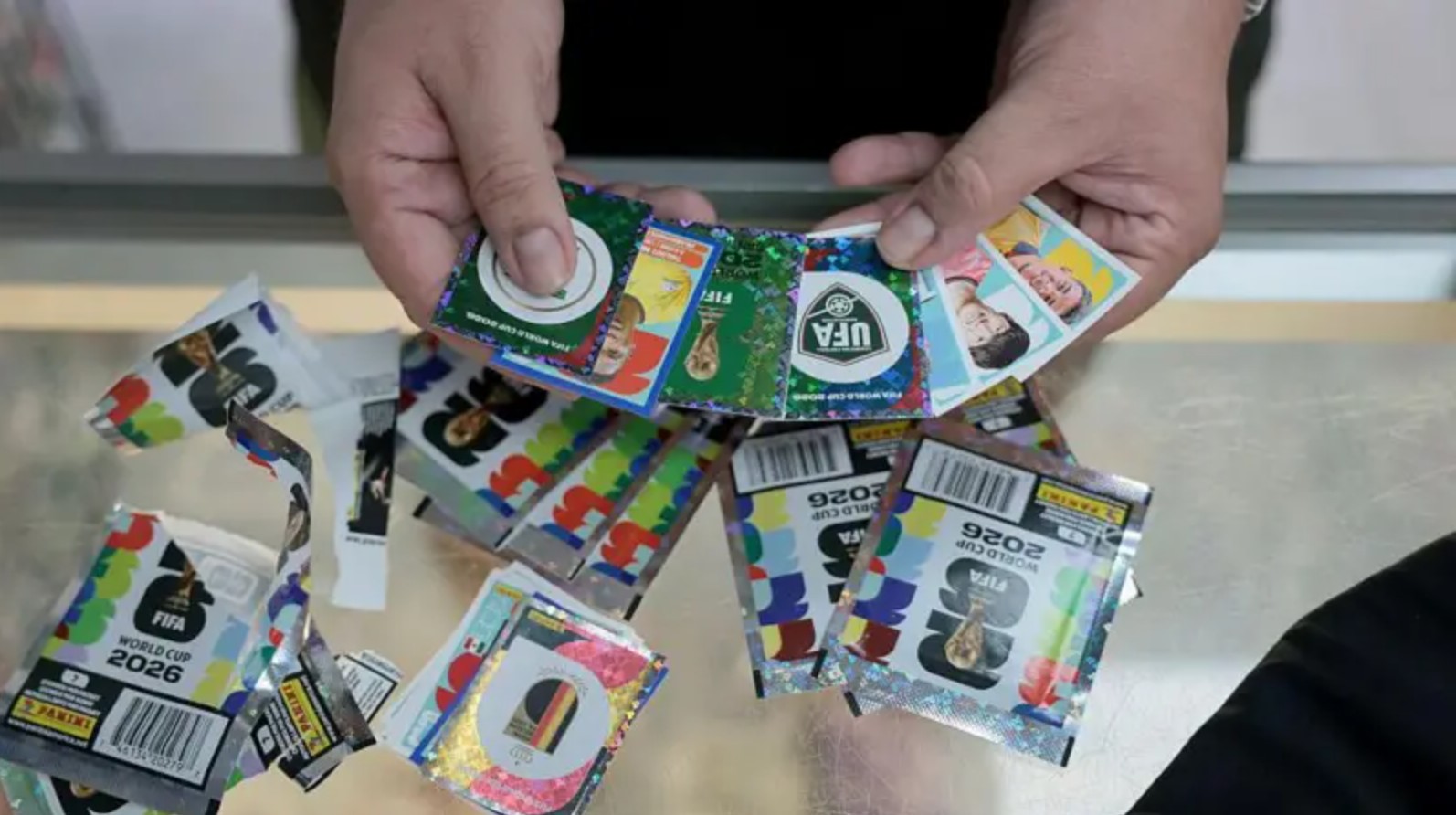
2026 World Cup stickers Getty Images/via BBC Collectors of the official 2026 World Cup album got something new this week.
2026 World Cup stickers
Getty Images/via BBC
Collectors of the official 2026 World Cup album got something new this week. Panini has opened pre-sales for a complementary pack with 120 new stickers to update the collection with players called up after the album's initial release.
Called the Update Set, the kit includes athletes who were left out of the original version, but ended up being confirmed in the final lists of the teams that will compete in the World Cup.
Among the names that join the collection are Neymar, from the Brazilian national team, German goalkeeper Manuel Neuer and Spanish defender Pau Cubarsí.
The update comes at a time of great excitement among fans. After all, the 2026 World Cup album is already the largest in the history of the World Cup, with 980 stickers — a number that now grows even more with the complementary package.
But how much does it cost, in practice, to complete a collection of this size? And what is the best strategy to achieve this? Mathematics helps to answer.
At first glance, it may be difficult to understand all the excitement. After all, they are just stickers.
But for decades, children — and many adults as well — have been buying, trading and collecting images of the world's best football players.
I remember the excitement, as a child in the 1990s, of going through a friend's pile of repeating stickers in the hope of finding one of the few that was missing to complete my album. The words "have, have, have, lack!" echoed through the school yard.
The fever around them can be compared to collecting Pokémon cards or cards from other football championships. As well as the frustration caused by those stickers that seem to appear repeatedly.
Some of them — especially the rarest ones from famous players — become so desirable that they sell for impressive sums. In 2021, a 1979 figurine of Argentine legend Diego Maradona was sold at auction for £413,000 (around R$2.8 million).
And, on the eve of the 2026 World Cup, demand remains strong.
Recently, more than 8,000 collectors of the official World Cup album gathered at a gigantic exchange meeting in Santiago, Chile.
The goal? Fill the pages of the album with players from all the teams competing in the World Cup. And, as this is the largest edition ever released, the challenge is considerable.
So what does it really take to complete a World Cup album? Fortunately, math can help us find out.
Much depends on the strategy adopted.
The buy everything strategy
The official album of the 2026 World Cup has 980 spaces for stickers. —For comparison purposes, there were only 270 stickers in the 1970 World Cup, in Mexico, and 670 in the 2022 World Cup, in Qatar.
In Brazil, where the launch took place on May 1st, the package with seven stickers costs R$7. The album costs R$24.90, in the simple cover version, or R$74.90, in the hardcover version.
The Update Set costs an additional R$119 — the package that includes all players who were left out in the first version (thus, no chance of having the stickers repeated).
For the rest of the album, if each sticker found was new, without any repetition, the minimum expense to complete the album would be R$1,004.90 — considering R$980 in stickers and the simple album.
But in practice, to fill each empty space in the album, the collector ends up buying several repeated stickers.
After getting your first sticker, the probability that the next one will be one of the 979 remaining stickers is 979 out of 980. This means that, on average, you will need to buy 980/979 stickers — just over one — to fill the next space.
The same reasoning is repeated: the next space will require, on average, 980/978 stickers; then, 980/977; and so on.
As the probability of finding different stickers is very high at the beginning of the collection, repeat stickers take time to appear. But as the album approaches completion, the amount needed to fill each remaining space increases dramatically.
When there are only 10 stickers missing, for example, the chance of each new sticker purchased being one of the missing ones is just over 1%.
To get the penultimate sticker, the chance of finding it is only 2 in 980 for each new sticker acquired. On average, 490 stickers would be needed to fill this space.
The last one is even worse. On average, it would be necessary to obtain 980 stickers to find exactly the one that is missing.
The end result is impressive. On average, a collector would need to acquire around 7,316 stickers to complete an album with 980 spaces alone.
Including the new stickers, Brazil, this would bring the total cost to around R$7,460.80, considering the sticker packs, the simple album and the Update Set sold by Panini for R$119.90.
Numbers arise from a well-known mathematical object called "harmonic series". The name comes from the concept of harmonics in music.
The same formula appears in several areas of knowledge because it is related to the cost or effort required to fully explore an unknown set.
It can be used, for example, to estimate how many people need to be interviewed in market research to capture the full range of consumer preferences. In ecology, it helps scientists estimate the number of species present in a given habitat.
*With information from the BBC News Brasil editorial team
How much does it cost to complete the World Cup album in Brazil compared to other countries?
Mexico beats South Africa in a chaotic game with three sent off by Brazilian referee
The 'most expensive and most politicized' World Cup: 4 important points about the 2026 World Cup
🗞️ 4 sources covered this story

Lula: if they play with their hearts in their boots, we will have a great World Cup
CNN Brasil
With US$1.8 trillion, SpaceX is the 8th most valuable company in the world; see top 10
CNN BrasilNeymar in the album: Panini launches updated stickers for the 2026 World Cup
CNN Brasil
Coca-Cola replaces bottles after label theft with World Cup stickers
CNN Brasil📰 Related Articles
DF's Administrative Center has cracks, infiltrations and even a gunshot mark on the window; see IMAGES
G1 Globo
'The pain of your departure will never diminish the love I feel', says mother of boy killed after being hit by bus in Alemão
G1 Globo
Twin brothers from Sorocaba mobilize campaign for bone marrow donor
G1 Globo
Before World Cup debut, US player explains fanaticism for the NY Knicks
CNN Brasil
Financially strangled, Corinthians delays payments and lives “D-Day”
CNN Brasil