


Haitian Revolution: the history vetoed by FIFA on the World Cup shirt
⚡ Quick Summary
When it debuts in the football World Cup on Saturday (13), Haiti will no longer display on its shirt an illustration of an emblematic episode in modern history: the revolution that led to the abolition of slavery and the country's independence (1791–1804).
When it debuts in the football World Cup on Saturday (13), Haiti will no longer display on its shirt an illustration of an emblematic episode in modern history: the revolution that led to the abolition of slavery and the country's independence (1791–1804).
The Caribbean team had to modify its game uniforms after the International Football Federation (Fifa) vetoed it. The entity argued that it was a political demonstration, something prohibited in its regulations.
Related news:
Haiti changes shirts for the World Cup after FIFA's objection.
Haiti: transition council ends mandate after US threat.
World Cup 2026: Brazil falls in bracket with Morocco, Scotland and Haiti.
The drawing showed a group of people holding a red and white flag. In an interview with The Athletic, a United States newspaper linked to The New York Times, a Haitian representative said it was a reference to the Battle of Vertières. Occurring in 1803, the rebellion was decisive for the French defeat in the territory.
The inclusion of the image valued a symbol of national pride, but also exploited a coincidence. The battle took place on November 18, 1803. The football team qualified for the World Cup on November 18, 2025, by beating Nicaragua 2-0, in a qualifying game.
Gabriel Léccas, professor and master in history at the State University of Rio de Janeiro (UERJ), researches the memory of the Haitian revolution. He recalls that this is not the first time that a sports entity has censored historical images of a Haitian delegation.
In February this year, at the Winter Games in Italy, the International Olympic Committee (IOC) banned an illustration of Toussaint Louverture, one of the leaders of the revolution, on the uniform that Haiti would wear at the opening of the event. The argument was also that it was a political element.
"They are demonstrations of the historical and political silencing of the memory of the revolution and of the historical subjects who built it. This silencing occurred in the 19th century due to slavery discourses, when the elites feared a new slave revolution.”
According to Léccas, this process is evidenced by racist discourses, whose worldview does not recognize the leading role of non-white historical subjects in the fight for their rights and the questioning of racial hierarchies.
The image, from around 1797, represents the limitations of freedom of French democracy on Haitian soil. Gironde departmental archives
Understand below what the Haitian Revolution and the Battle of Vertières were:
Colonization
According to historian Marco Morel, in the book The Haitian Revolution and Slave Brazil (2017), the Caribbean island was inhabited by the Taïno (or Arawak) indigenous group, who called the place Haïti (mountainous land), before the arrival of Europeans. In 1492, Christopher Columbus landed there and named the island Hispaniola.
The indigenous population, estimated at between hundreds of thousands and a million people, was decimated in a few decades due to massacres, European diseases and work in the mines imposed by the Spanish.
To meet the shortage of labor, King Charles V of Spain authorized, in 1517, the importation of enslaved Africans to the island. The Spanish concentrated their colonization in the western part. The eastern part was ceded to France in 1697 and came to be called Saint-Domingue (Saint Sunday).
The economy in this area was based on a tripod of export agriculture: sugar cane, coffee and indigo. By 1789, the colony accounted for two-thirds of France's foreign trade and was the largest single market for the European slave trade. Society was divided between a minority of free whites and blacks, and a majority of Africans and enslaved descendants.
The lives of enslaved people were regulated by the Code Noir (Black Code) of 1685, which provided for severe corporal punishment and strategies to avoid rebellions. This ended up not being enough to prevent the collapse of the colonial system.
Revolution
In the book The Black Jacobins: Toussaint L'ouverture and the Revolution of St. Dominic, Caribbean historian C. L. R. James explains that the weakening of France's power and the circulation of Enlightenment ideals of freedom and equality on the island created a favorable framework for the revolt.
Image by Toussaint Louverture, by Nicolas Maurin (1838). Bibliothèque Nationale de France François
The rebellion was organized by leaders of African origin, such as Toussaint Louverture, Jean-Jacques Dessalines and Henri Christophe. The researcher called them "black Jacobins", due to their similarity to the Jacobins of the French Revolution (1789–1799), who represented poorer sections of the population and had a firmer position in defense of social equality.
In São Domingos, the armed uprising effectively began on the night of August 22, 1791, when hundreds of mills and plantations were destroyed, and white settlers were killed. The island entered a war that lasted 12 years.
Although France formally decreed the abolition of slavery in its colonies in 1794, the government led by Napoleon Bonaparte sent a military expedition in 1802 with the aim of reestablishing the slave regime on the island. The measure provoked the union of local rebel forces in an all-out war for independence.
Battle of Vertières
The decisive confrontation against French troops took place in November 1803, near French Cape (currently Cape Haitian). Rebel forces made up of blacks, under the leadership of Jean-Jacques Dessalines, concentrated the offensive against the army commanded by French general Donatien de Rochambeau.
During the fighting, the performance of the Haitian officer François Capois (known as Capois-la-Mort) stood out, who led the advance of his military column under artillery fire. The victory of the troops commanded by Dessalines forced the evacuation and definitive surrender of French soldiers in the territory.
Independence and impact
On January 1, 1804, Dessalines officially proclaimed the independence of São Domingos, which was renamed with the indigenous name Haiti. The act marked the founding of the first black republic in the world and the first national state in the Americas to legally abolish slavery since its origin.
The Haitian revolutionary process generated international repercussions, influencing emancipationist movements and debates on civil and racial rights in other territories in the Americas, including Brazil during the imperial period.
For historian Gabriel Léccas, one of the most important elements of the Revolution was the fact that it was the first to combine the anti-colonial struggle with an abolitionist political program.
"The trait that directly contributed to this pioneering spirit was the leading role of black people, both freed and enslaved, in the independence struggles."
The professor explains that the revolution founded an abolitionist empire in which citizens – of any color – were called black, giving new meaning to the term blackness as a political identity.
“This aspect questioned the idea of humanity elaborated by movements such as the French Revolution and the Independence of the United States, which initially did not recognize the citizenship of black and mixed-race people.”
🗞️ 4 sources covered this story

Haitian Revolution: the history vetoed by FIFA on the World Cup shirt
CartaCapital
World Cup 2026. Haitian striker fled the war in Iran
Observador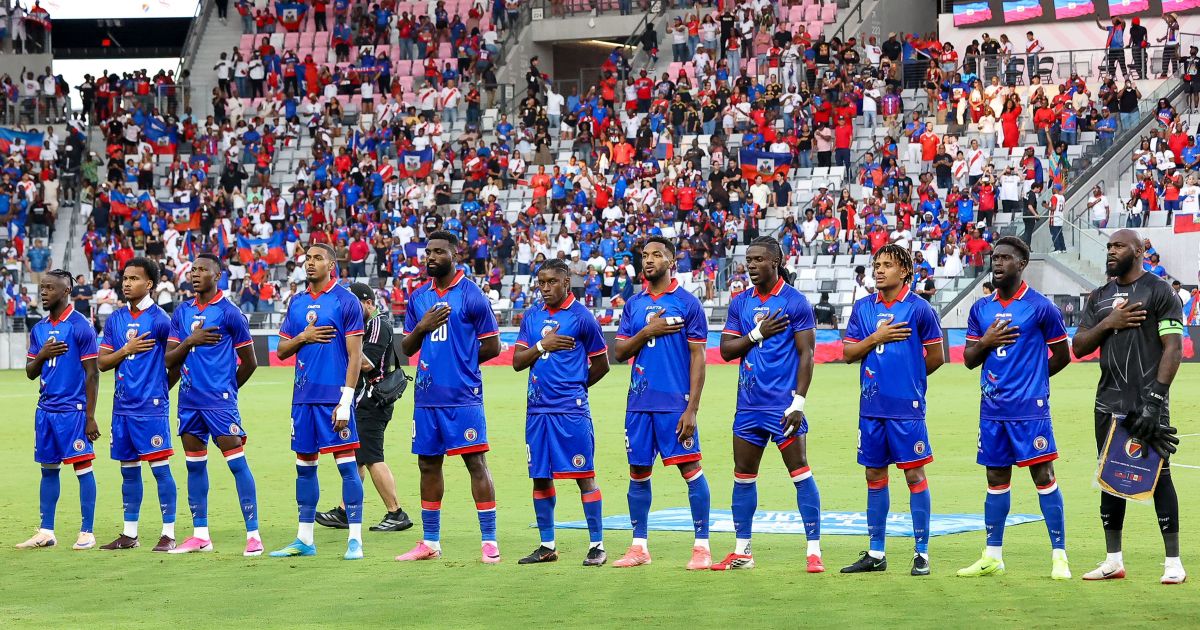
World Cup format guarantees duels between distant teams in the FIFA rankings
CNN BrasilRamon Abatti Abel is chosen by FIFA to referee Belgium and Egypt in the World Cup
terra.com.br📰 Related Articles
Fog causes flight cancellations at BH International Airport
G1 Globo
After failure on Line 11-Coral, Line 7-Rubi also presents circulation problems this Friday
G1 Globo
Understand the next steps after the PF’s rejection of Daniel Vorcaro’s plea
G1 Globo
Married for more than 6 decades, husband dies an hour after his wife's funeral: 'Not even death could separate them', says son
G1 Globo
Florentino moves permanently to Burnley
Observador/https://i.s3.glbimg.com/v1/AUTH_59edd422c0c84a879bd37670ae4f538a/internal_photos/bs/2026/r/I/dcN7BpTfS4qEOCQBuYGg/globo-canal-4-20260522-2000-frame-95892.jpeg)