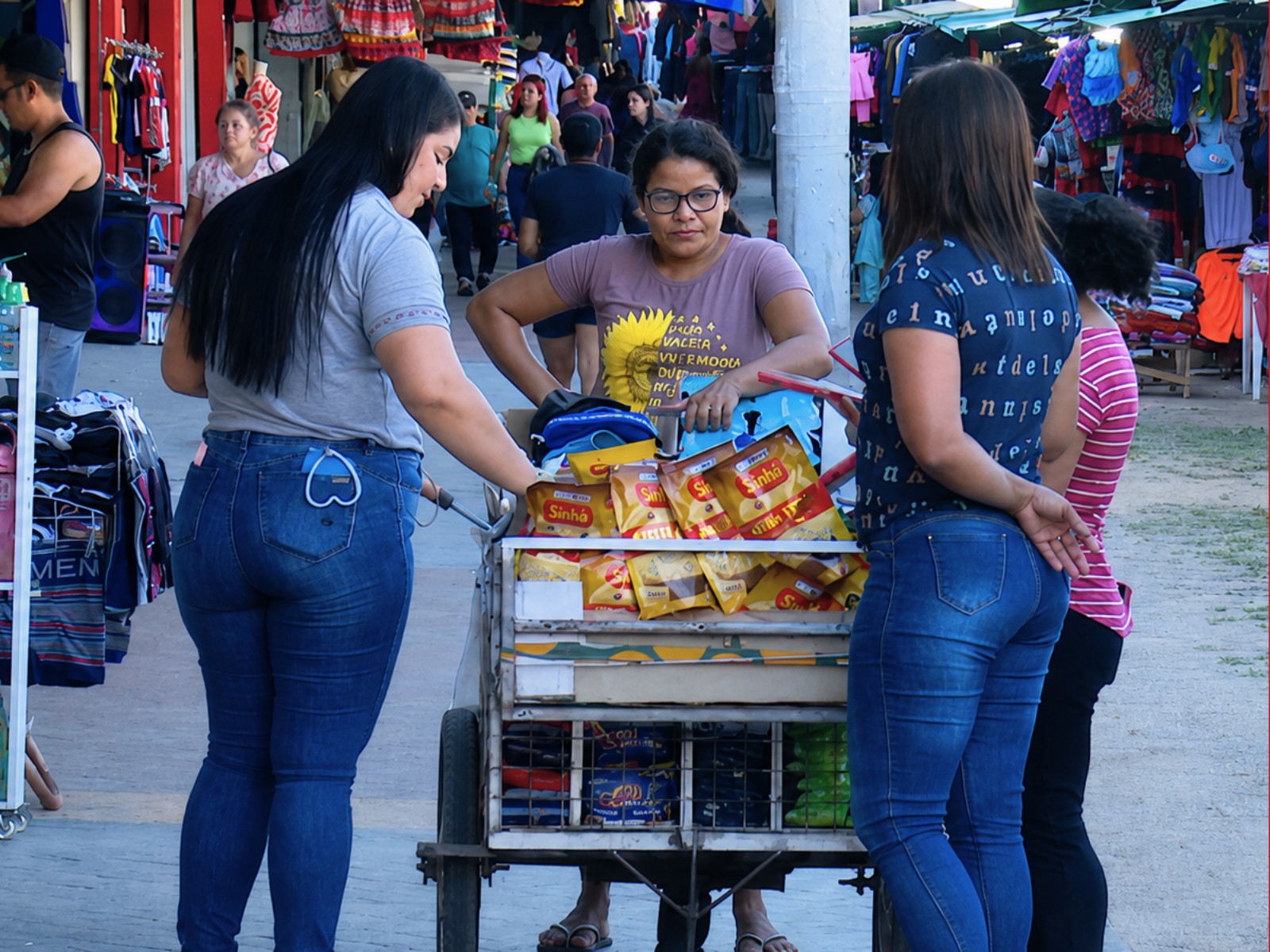
Research shows that home and family care impacts women's employment in AC: 'Charged from an early age'
⚡ Quick Summary
Double shift continues to impact women’s professional lives Women face more difficulties than men in gaining space in the job market in Acre.
Double shift continues to impact women’s professional lives
Women face more difficulties than men in gaining space in the job market in Acre. Data from the Continuous National Household Sample Survey (Pnad) show that the unemployment rate among women reached 7.9% in the state, while among men it was 5.7%.
The scenario reflects a reality that goes beyond the search for a job. According to the Brazilian Institute of Geography and Statistics (IBGE), women dedicate almost twice as much time to home and family care compared to men, an overload that impacts opportunities for qualification, income and professional growth.
✅ Join the g1 AC channel on WhatsApp
For student Kauane Santos, this responsibility is usually attributed to women from an early age.
"It's something that is demanded from an early age. A woman has to form a family, find a job and be the basis for everything at home. I have colleagues who are mothers and face an even more difficult reality, because they have to balance studies with caring for their children", she reports.
In addition to registering a higher unemployment rate, many women still encounter obstacles in advancing professionally and end up concentrated in informal or lower-paid occupations.
Home and family care impacts women’s employment in Acre
Aldo França/Amazon Network
Professor Gigliane Souza assesses that inequality is directly linked to the division of family responsibilities.
"Caring for the family is socially determined, especially for women. Men often don't need to worry about it in the same way. This ends up affecting the search for qualifications and, consequently, job opportunities and better salaries", he explains.
READ MORE:
Acre is among states with the lowest wage inequality between men and women, says study
Program for women will receive only R$3 budget for 2026 in Rio Branco
'Search for zero feminicide': New Women's Secretary intends to expand actions after record number of cases in AC
According to her, when men and women compete for the same position, domestic responsibilities can reduce the time available for continued training and professional development.
“If a woman needs to think about several other issues to qualify, the chances of a man arriving more prepared for this contest end up being greater”, he adds.
Although challenges persist, recent indicators point to progress in reducing wage inequality in the state.
Salary difference
A survey released by the Ministry of Labor and Employment (MTE) showed that Acre is among the Brazilian states with the lowest salary difference between men and women, with an equivalence index of 91.9%. The closer to 100%, the smaller the distance between the incomes of the two groups.
Home and family care impacts women’s employment in Acre
Getty Images via BBC
In practice, however, equality has not yet been achieved. Data from the report indicate that the average salary of Acre women is R$2,356.89, while that of men reaches R$2,565.24.
Differences also appear when factors such as race and job occupation are considered.
Qualification
To expand opportunities for professional insertion, the Acre State Secretariat for Women (Semulher) offers qualification courses aimed mainly at women in situations of social vulnerability.
The head of the department's Department of Economic Autonomy and Care Policies, Vanessa Rosella, states that the lack of qualifications and support network are still among the main obstacles to female entry into the job market. Vanessa Rosella states that the lack of qualifications and support network still makes it difficult for women to access the job market
Aldo França / Amazon Network
"Many women are at home carrying out family and childcare activities. That's why we take the courses into the communities, facilitating access to training and creating opportunities for them to generate income", he highlights.
Among the actions developed by the secretariat are courses aimed at different audiences, including indigenous women in urban contexts, with a focus on income generation and entrepreneurship.
Despite advances in female participation and the reduction of salary differences in some states, equal opportunities in the job market are still far from being a reality for many Brazilian women.
VIDEOS: g1
🗞️ 2 sources covered this story


📰 Related Articles

Alcolumbre signals vote on new ‘bomb agenda’ in the Senate next week
CartaCapital
Enel records more than 3 thousand cable thefts in five months of 2026
CNN Brasil
Big techs have 60 days to adapt to the new content accountability rules on social media
G1 Globo
VIDEO: Personal trainer saves choking student at Fortaleza gym
G1 Globo
Super Sete today: results of contest 861 and numbers drawn
G1 Globo