Square, round or triangular? Understand the shape of the bonfire of each June saint
⚡ Quick Summary
Square, round or triangular? Understand the shape of the bonfire of each June saint Far beyond warming up the cold June nights and setting the scene, the June festival bonfires carry historical and religious meanings.
Square, round or triangular? Understand the shape of the bonfire of each June saint
Far beyond warming up the cold June nights and setting the scene, the June festival bonfires carry historical and religious meanings. According to popular tradition, each saint of the month is honored with a different shape of bonfire.
To explain the origin of this relationship, g1 spoke with Diogo Comitre, professor of History at the Federal Institute of São Paulo (IFSP), Sorocaba campus (SP).
📲 Join the g1 Sorocaba and Jundiaí channel on WhatsApp
In some communities, the types of bonfires are divided specifically between the three main Catholic saints of the month: Saint Anthony, Saint John and Saint Peter.
Each of them is honored with a bonfire of different shapes: square, round and triangular. Each drawing has a symbolic explanation linked to the beliefs of each saint, according to the historian.
Square, round or triangular? Understand the shape of the bonfire of each June saint
Art/TV TEM
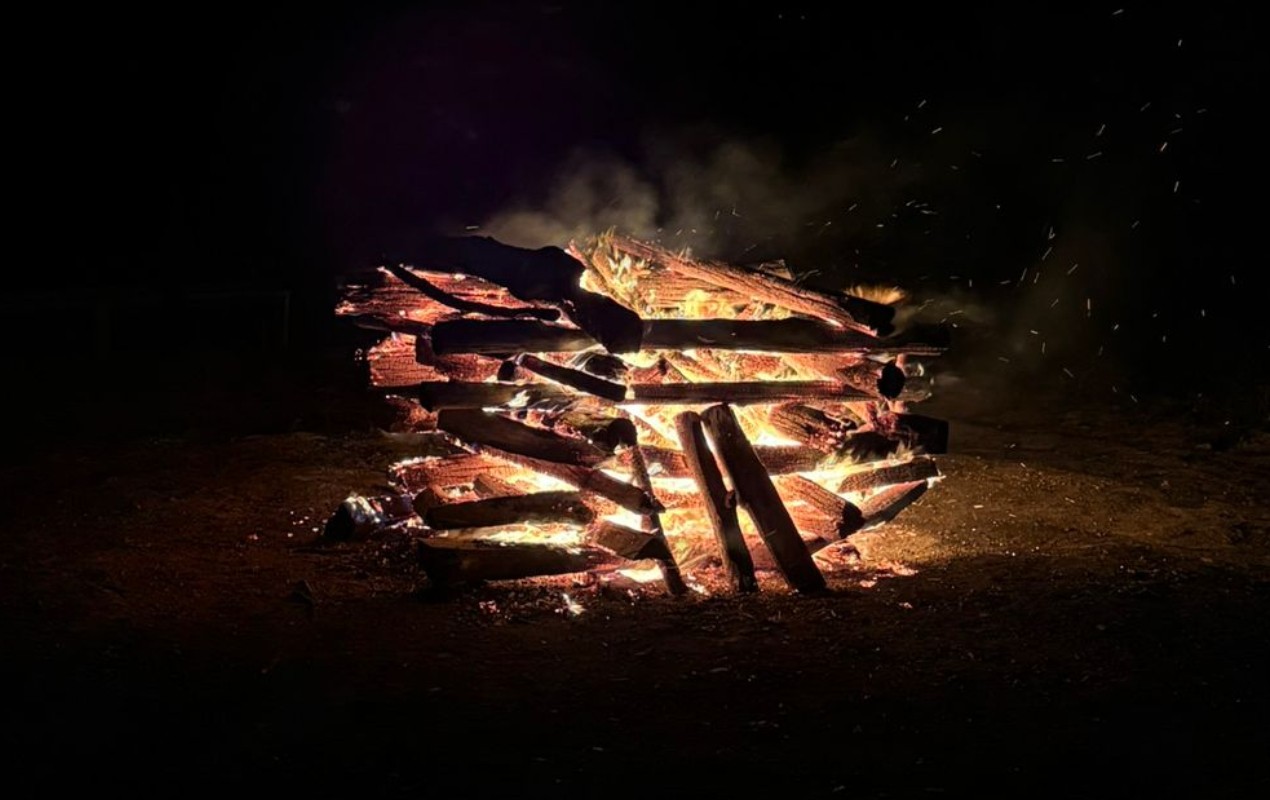
The Santo Antônio bonfire has a square shape. Diogo explains that the design represents stability and family unity, a direct reference to the saint's fame as a "matchmaker".
The São João bonfire is mounted on a round base. The circular shape symbolizes the community gathered around faith and also alludes to the sky and the cycles of nature.
“The circle can also symbolize the sky, indicating cyclical movements”, he explains.
The São Pedro bonfire has a triangular shape. The historian explains that the triangle is a tribute to the Holy Trinity (Father, Son and Holy Spirit), one of the pillars of Christian doctrine.
Mixture of beliefs
In Brazil, the tradition of June bonfires joined indigenous and African beliefs. Diogo cites the religious syncretism between Saint John and Xangô, the orisha of justice linked to the element of fire.
Family sets up square bonfire in honor of Saint Anthony in Itapetininga (SP)
Gustavo Leme
“This syncretism caused enslaved people and their descendants to celebrate Xangô in the June period through the bonfire tradition”, he explains.
In shamanic traditions, fire functions as a spiritual guide to connect the material world with the divine. Despite these different views, the historian reinforces that the formats of bonfires continue to be a free tradition. He remembers that the Catholic Church accepted bonfires at the Council of Trent (16th century), but never dictated rules about their shape.
In Itapetininga (SP), family maintains tradition and prepares square bonfire dedicated to Saint Anthony
Gustavo Leme
In Itapetininga (SP), the family of Maria Luiza Azevedo, 23 years old, keeps these customs alive. Catholic, the family decided to research the meaning of bonfires last year, when they organized the first June festival on the family farm.
“We knew that there were different types of fires, but we didn’t know what they were,” he says.
The intention of Maria Luiza and her mother was to rescue the religious culture in the fraternization. They chose to set up the Santo Antônio bonfire, which has a square base.
“We researched how to bring a little culture, and not just throw a party”, he explains.
Maria Luiza Azevedo, from Itapetininga (SP), says that the family researched the meaning of bonfires
Personal Archive
For Maria Luiza, fire plays an essential social role in the June festivities, functioning as the main point of the event.
“People usually plan for everything to happen around it, both to keep them warm due to the cold and as a meeting point, for conversation, something more social,” he says.
Origin of bonfires
Square bonfire made by a family from Itapetininga (SP) pays homage to Saint Anthony
Gustavo Leme
The custom of lighting bonfires in June is older than Christianity. The tradition began with peasants in ancient Europe, who performed pagan rituals to honor the gods of nature and fertility. The rituals took place during the beginning of summer in the Northern Hemisphere, according to Diogo. Residents gathered around the fire to give thanks for the harvest, scare away pests from crops and ask for protection against evil spirits.
Centuries later, the Catholic Church faced resistance to convert the rural population in Europe. To facilitate the acceptance of Catholicism, religious authorities decided to mix pagan traditions with Christian elements.
"Aiming to overcome these difficulties, Christian authorities sought to mix pagan and Christian traditions in the Iberian Peninsula as a strategy to approach the rural population, making Christian doctrine more palatable to this population", he says.
As the Church was unable to prohibit the festivals that the people loved so much, it replaced the tribute to the gods of nature with the celebration of popular saints. This is how the bonfire came to be linked to Saint Anthony, Saint John and Saint Peter. The custom arrived in Brazil with Portuguese colonizers in the 16th century.
Historian from Sorocaba (SP), Diogo Comitre, explains the origin of June bonfires and the meanings associated with the formats in popular traditions
Personal Archive
In the case of Saint John, Catholic tradition created a popular story: John the Baptist's mother lit a fire on the top of a mountain to warn Mary about the baby's birth.
“Although the episode does not appear in the Bible, according to Catholic belief, John the Baptist's mother lit a fire as a way of warning Mary about his birth, which explains the practice of lighting a fire on June 23rd”, explains the historian.
Just like the story of Saint John, the custom of linking the shapes of bonfires to different saints is also a popular custom, and not a religious rule.
"There is no right or wrong, because, as it is a popular practice, it may or may not be relevant. It is important to understand that there is no association between the shape of the bonfire and the saint according to the liturgical recommendations of the Catholic Church itself", he states.
For Maria Luiza, this mix of stories helps keep the custom alive. According to her, the bonfire unites the religious past and ancient culture with the current function of bringing friends and relatives together.
"The bonfire brings together this Christian, Catholic culture, and also a previous tradition, linked to pagan culture. Today, it also has this more social side, of being a center for bringing people together", he concludes.
Maria Luiza Azevedo, from Itapetininga (SP), says that the bonfire also represents a moment of reunion between family and friends
Personal Archive
*Collaborated under the supervision of Júlia Martins
See more news from the region on g1 Sorocaba and Jundiaí
Initial plugin text
VIDEOS: watch TV TEM reports
📰 Related Articles

Glória Pires reacts to the corn look created by a TO influencer to support Brazil in the World Cup
G1 Globo
Court orders start of recovery works at Conjunto Imigrantes, in Cubatão; understand the case
G1 Globo
Elections in Peru: Sánchez and Keiko compete vote by vote; see timeline and MAP of calculation
G1 Globo
Rui Rodrigues wins Vitória de Guimarães by 2 votes
Observador
Roraima increases cocoa production by almost eight times and cultivated area reaches 1,300 hectares
G1 Globo