


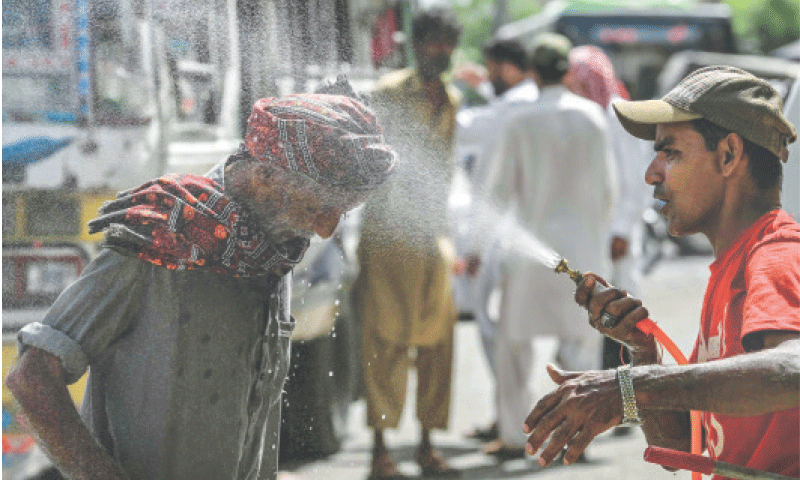
Karachi sizzles as feels-like temperature climbs to 54°C
⚡ Quick Summary
• Jacobabad becomes hottest place with 49.5°C • Weatherman expects some relief after tomorrow • Expert says staying hydrated key to coping with heat-related illnesses KARACHI: While the maximum temperature recorded in Karachi on Wednesday was 37.4 degrees Celsius, the feels-like temperature surged to 54°C, the Met Office data showed.
• Jacobabad becomes hottest place with 49.5°C
• Weatherman expects some relief after tomorrow
• Expert says staying hydrated key to coping with heat-related illnesses
KARACHI: While the maximum temperature recorded in Karachi on Wednesday was 37.4 degrees Celsius, the feels-like temperature surged to 54°C, the Met Office data showed.
According to the data, the feels-like temperature gradually soared from 49°C at around 1pm to 54°C at 3pm.
It showed relative humidity was 79pc and 65pc in the morning and evening, respectively. The minimum temperature was 30°C.
Other districts of Sindh also experienced harsher weather conditions with mercury soaring to 49.5°C in Jacobabad followed by Dadu 49°C, Paddidan and Sukkur 47°C, Mohenjo Daro, Larkana, Shaheed Benazirabad 46.5°C, Rohri 46°C, Khairpur 45.5°C and Sakrand 45°C.
“We are expecting relief after Friday (tomorrow). The high pressure area developed over the region will gradually subside and the temperature will drop to 36°C to 34°C. But, there are no chances of rain in coming days in Karachi,” Chief Meteorologist Ameer Hyder Laghari told Dawn.
According to him, the highest ever recorded temperature of Karachi in the month of June is 47°C, which was recorded on June 18, 1979.
Preventive measures
Speaking about prevention from heat-related illnesses, Dr Nadeemullah Khan, Professor and Chair Department of Emergency Medicine, Aga Khan University Hospital, said that staying hydrated was the most important preventive step people need to take to protect themselves.
“Avoid sugary drinks, caffeinated beverages, tea, coffee and alcohol, which accelerate fluid loss. Avoid the hottest hours and use air conditioning or cooling spaces, if possible. Evidence shows that time in air-conditioned environments is among the strongest protective factors against heat death. Fans alone are insufficient when ambient temperature exceeds body temperature,” he told Dawn.
“Heavy protective gear and dark clothing significantly increase heat absorption. Women whose cultural dress limits heat dissipation are at elevated risk and should take extra precautions.
“Workers must be given adequate water, shade and rest breaks. New workers and those returning from leave require gradual acclimatisation. Heavy work should not be assigned to elderly or high-risk workers during extreme heat.”
About any special precautions needed for children and the elderly, he said they were the two highest-risk groups and required specific protective strategies.
“Children have a higher surface area-to-body mass ratio, meaning they absorb heat from the environment faster than adults. Their sweat rates are slower, they have a higher temperature threshold before sweating begins, and they produce more dilute sweat, all of which impair heat dissipation,” he added.
Children, he emphasised, must never be left in parked vehicles, temperatures inside can be fatal within minutes. “Outdoor sports and play should be restricted to early morning or evening. Frequent water breaks are mandatory.”
The elderly, he said, were vulnerable because of their diminished cardiovascular reserve, which meant reduced ability to increase heart rate and redirect blood to the skin for cooling.
“Their reduced mobility, immobility and loss of heat-shock proteins increase vulnerability. Many elderly patients live alone, in poorly ventilated homes, without electricity or air conditioning, a critically dangerous combination during heat waves.
“Community health workers and family members should conduct twice-daily welfare checks on elderly individuals during extreme heat events,” he said.
Published in Dawn, June 11th, 2026
📰 Related Articles
Naira depreciates to N1,400/$ in parallel market
Vanguard Nigeria
Video Captures Moment When US Struck Tanker Carrying Indian Crew
NDTVTerrorists kill vice principal, 2 others in Kogi, Edo shuts schools
Vanguard Nigeria
Bike-borne men open fire outside Delhi’s Paschim Vihar gym, Bishnoi gang claims responsibility
The Hindu
Railway Minister V. Somanna sets 2026-27 deadline for completion of 32 ROBs, RUBs in Tumakuru
The Hindu