Conpresp authorizes renovation to create a gym at Serraria do Parque Ibirapuera
⚡ Quick Summary
Urbia wants to transform Serraria do Parque Ibirapuera into a shopping center Personal file The renovation project for the old Sawmill in Parque Ibirapuera, in the South Zone of São Paulo, was approved this Monday (8) by Conpresp, the capital's heritage preservation council.
Urbia wants to transform Serraria do Parque Ibirapuera into a shopping center
Personal file
The renovation project for the old Sawmill in Parque Ibirapuera, in the South Zone of São Paulo, was approved this Monday (8) by Conpresp, the capital's heritage preservation council. The Urbia concessionaire's initiative aims at the commercial exploitation of the space, currently used for practices such as tai chi chuan, yoga and other free collective activities. The vote ended 5 to 3 after months of debate with users and experts who called for the structure to be preserved.
The planned interventions include the closure of more than half of the sides of the warehouse with glass panels and the construction of a mezzanine along almost its entire length, where gym equipment will be installed. Urbia is awaiting authorization from the Municipal Green and Environment Secretariat to begin the works and says it does not yet have a commercial partnership for the area.
The discussion between the Conpresp advisors was resumed with the reading of a legal opinion that states that there are no objective limitations for the occupation of the Serraria in the resolution of the park's listing. The document argues that the general guidelines established in the park's 2020 Intervention Plan – such as an occupancy limit of 50% of the area on the ground floor and 30% on the upper floor of the warehouse – are merely guidelines and can be revised.
To substantiate the regularity of the proposal, Urbia cited as a precedent a project by the city hall itself to convert the Serraria into a museum dedicated to the work of sculptor Frans Kajcberg, which was approved with a higher occupancy rate than the current one and had its legality confirmed by the Court of Justice of São Paulo in 2010, but ended up not getting off the ground.
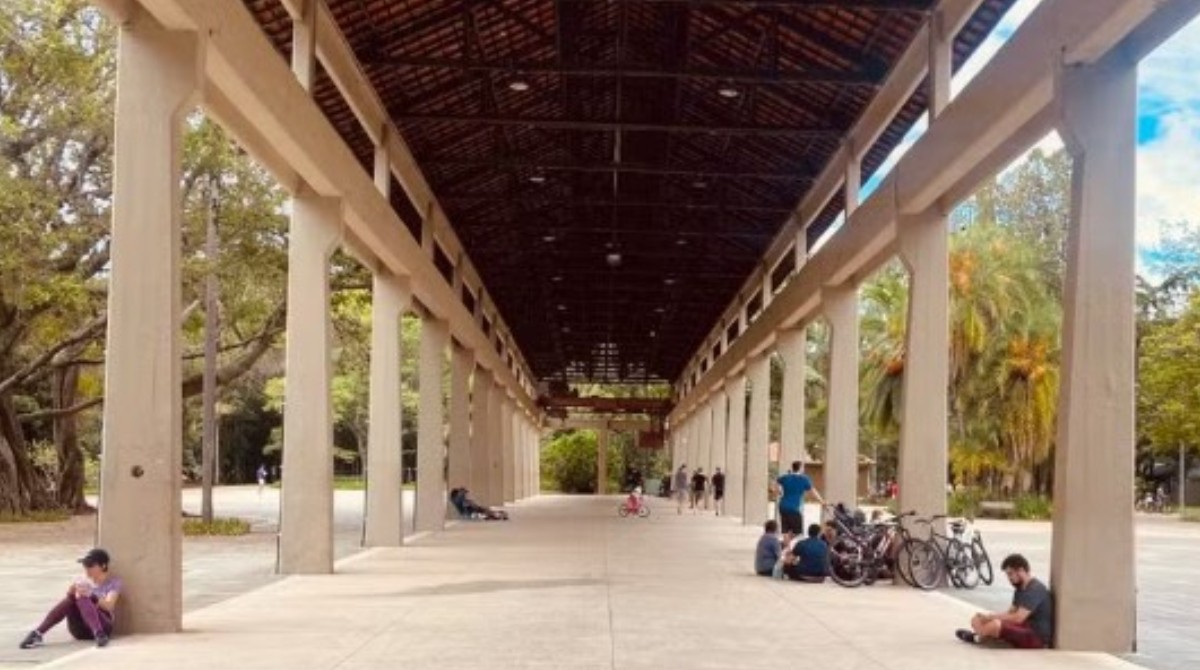
Visitor movement at Serraria and Praça Burle Marx, in Ibirapuera Park
The analysis received a favorable opinion from the technical area of the Municipal Department of Culture, which considered the arguments against the project to be without legal relevance. The Association of Owners, Protectors and Users of Listed Properties (Appit) had alleged the risk of irreversible damage to property in an attempt to block the reform proposed by Urbia.
When reading his vote, in favor of the proposal, the president of Conpresp, Wilson Levy, stated that if it "does not satisfy the entirety of Ibirapuera users, it does not disqualify the building or its surroundings, without major interference with activities carried out there"
After notes made by heritage defense entities and counselor Danielle Santana, representative of the Institute of Architects of Brazil (IAB), he included in the text that Urbia should present, in August, a restoration plan for the park for the following semester. The objective is to allow the council to have a "global view" of the concessionaire's plans and thus avoid mischaracterization in the "general sense" of Ibirapuera.
Concessionaire says economic activity guarantees conservation
Although the proposal has generated criticism from the park's management council, which fears the destruction of the area and restrictions on access, the director of Urbia, Samuel Lloyd, defended at the meetings that economic activity is what will guarantee the maintenance and restoration of the heritage. In a public hearing held at the City Council on May 19, he cited the Sala São Paulo management model as a reference.
"We have ticket offices for shows, food and beverage services, renting a space for events and exhibiting sponsoring brands, to name some of the economic activities, and that doesn't make this space [Sala São Paulo] any less noble," argued Lloyd.
According to the director of Urbia, the project underwent significant changes to adapt to the requirements of heritage bodies (Conpresp, Condephaat and Iphan), such as the removal of tables and a food kiosk, in addition to the replacement of masonry walls with wooden cladding in the area where the changing rooms will be located. Lloyd also explained that the mezzanine will be self-supporting, built using a 100% reversible technology called steel frame — which would allow a return to the original design in the future. "We're talking almost like a Lego, we don't need to do any kind of mutilation to this structure"
He also rejected the comparison with a "shopping center" and said that the intervention will bring "more usefulness" to the area.
Sawmill renovation project foresees construction of a slab and closure of the upper floor with glass
Reproduction/Urbia
The Sawmill is an industrial structure remaining from the 1930s — prior to the creation of the park — and was originally used to preserve trams and carpentry. In 1992, the space was redeveloped by renowned landscaper Roberto Burle Marx (1909-1994), who integrated the warehouse into a square with water mirrors, fountains and native vegetation in front of Viveiro Manequinho Lopes.
Specialist in urban parks and professor at Mackenzie University, architect Cássia Mariano considers the Serraria as a central element of one of the few public spaces designed by Burle Marx in São Paulo. For her, the closure with glass and construction of an internal slab would end the visual continuity and integration of the complex, in addition to reducing the visibility of historical and architectural aspects, such as the wooden scissors that support the roof and an almost century-old lifting crane.
The architect also criticized the excess of commercial activations in the park, which would be taking up space for contemplation and coexistence with nature. "We need somewhere within Ibirapuera to be able to simply look at the green; to be able to simply have peace; to be able to simply have peace; to be able to simply breathe, which is what public parks exist for", declared Cássia during the hearing in the Chamber.
In January, the City Hall's Department of Historical Heritage (DPH) issued a technical opinion opposing the renovation project, pointing out a possible mischaracterization of the original work and damage to the area's landscaping. The body considered that the proposed occupancy — 57% on the ground floor and 89% on the upper floor — violates the maximum occupancy guidelines of 50% and 30% provided for in the park's Master Plan. The opinion assesses that this compromises the visual fluidity and limits the public use of the space.
Urbia's proposal for renovation at Serraria do Ibirapuera provides for commercial outlets on the ground floor and upper floor
Reproduction/Urbia
The body also criticized the lack of a landscape restoration plan faithful to the original project, citing a phrase from Burle Marx himself: "Let us not forget that the landscape is also defined by an aesthetic requirement, which is neither luxury nor waste, but an absolute necessity for human life and without which civilization itself would lose its reason for being", says an excerpt from the opinion.
Despite the technical refusal, the director of the DPH, Marília Barbour, forwarded the proposal for analysis by the Municipal Council for the Preservation of Historical, Cultural and Environmental Heritage of the City of São Paulo (Conpresp), arguing that the concession's intervention plan should not be seen as "something immutable, which cannot be revised, as long as it is duly justified".
Concession
Ibirapuera Park was granted to the private sector in 2020, during the administration of former mayor Bruno Covas (PSDB). The contract gave Urbia the right to commercially exploit the public area for 35 years.
The concessionaire belonging to the company Construcap has the rental of food spaces among its main sources of revenue. In recent years, kiosks, snack bars and restaurants have multiplied throughout the park.
According to the director of Urbia, Samuel Lloyd, commercial actions support the maintenance and preservation of listed assets. The company foresees R$350 million in investments for Ibirapuera throughout the concession.
Other parks in the capital went through similar processes after concession, such as Villa-Lobos and Água Branca, in the West Zone. Both saw growth in commercial actions sponsored by major brands and events.
Ibirapuera Park marquee reopens after revitalization
📰 Related Articles

16-year-old teenager dies after receiving an electric shock in a mining area in Bahia
G1 Globo
Father who killed 12-year-old daughter after beating has preventive detention ordered by the MT Court
G1 Globo
Henry Borel's father asks for Monique Medeiros' trial to be annulled
CartaCapital
Hospitals. Most of the new appointees have links to the PSD
Observador
Claro is sued for irregular sharing of customer data with Serasa
G1 Globo