


'Guardians' of Creole corn: learn about the activity carried out by women that preserves traditional seeds in the interior of SP
⚡ Quick Summary
Guardians of Creole corn: learn about activities carried out by women in the interior of SP Femininity is often associated with characteristics such as care, affection and protection.
Guardians of Creole corn: learn about activities carried out by women in the interior of SP
Femininity is often associated with characteristics such as care, affection and protection. For a long time, however, these qualities were linked to the idea of fragility and sensitivity attributed to women. But they have long shown that carrying out these roles requires, above all, strength, courage and determination.
It was with this spirit that the members of Associação Arte e Vida, from Guapiara (SP), took on the mission of preserving Creole corn seeds. They also dedicated themselves to understanding the cultivation and conservation processes of the species, which results in purple, red, orange, black and even blue spikes.
📲 Join the g1 Itapetininga e Região channel on WhatsApp
The work began in 2008, when residents rescued corn with the aim of using the straw in the production of handicrafts, which caught the attention of actress Paolla Oliveira, who received a piece from the artisans.
Over the years, however, the initiative went beyond manual activity and became a commitment to preserving the region's cultural and agricultural heritage, as explained by artisan Alice de Oliveira, aged 57, who represents the association.
"They rescued Creole corn seeds in the Guapiara region to start planting with the aim of using their naturally colored straws in the production of braided corn. Since then, we have been looking for other varieties at seed exchange fairs."
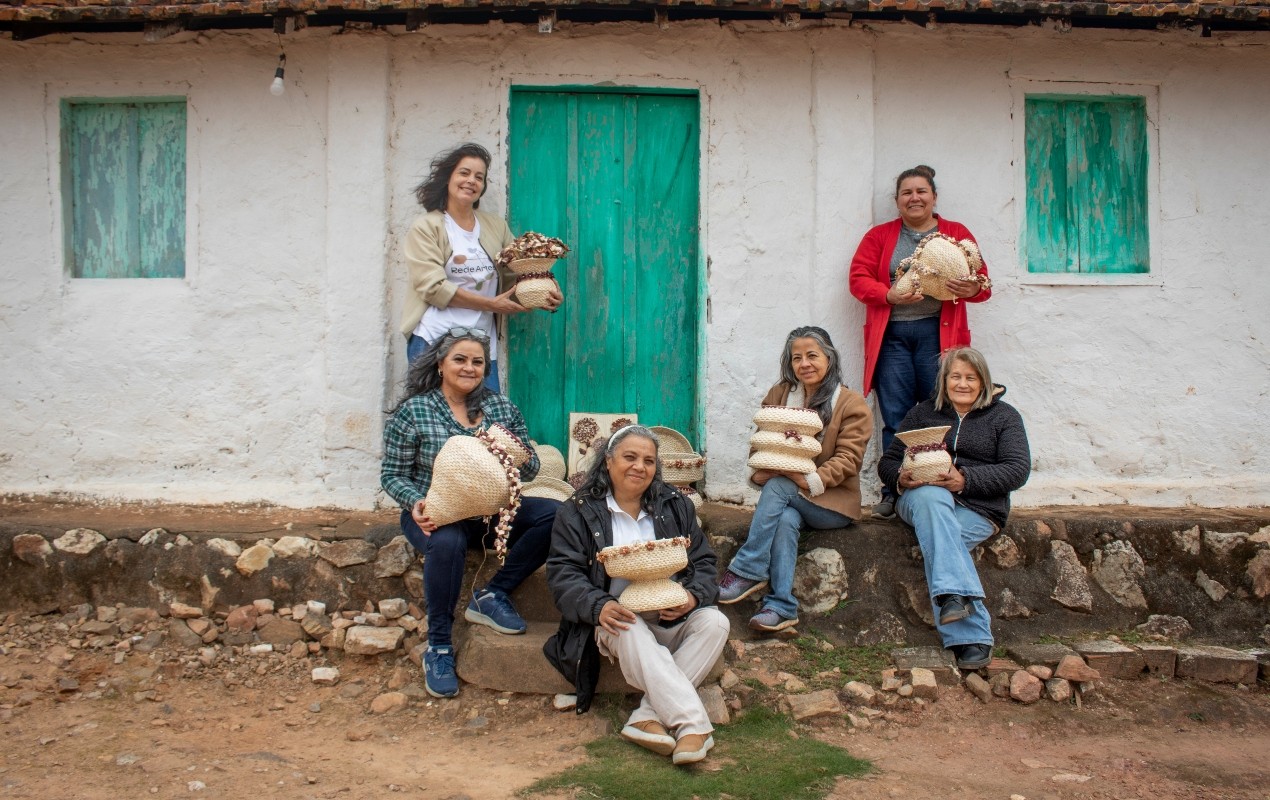
A group of Guapiara residents act as guardians of the Creole corn seed
Reproduction/Paulista Canyons
Formed by 15 women and active for 13 years, the group considers itself guardian of the seeds as it assumes the responsibility of preserving and perpetuating the varieties of Creole corn.
“We work to preserve, select and share traditional varieties of Creole corn seeds, keeping species adapted to the local climate alive, guaranteeing food sovereignty, biodiversity and independence from large agrochemical corporations”, points out Alice.
According to her, being a seed guardian means making a commitment to protecting a valuable heritage.
"You have to have a lot of courage. There's a life in your hand, it's not just a seed. It's a life that you rescued and lived with since you were born. Along the way, it escaped, but then you got it back. For us, in the group, taking care of and caring for the seeds is a struggle", says Alice.
The association of artisans responsible for looking after the seeds has existed for 13 years in Guapiara
Personal archive/Rodrigo Antunes
The artisan explains that the activity carried out by women confronts neighbors and agribusiness, so that the seeds are kept preserved and without external contamination.
In total, they care for four varieties of Creole corn and two of the version used for popcorn. In addition to guarding them, women are also responsible for planting, carried out in the rural area of Guapiara. According to Alice, the germination, growth and harvest process can take four to six months.
"Planting is carried out by selecting the seeds, respecting the phase of the moon, planting during the waning moon with an interval between one variety and another so as not to mix. It means keeping the seeds alive, preserving food sovereignty, genetic conservation and autonomy of the farmers", said the artisan.
READ ALSO:
National Coffee Day: discover characteristics of the Arabica species, cultivated by Sabrina Sato on a farm in the interior of SP
Fresh produce, meeting point and source of income: for almost 100 years, Itapetininga's street market has been driving the economy and social life
Bird watching, primates, trails and night walks: Parque Carlos Botelho is a reference in ecotourism in the interior of SP
Creole corn is the seed cultivated without genetic interference
Personal archive/Ana Cláudia Rocha Braga
Currently, the group is mobilized to expand the cultivation of Creole corn. The members distribute seeds and encourage the planting of traditional varieties, free from genetic modifications. The initiative seeks to strengthen seed preservation, encourage sustainable cultivation and guarantee raw materials for artisanal production.
"We sell the seeds at fairs and events we participate in. We recently sent seeds to an artisan in Goiás. We were recognized as a social technological group formed by women, in 2017. We are the guardians of the Creole corn seed", says Alice.
🌽 Creole corn
To better understand the importance and presence of the species in the interior of São Paulo, g1 spoke with agricultural engineer Edegar Mascari Petisco, 64 years old, resident of Itapetininga (SP).
According to the expert, Creole seeds refer to the original species, planted by ancestors and which are currently preserved. In addition to their historical and cultural value, they play an important role in agriculture, as they serve as a source of genes used in genetic improvement programs.
"The great danger that Creole seeds are facing today is the contamination of these plants by pollen from transgenic corn, which can travel by the wind. This can occur if there is a very strong wind, at a distance considered to be more than a kilometer", he explains.
In addition to preserving the species, the guardians are also responsible for planting corn
Personal archive/Verônica Volpato
To avoid this, the agronomist gives a tip: landraces should be planted in isolated locations, away from commercial crops, to avoid contamination. He points out that in other countries in Latin America, such as Mexico and Peru, the original material was lost due to contamination.
"They [the corn] have very special characteristics, right? With black grain. So, this work to preserve these native creole varieties is something very cool," observes Edegar.
According to the professional, the seeds ended up falling into disuse, as the commercial varieties presented to consumers gained more space due to their more productive and homogeneous profiles, the result of a cross between strains.
"The Creoles, as they produced less, ended up being left aside. Some people, very traditional, continue to multiply and we managed to reach today. But, perhaps along the way, some of these varieties were lost due to commercial corn", he analyzes.
The difference between commercial and Creole corn is in appearance, with grains of different colors and colored straw
Personal archive/Ana Cláudia Rocha Braga
🗺️ Corn route in the interior of São Paulo
Despite this significant loss, the work of the women of Guapiara was recognized and included in a corn route, an initiative produced by an association that seeks to strengthen rural tourism in the Southwest of São Paulo.
The members were invited in 2018. For them, it is a sign of recognition, appreciation and which also allows the work developed to be publicized.
The researcher and creator of the initiative. Cristina Fachini, 46 years old, shares that this script is the result of research she began more than 20 years ago.
"When I started working in the Southwest of São Paulo, I sought to identify value chains capable of boosting the rural development of the territory. It is a region historically known as the 'hunger branch', marked by low levels of human development and low industrialization. At the same time, it is a territory extremely rich in biodiversity and with a strong presence of family farming, which plays a fundamental role in the conservation of country culture and agricultural diversity", he explains.
Along this journey, Cristina found that corn plays a central role in regional identity. More than a food, it integrates local history and culture, marking its presence in cultivation systems, cuisine, festivities, knowledge transmitted between generations and in the daily lives of communities.
“The Corn Route emerges as a territorial development strategy that seeks to transform this heritage into an opportunity, connecting culture, agricultural production, gastronomy and tourism”, he comments.
The project was structured based on territorial mapping in the Southwest of São Paulo, covering the cities of Itapetininga, Capão Bonito, São Miguel Arcanjo, Ribeirão Grande, Guapiara, Ribeirão Branco, Apiaí, Itapeva, Taquarivaí, Itaberá, Itararé and Bom Sucesso de Itararé.
According to Cristina, the itinerary is divided into two territorial axes. The first connects Itapetininga to Apiaí, passing through the Rastro da Serpente and the region of natural parks.
The second, which connects Itapetininga to Itararé, integrates Caminhos Tropeiros and the Cânions Paulistas region.
In the Corn Route, visitors learn about everything from planting to the use of corn in activities such as handicrafts
Personal archive/Ana Cláudia Rocha Braga and Verônica Volpato
In this way, more than 50 enterprises and several traditional recipes were identified.
“Several actors and initiatives that were fundamental to the construction of the itinerary were identified, such as farmers who are guardians of Creole seeds, flour factories and traditional monjolos, corn straw artisans, corn festivals, restaurants with typical cuisine and local tour guides”, details the creator.
The first phase of the project begins on Saturday (13), between the cities of Itapeva and Itaberá, where interested parties will be able to visit the settlements and learn more about family farming, traditional cuisine and sustainability.
Those interested in participating in this itinerary or producers who wish to join the project can find more information on the website.
🪴 Itinerary participants
The “start” point of the itinerary takes place in Itapeva and Itaberá, on the “Agrovilas Route”. Currently, activities are focused on rural daily life and agroecological production, covering rural settlements.
One of the participants is Wagner da Silva Carvalho, 44 years old. The agroecology technologist and environmental educator lives in Agrovila 5, located in Itaberá.
To better understand the place, Wagner explains that the villages are rural neighborhoods within agrarian reform settlements, between the two cities. In the space, there are around 700 families, including settled and aggregated.
“This is a space where families live, produce food, preserve regional culture and develop initiatives linked to family farming.”
The settlement, according to Wagner, has existed since 1984, being one of the first of agrarian reform in the State of São Paulo. The local participation in the itinerary took place through work carried out on site, “Panela Cheia”, and also through the preservation of Creole corn.
"We received the invitation from the corn route with great joy. It was a recognition of the work carried out by our family for years. Knowing that our experience could contribute to strengthening the culture of Creole corn, family farming and rural tourism in our region leaves us very motivated", shares Wagner.
Another place on the itinerary is the quilombo Fazenda Silveiro, in Itararé. Silvane Aparecida Matias, 47 years old, is one of the residents and farmers who make up the place.
“The quilombo is a farm where 26 families currently live, and has existed since 2001. The quilombo was recognized as a remnant in 2019. Production here in the community involves a little bit of everything, there is an area of soy, corn, wheat and we also have an area of vegetables in the field and greenhouses”, he explains.
The resident found out about the project through a socio-technical network. For her, participating in the script has a very important meaning.
“It’s a part of my history, it’s being able to be with people we love and learn new things.” One of the points reached by the route are the settlements between Itaberá and Itapeva
Personal archive/Cânions Paulista
*Collaborated under the supervision of Larissa Pandori
Initial plugin text
See more news on g1 Itapetininga and Region
VIDEOS: watch TV TEM reports
📰 Related Articles

Oil rises almost 5% after crossfire between Israel and Iran
ObservadorAttacks between Iran and Israel complicate Trump's efforts to negotiate an agreement and quickly exit the war
G1 Globo
Woman dies after recording video about lack of care at UPA in MG
CNN Brasil
Iran announces suspension of attacks against Israel
G1 Globo
Israel and Iran turn a 'deaf ear' to Trump's warnings
Observador