


"Mornings and nights no longer exist": what it's like to live in one of the hottest and most humid places on the planet
⚡ Quick Summary
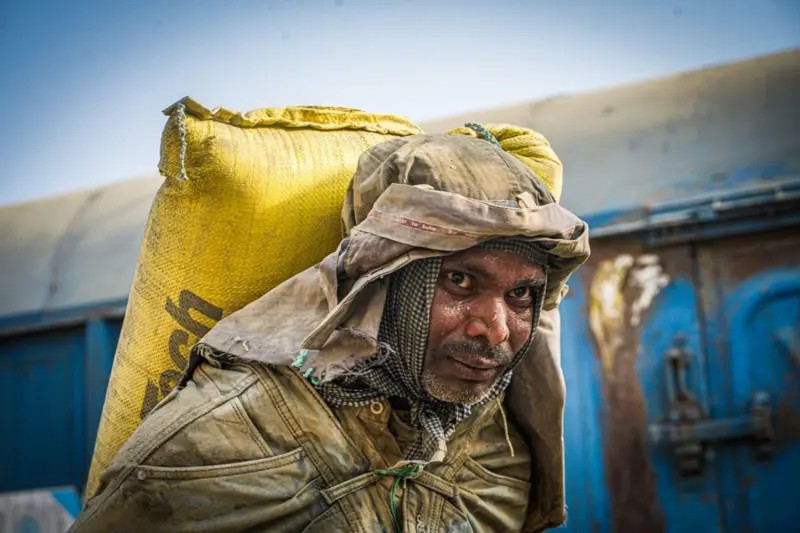
Ram Chandra, a railway employee, says this summer's heat is the worst he has faced in years of work. Ankit Srinivas via BBC At 6am, the sun over the Banda district seemed to have forgotten that noon had not yet arrived.
Ram Chandra, a railway employee, says this summer's heat is the worst he has faced in years of work.
Ankit Srinivas via BBC
At 6am, the sun over the Banda district seemed to have forgotten that noon had not yet arrived.
The light had the intense glow of a summer afternoon. The shadows were already shortening before breakfast.
In May, this dusty district in the Indian state of Uttar Pradesh spent days at the top of an unenviable national ranking: the hottest place in the country.
Temperatures remained between 47ºC and 48ºC for more than a week, something extraordinary even by local standards.
What caught attention, however, was the way people adapted.
Banda's more than 2 million inhabitants, who depend on agriculture, construction, transport and other outdoor work, had no alternative but to endure the heat. So they reorganized their lives around that.
30 kilometers from the district center, the Atarra vegetable market closed its doors before most towns even fully woken up.
Farmers arrived at dawn with tomatoes, pumpkins, peppers, lemons and melons. They wanted to sell quickly and get home before the heat intensified.
"Look at the sun," said Himanshu, a trader standing next to boxes of tomatoes. "It's only 6:15, but it feels like 8 or 9."
Heat shortened the useful life of products as much as it shortened market hours. "A box of tomatoes needs to be sold today or tomorrow. In this climate, they won't last."
Where before the movement lasted until the end of the morning, now it began to empty at 8 am. At 10am, the market was almost deserted.
Banda, home to more than 2 million people, is close to the Tropic of Cancer.
Ankit Srinivas via BBC
The same reduced schedule governs almost everything in Banda.
Between the incandescent sky and the scorching ground, people do what Polish journalist Ryszard Kapuściński once observed in another fiery African landscape: dedicate their energy to the search for "shade and breeze."
Pappu Verma is a bricklayer and now works from 7am to noon and then from 4pm to 7pm. The four hours in the middle of the day are for waiting out the worst of the heat.
“You still have to do eight hours,” he says. "Work non-stop in the sun or stop and start again, the pay is the same."
Rest saves him from heat-induced headaches and dizziness, but it extends his day to 12 or 13 hours. If I didn't do it this way, he comments with a shrug, 'what I earn would be spent on medicine'.
Vicious circle
One day last week, around 2pm, when the temperature in Banda reached 46ºC, three workers took shelter under a water truck on a highway over the Ken River Bridge to have lunch in the shade of the vehicle's chassis.
One of them, Shanti Devi, walks six kilometers to work every morning and another six kilometers back.
Her lunch was bread with onions, salt and pickles. “If we take vegetables, they spoil before noon,” he explained.
Then he released a phrase that could be the motto of Banda's heat wave.
"Poor people can't afford to worry about the heat."
Shanti Devi (left) and her coworkers took shelter under a water truck on a highway bridge over the Ken River.
Ankit Srinivas via BBC
Their shelter over Ken was appropriate. The river is at the heart of Banda's fight against the heat.
Researchers say sand extraction and groundwater depletion have weakened the river's ability to cool the surrounding landscape, creating a vicious circle in which water scarcity and extreme temperatures reinforce each other.
The economic effects of the heat are visible everywhere.
Electric tuk-tuk drivers face afternoons without passengers. Merchants open before sunrise and close between noon and 4pm. The number of customers fell by half. Entire villages take refuge at home during the busiest hours, and only come out again at night. Cell phones vibrate repeatedly with government warnings about a severe heat wave. “Stay alert, be cautious,” the messages warn.
Local hospitals receive a constant flow of patients suffering from the heat.
“Since the temperature intensified, we have been receiving between 15 and 20 cases a day, mostly children and elderly people,” says K. Kumar, chief medical superintendent, District Women’s Hospital.
"The most common symptoms are diarrhea, vomiting and fever."
Yash, 6, spent two days in hospital after falling ill during the heatwave that hit Banda.
Ankit Srinivas via BBC
Moist heat
This difficult experience in Banda is the local expression of a broader trend.
Across India, heat is increasingly arriving not just in the form of high temperatures, but also as a combination of heat and humidity that puts further pressure on the human body.
Climate researchers consider the Indo-Gangetic Plain — which stretches across much of northern India and includes Uttar Pradesh — one of the world's emerging hotspots for this type of dangerous heat that combines high temperatures and humidity.
Population density, abundant humidity, and large numbers of outdoor workers combine to create conditions in which even routine work can be risky.
Uttar Pradesh is especially vulnerable due to its huge population exposed to harsh weather conditions, reliance on outdoor work and limited access to cooling systems for millions of households, according to think tank Climate Trends.
Scientists say that the region's geographic and development choices have combined to worsen the situation.
Sand mining and groundwater depletion have weakened the River Ken's ability to cool the surrounding landscape.
Ankit Srinivas via BBC
Banda is close to the Tropic of Cancer, a latitude associated with some of the hottest summers in the world.
Rivers flow at low levels and expose beds of sand, stone and gravel, which absorb and radiate heat.
Concrete replaced vegetation. Tree cover has fallen well below recommended levels.
A study by the Banda University of Agriculture and Technology found that almost a sixth of the district's dense forest cover disappeared between 1991 and 2022, largely because of the expansion of mining and agriculture.
Together, these factors made Banda increasingly vulnerable to extreme heat.
According to Dinesh Sah, a meteorologist at the university, the district has already recorded temperatures between 48ºC and 49ºC. In 2024, the thermometer reached 49ºC on two consecutive days.
But what made this summer's episode unusual was its persistence.
"For eight or nine days, temperatures of 47ºC to 48ºC remained uninterrupted", highlights the expert. "That's the new thing."
Prem Singh, a farmer in the region, says the annual wave of extreme heat is nothing new and is essential for crops. What worries him is the increasing intensity.
He blames decreasing tree cover, large-scale mining, increased use of fossil fuels and the growing use of air conditioning.
"This has made life more difficult for the poor, while the rich have not been affected as much."
The heat persists long after sunset.
“It seems like mornings and evenings no longer exist,” says Sah.
At 7am or 8am, it already seems late.
Temperatures at night are around 30ºC. The result is a population that never completely refreshes itself.
"I don't know if I can handle this"
In the village of Achharaund, 20 km from the town of Banda, the fight is not so much with the temperature as with the lack of water.
A single well provides much of the village's drinking water. Every day, women line up with buckets under a burning sky.
Kranti Vishwakarma, 18, spends four or five hours fetching water for home. When there are power cuts in the afternoon, relief comes from the shade of a neem tree.
"We don't have a refrigerator or air conditioning," he reports. "For us, neem trees play that role."
Nearby, an 80-year-old woman named Chunubadi sat next to a makeshift table fan patched together with ropes. It worked with difficulty, blowing dry, hot air.
"Sweat dries," he observes, as he watches the blades turn, "but for an old body, these blasts of heat are difficult to bear."
Then he makes a more somber reflection.
"In my 80 years, I have never seen heat like this. Older people die in extreme cold or heat. I don't know if I can handle it."
Throughout the village, the animals managed their own way.
Around noon, dozens of buffaloes were standing in a dam.
Some shepherds waited for them to come out of the water.
There we met Rameshwar Yadav, 60 years old, a former private school teacher who now makes a living from raising buffaloes.
Interestingly, he was wearing heavy clothes, more suitable for winter than a summer day at 46ºC, and he had a shawl wrapped around his head.
"We wear thick clothing because it doesn't let the sun's heat reach the body," he explains.
"The thick fabric protects us from the sun and hot winds. Yes, it makes us sweat, but it also prevents us from getting sick."
Like everyone else in Banda, Yadav adapted. But adaptation and relief are not the same thing.
A change in the weather from the west finally brought dust storms and rain. Temperatures dropped between 8 and 9 degrees. The district began to breathe again.
But the relief was temporary.
The routines that Banda residents have developed — starting work before dawn, going home at noon, seeking shade wherever possible — are no longer adaptations but are becoming a necessity.
Risk of death
A study by Piyush Narang and Ashok Gadgil of the University of California at Berkeley estimates that Uttar Pradesh could record more than 8,000 additional deaths during an intense five-day heat wave — more than many other states in India.
The impact falls disproportionately on the elderly, workers exposed to outdoor heat, and families without reliable access to refrigeration.
Banda residents, however, appear less alarmed than many climate scientists.
They have lived with heat for generations.
What worries researchers is not that the district is hot, but that it is getting hotter, for longer periods of time, in a landscape that is losing the trees and water that once helped keep temperatures in check.
The workers who had taken shelter under a water truck on the road seemed oblivious to the danger.
"We're used to it," they said.
🗞️ 3 sources covered this story

📰 Related Articles

Montes Claros City Hall brings free internet to popular fair
G1 Globo
The next holiday is only in 3 months; see the remaining holidays in 2026
G1 Globo
City Hall says it is evaluating possible impacts on public transport in BH after fire destroyed 27 buses
G1 Globo
Israel says it has identified an attack coming from Yemen; sirens sound in Tel Aviv
CNN Brasil