


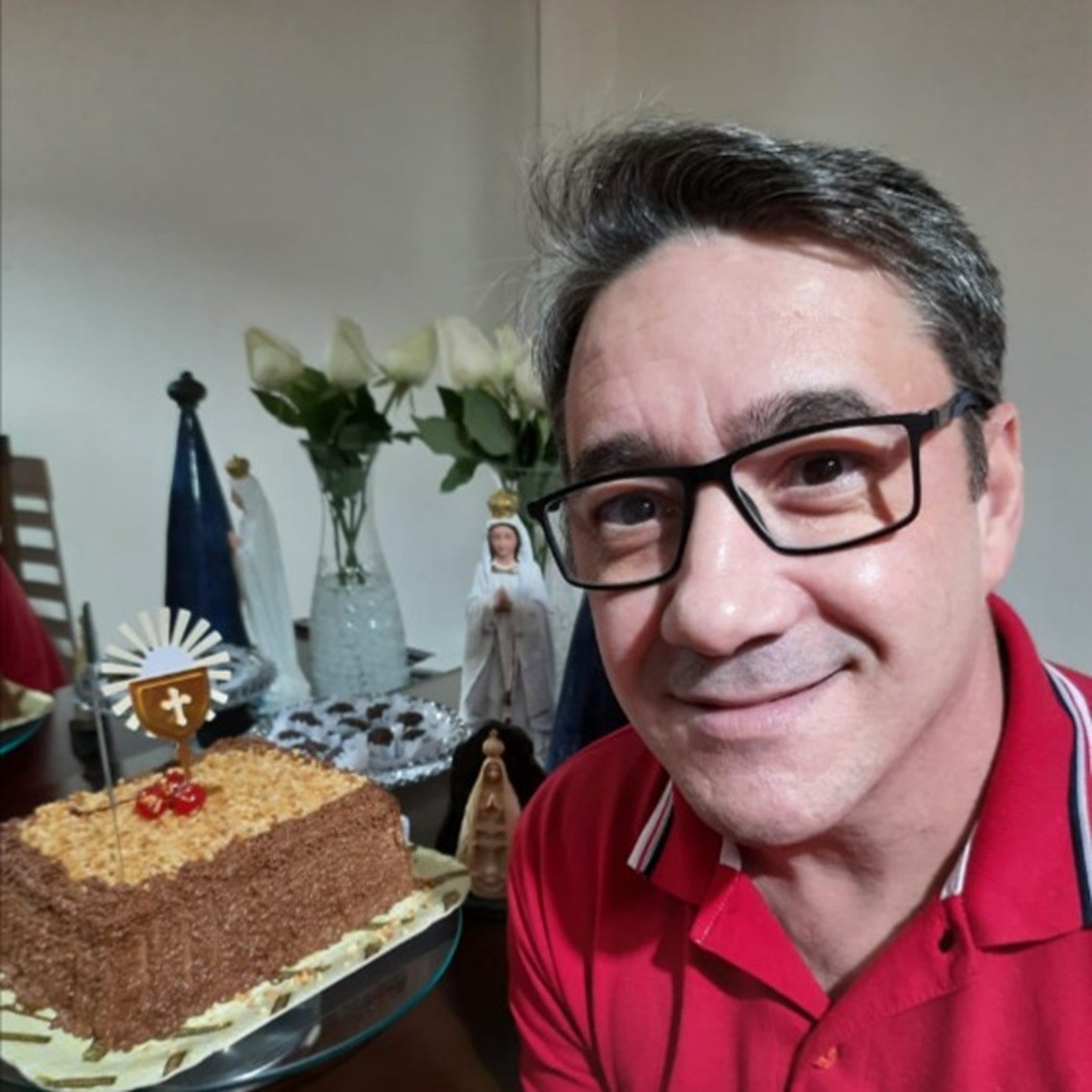
After pancreatic cancer and recurrence, patient with a 5% chance of cure reaches 8 years without detectable disease
⚡ Quick Summary
Edgard, patient cured of pancreatic cancer Personal Archive On the Sunday morning that Edgard de Luna was waiting to be discharged, an oncologist entered the room saying she had results to discuss.
Edgard, patient cured of pancreatic cancer
Personal Archive
On the Sunday morning that Edgard de Luna was waiting to be discharged, an oncologist entered the room saying she had results to discuss. He had spent the weekend admitted to Hospital São Camilo, in Pompeia, São Paulo, undergoing tests that no one had explained properly. I thought I was going home. I was alone.
The doctor explained everything at once — pancreatic cancer, prognosis, next steps. Edgard listened without being able to assimilate. When she left, she took out her cell phone and typed into Google. The first thing that appeared: five months to live.
He was 42 years old, had two young daughters and no history of serious illness. There was no sign to justify that Sunday.
Today, eight years later, there is no detectable disease. The case is being documented for scientific publication and presented at medical conferences as something that medicine still cannot fully explain.
A pain that no one knew how to name
It had all started months before, with an upset stomach. Emergency care: worm medicine. It didn't get better. Gastroenterologist: gastritis, H. pylori, antibiotics. It continued. Other gastro: change of medication. It persisted.
When the pain migrated to the middle of his back, a new diagnosis: muscle contraction, probably from the capoeira classes he had taken at the gym. More medicine. Two hours of observation. High.
One more week. The pain got worse.
On a Thursday, his wife Andreia had a family birthday. They agreed: tomorrow we'll go to the hospital. On Friday, the doctor who treated him made a different decision than everyone else: "You've been experiencing these symptoms for almost three months. It's not normal," he says he heard. He ordered a CT scan with contrast. Four hours later, he returned with a surgeon at his side. A stain had appeared. They wanted to admit him at that moment.
What Edgard didn't know (and would only understand later) was that the back pain had been, paradoxically, his luck. The tumor was adjacent to the mesenteric artery. The doctor explained that it was this pressure that caused the symptom. And that's what led to the diagnosis before stage IV, when there's almost nothing to do.
Pancreatic adenocarcinoma is considered by most experts to be the most studied cancer with the worst prognosis. The pancreas is hidden deep in the abdomen, with no structures that produce early symptoms.
When pain appears, the tumor is usually already advanced — often inoperable, often disseminated. The five-year survival rate, even in cases diagnosed early and operated successfully, is between 30% and 50%. In advanced cases, it drops to single digits.
Edgard's tumor was what medicine calls borderline for resectability: not clearly operable, but not definitely inoperable. It was in the head of the pancreas, dangerously close to an artery. Operating immediately was too risky.
Now on g1
Twelve sessions before the knife
The strategy chosen was neoadjuvant chemotherapy — an approach that tries to shrink the tumor before attempting surgery. Every 15 days, Edgard arrived at the clinic on Monday morning, stayed until five in the afternoon receiving the medication, left with a small bag that continued infusing the chemotherapy for 48 hours and returned on Wednesday to collect it. On Tuesdays and Thursdays, I worked.
In the first sessions, Edgard left the clinic faster, a counterintuitive effect that he himself found funny, because it seemed that the chemotherapy energized him instead of knocking him down. In the last few years, it was no longer like that.
The accumulated fatigue was dragging down his pace until, close to the tenth session, he got out of bed in the morning to take a shower and fell back. The maze had given way. He spent almost an hour on the floor before managing to get up. It was the only time he stopped working.
There were 12 sessions in total. The exams showed sufficient tumor reduction. The surgeon considered it time. But he entered the surgery center with a reservation that he told the family bluntly: "I might be able to open it and be able to get it out, maybe not. If I can't, we'll activate palliative care."
"From the beginning they told us there was a 5% chance of survival", recalls Edgard.
The surgery lasted nine hours. Four surgeons in the room. The procedure was a pancreatoduodenectomy — removal of the pancreas and the adjacent small intestine loop, one of the most complex abdominal surgeries. When the doctor left the room, Andreia says he looked like he was about to lift a trophy. "I took everything off. Everything worked out fine."
Edgard spent Christmas, his birthday and New Year's Eve hospitalized. In January, he went home.
The recurrence
One month after surgery, the CA 19-9 tumor marker remained elevated. The surgeon attributed it to post-operative inflammation. The oncologist was not satisfied. He asked for another month. It remained loud. He ordered a PET scan.
An injury appeared. Small —between 1.2 and 1.3 centimeters— in a region close to the surgery site, possibly in a lymph node or a recurrence in the pancreas itself. Doctors were unable to identify it.
Conventional chemotherapy was ruled out: Edgard's body needed time, the surgery was too recent. Jamile Almeida, the oncologist responsible for the case, tells g1 that she presented her colleagues and the patient with two options:
The first was radiosurgery — high-precision radiotherapy directed to that specific point, a more consolidated approach for this type of situation.
The second was unusual for the pancreas context: radiofrequency ablation, with some data from Japanese studies on liver metastases, but little used there.
"Our expectation was to control the recurrence for a while", admits the oncologist. "We had no expectation that the lesion would disappear. If the ablation didn't work, we still had radiosurgery. Then, chemotherapy. There was a plan B and a plan C."
Edgard agreed to the ablation.
A needle that trembles
The case reached Ricardo Freitas, a collaborating professor at the Department of Radiology and Oncology at the Faculty of Medicine of the University of São Paulo (FMUSP) and an interventional radiologist. Freitas evaluated the images and concluded that the injury was technically treatable.
Thermal ablation works like this: a thin needle is guided by computed tomography in real time to the target. The tip of the electrode vibrates at a very high frequency, generating localized heat. This heat coagulates the proteins in the surrounding tissue, killing the cells. The tumor is not removed — it is devitalized.
In successful cases, the tissue dies and is gradually absorbed by the body, leaving only a scar.
“It’s not surgery,” says Jamile. "The tumor is not removed, it is devitalized on site. I can kill that tissue, but I don't remove it. And it may work out, the tumor will be controlled. Or it may not."
Freitas arrived at Edgard's nodule using a tomography, confirmed the lesion with a biopsy and, using the same instrument, applied the treatment. The pain was more intense than expected — Edgard needed morphine and was hospitalized. The next day, the doctor returned to the room with the news: he had managed to burn the diseased tissue on all sides.
In the following months, tests showed no recurrence. In the following years, neither. Today, about eight years after the ablation, Edgard has no detectable visible disease.
"The tumor disappeared. All that was left was the scar from the procedure," says Jamile. "This is anecdotal. It doesn't happen like that often."
Why is it not a recipe
Both the oncologist and the radiologist are accurate in calibrating what Edgard's case means. Ablation is not indicated for any tumor, in any location, at any stage. Jamile lists three criteria that need to be evaluated together:
the accessibility of the lesion — if it is close to large vessels, the risk of rupturing the structure when heating it is real;
the type and molecular subtype of the tumor;
and the status of the disease, whether it is confined to that point or is already circulating in other locations.
The vast majority of patients, according to her, will not be candidates for the procedure.
The technique accumulates evidence mainly in liver metastases and tumors from other organs. For pancreatic cancer specifically, data is still limited: a review published in January 2026 in the World Journal of Gastrointestinal Oncology mapped the main studies available and concluded that, although the results are promising — especially when ablation is combined with chemotherapy —, the lack of large-scale randomized clinical trials prevents the procedure from being considered standard treatment.
Freitas adds another layer. In oncology, tumors of the same type can have very different behaviors — and pancreatic cancer also has its spectrum, with more and less aggressive forms.
Edgard's tumor, when it recurred, did so with a single lesion, in an accessible place, found early due to discipline in the control exams. There was also the circumstance that the team that accompanied him knew and practiced the procedure. Remove any of these factors, and the outcome could have been different.
There is something that medicine cannot answer. Jamile does not have any tumor-specific molecular changes that explain why it worked. At the time of treatment, available molecular assessment was limited. Today there would be more resources — but Edgard no longer has a tumor to test.
The case is being documented by Freitas for scientific publication.
After
Today, Edgard de Luna is 50 years old. Follow up regularly. Take a digestive enzyme for your pancreas — although your doctor has already suggested that you might not even need it anymore. He was left with mild neuropathy in his extremities, a recognized consequence of chemotherapy, but without dietary restrictions and without functional limitations.
He recently traveled with Andreia to Portugal to fulfill a promise made in Fátima during treatment.
When asked what changed, he details:
"The problems are small. An error at the printing press, people getting nervous... For me, that's no big deal. It's almost funny."
📰 Related Articles

Bernardo Silva signs for Real Madrid until June 30, 2028
Observador/https://i.s3.glbimg.com/v1/AUTH_59edd422c0c84a879bd37670ae4f538a/internal_photos/bs/2023/K/r/zACPA4QbyvJEdFAsuq1Q/pao2.jpg)
Salvador City Hall offers 150 places for free delicious bread, pizza maker and naval electrician courses
G1 Globo
Mega-Sena 3019 results: 11 bets from Piauí match numbers; see values
G1 Globo
Convicted of murder is arrested by the police after falling from a wall while escaping in Fortaleza; see video
G1 Globo
Man arrested after attacking dog with piece of wood on the North Coast
G1 Globo/https://i.s3.glbimg.com/v1/AUTH_59edd422c0c84a879bd37670ae4f538a/internal_photos/bs/2026/5/J/A5MFJsTpSX1BoJF6viUQ/bdrj-limpo-20260617-0545-frame-32582.jpeg)