


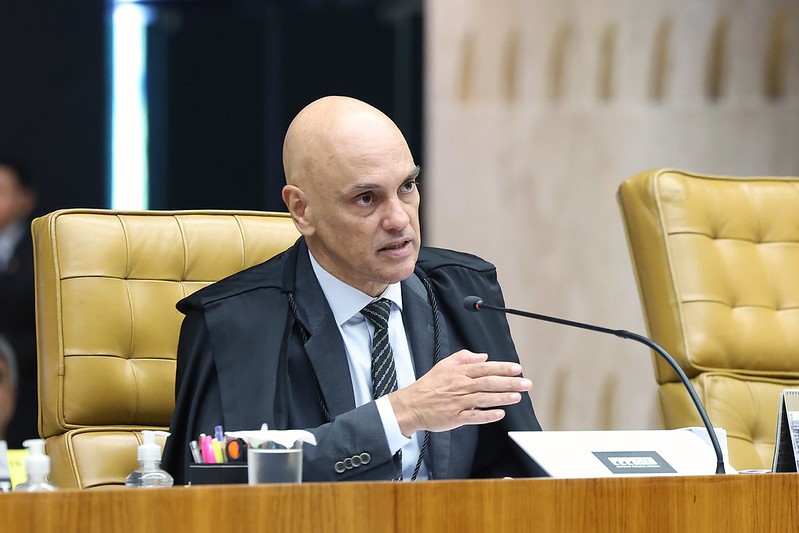
Moraes votes to convict Eduardo Bolsonaro for coercion in a coup plot case
⚡ Quick Summary
Minister Alexandre de Moraes, of the Federal Supreme Court (STF), voted this Tuesday (16) to convict the impeached deputy Eduardo Bolsonaro (PL) for attempting to interfere in the trial of his father, former president Jair Bolsonaro (PL), in the coup plot.
Minister Alexandre de Moraes, of the Federal Supreme Court (STF), voted this Tuesday (16) to convict the impeached deputy Eduardo Bolsonaro (PL) for attempting to interfere in the trial of his father, former president Jair Bolsonaro (PL), in the coup plot.
Moraes is the rapporteur of the case in the First Panel of the STF. He understood that there are elements that prove that Eduardo Bolsonaro committed the crime of coercion during the process, as accused by the Attorney General's Office (PGR).
Ministers Cristiano Zanin, Cármen Lúcia and Flávio Dino, who is the president of the First Panel, still have to vote.
Eduardo Bolsonaro is accused of promoting, with the Donald Trump government, in the United States, actions that aimed to create a climate of instability and fear, threatening and projecting foreign retaliation against Supreme Court ministers and Brazil.
Eduardo was denounced by the Public Prosecutor's Office and is a defendant in the STF. The objective of the actions abroad, according to the Prosecutor's Office, was to try to prevent former president Jair Bolsonaro from being convicted in the so-called coup plot.
Now on g1
The reporting minister refuted Eduardo's preliminary defense which claimed that they were covered by freedom of expression and parliamentary immunity.
"It is not the role of a Brazilian federal deputy to lobby abroad against his own country. Even if he were in office and not licensed, even if he were in office, he would not be covered by parliamentary immunity", he stated.
Moraes also stated that Eduardo himself said that he did not communicate a change of domicile to the USA, and that he was abroad to escape justice.
"To date, at no point has the defendant himself said anywhere that he has changed his domicile. He has only said that he is not returning to Brazil for fear of answering for the crimes he committed. Can the defendant, any defendant, benefit from his own turpitude."
"The criminal process is not a joke, the application of justice is not a joke. The rules exist to guarantee the contradictory, the broad defense, within the parity of arms, not so that frauds and crimes committed continue to be perpetuated".
Moraes highlighted that Eduardo focused on threats with the intention that his father would not be convicted and that the STF would not carry out the trial of the coup plot.
“No relation to parliamentary activity, but threats intending that his father would not be convicted,” he stated.
Indictment
Eduardo's objective, according to the PGR, was to try to prevent former president Jair Bolsonaro from being convicted in the so-called coup plot.
The prosecutor's office argued that the evidence gathered throughout the process confirms criminal conduct, and the objective has always been to override the interests of the Bolsonaro family over the standards of due legal process and the good order of justice to free the father from criminal liability.
The Prosecutor's Office lists a series of statements by Eduardo, in interviews and in posts on social networks, as well as exchanges of messages with Jair Bolsonaro that reveal efforts in the United States to embarrass the Judiciary leadership.
The Deputy Attorney General of the Republic Antônio Edílio Magalhães presented in his statement a series of publications and messages exchanged between Eduardo and his father to support the request for conviction.
"This is a relatively simple situation from a criminal point of view. There is a whole element, a factual context and set of evidence showing that this coercion actually existed," he stated.
"When we talk about defending institutions, we talk about defense, including citizenship, in defense of everyone. So, the position of the Attorney General's Office, which is a position already evident from the beginning and reinforced in the final arguments, is in the sense of the merits of this criminal action."
Minister of the STF Alexandre de Moraes
Luiz Silveira/STF
Defense
The lawyer who spoke in Eduardo's defense was Public Defender Esdras dos Santos Carvalho. Eduardo did not appoint a lawyer. He asked for the ex-deputy's acquittal due to lack of evidence. The DPU stated that procedural issues justify the annulment of the entire process, including Moraes' participation in the trial.
For the Defender's Office, Eduardo had a "merely formal defense, produced without any contact with the defendant, without his version of events and without his guidance.
The DPU stated that the case is one of acquittal due to lack of evidence, and the conduct narrated by the Prosecutor's Office does not constitute a crime and the statements were protected by freedom of expression.
The defense also emphasized that the former deputy would not have decision-making power over the sovereign acts of the American government.
"The defender's office understands that the examination of the elements in the case, the political demonstrations, would be covered under the freedom of expression that would have denounced him at the time. And these demonstrations of a political nature could never be considered criminal offenses", he stated.
🗞️ 4 sources covered this story
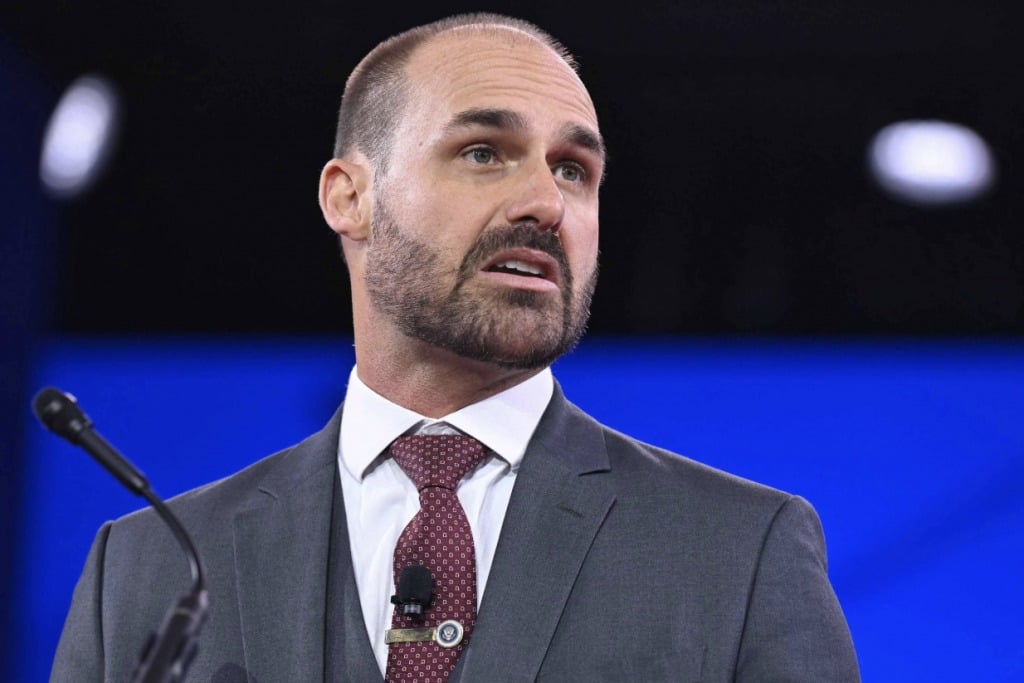
Eduardo Bolsonaro's reaction after being convicted by the STF for coercion
CartaCapital
Eduardo Bolsonaro’s conviction implodes ‘pretend’ candidacy for the Senate
CartaCapital
STF sets 4-year sentence for Eduardo Bolsonaro for coercion in the coup plot process
CartaCapitalSTF condemns Eduardo Bolsonaro for articulating Trump government actions against Brazil: what could happen to him?
BBC📰 Related Articles

88-year-old woman dies after being attacked by a dog that was scared by fireworks during a Brazil game
G1 Globo
Three-year-old child dies after drowning in school swimming pool in RN
G1 Globo
11pm. Portugal is already in Houston for its World Cup debut
Observador
Cristiano Ronaldo: sleep and nutrition are key to an athlete's longevity
CartaCapital
France x Senegal: Mbappé shines, but FIFA chooses another best on the field
CNN Brasil