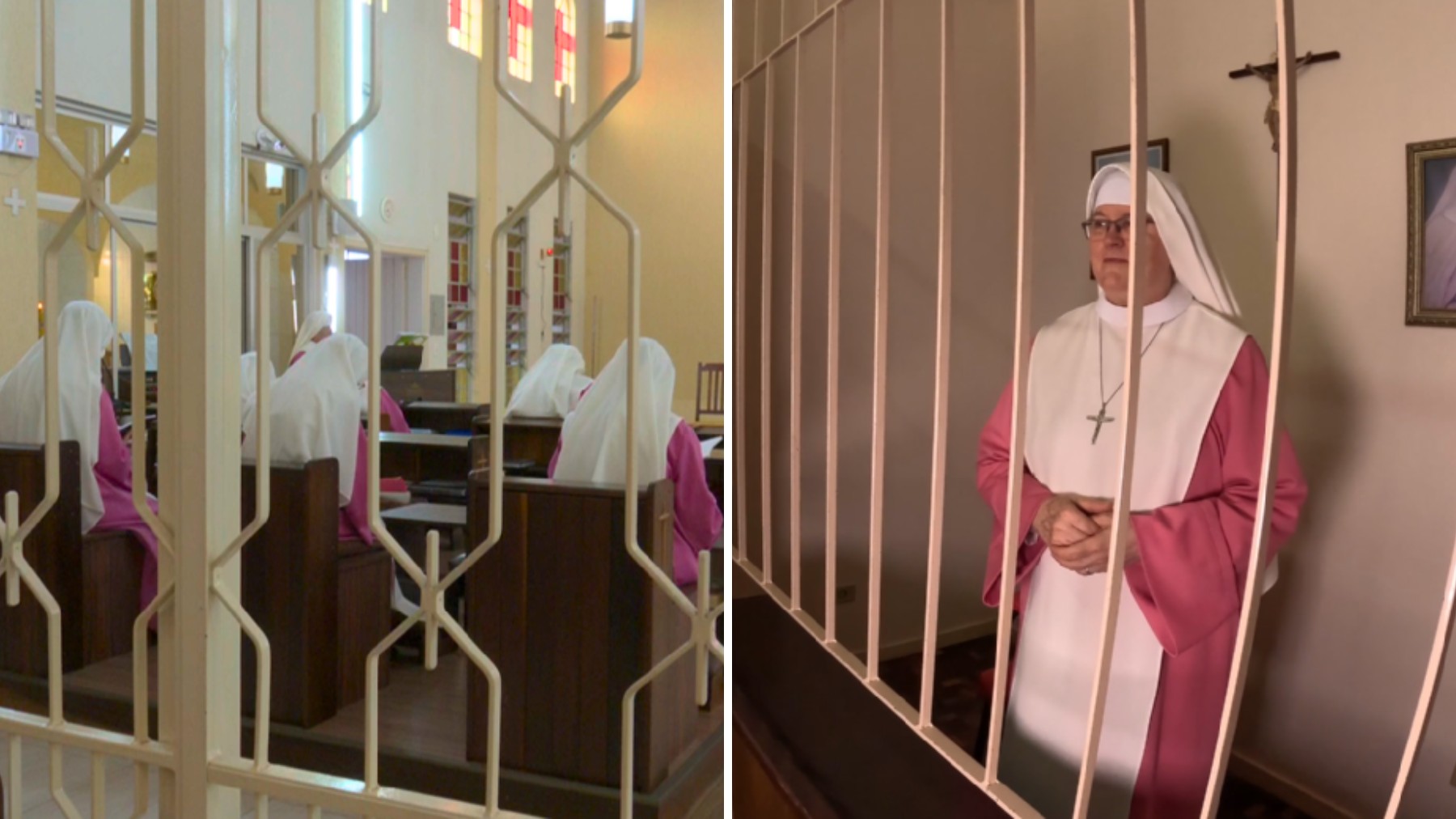
Behind bars and dressed in pink: the story of the nuns of 'perpetual adoration' who live cloistered in Paraná
⚡ Quick Summary
Nuns of 'perpetual adoration' live cloistered in Paraná Behind bars to focus on the mission of praying for the whole world and in traditional pink clothing to represent the happiness of being at the service of God.
Nuns of 'perpetual adoration' live cloistered in Paraná
Behind bars to focus on the mission of praying for the whole world and in traditional pink clothing to represent the happiness of being at the service of God. This is the life of the Sisters Servants of the Holy Spirit of Perpetual Adoration, a Catholic congregation that has around 20 convents around the world and just one in Brazil.
There, their main occupation is praying, and this basic precept is what differentiates them from other congregations. Instead of embarking on external missions, working in hospitals or teaching, for example, they lead a predominantly contemplative life.
✅ Follow g1 Ponta Grossa on WhatsApp
"We pray a lot for people, for the church, for the whole world. For priests, for missionaries... Our main mission is this: our total surrender to God in praise, in adoration, in supplication as well and in truly asking for all of humanity", says Mother Maria Elizabeth.
Doctor of Theology Kevin Kossar Furtado, professor in the Journalism department at the State University of Ponta Grossa (UEPG), highlights that continuous prayer is central to the identity and mission of the sisters.
Congregation nuns wear pink habits
Paulo Roberto Martins/RPC
"The congregation understands that its contribution to the Church and society occurs through permanent prayer in favor of different causes and people around the world", he states.
The congregation was founded in 1896, and the Nossa Senhora do Cenáculo Convent was created in Ponta Grossa, about 100 km from Curitiba, in 1983. The 18 nuns who live there only leave in cases of medical or dental emergencies or to resolve bureaucracy — which means they are in permanent seclusion. Ages range from under 30 to over 90 years old.
The routine at the convent is extensive: it starts with waking up at 4:45 am and the first praise at 5:15 am (find out more below.)
Long journey to closure
To be a sister, you just need to demonstrate interest — it is not necessary, for example, to have been a nun in another convent before. The entry process involves making commitments in the congregation until, progressively, reaching closure.
Training follows the standard model of the Catholic Church, being divided into stages, each with a specific duration. In some cases, adding up all the steps, it can take more than 10 years. The definitive commitment only occurs with perpetual vows, which is the definitive consecration of a sister.
Even after this decision, she can stop being a nun, but this requires a formal process that depends on the evaluation of higher authorities and can reach the Vatican.
"The enclosure was created precisely to help us live our way of life better. For us, it is a symbol of freedom... Freedom to be able to live fully and intensely our vocation, our mission here", evaluates Maria Elisabeth.
The nuns take turns day and night so that at least one of them is always in adoration before the Blessed Sacrament. They divide their time between prayers, making hosts, household chores and masses open to the public — in which they remain in an area separated by bars.
In the chapel, bars separate nuns from the faithful
Paulo Roberto Martins/RPC
Maria Elisabeth explains that, although silence is considered necessary for much of the day to promote communion with God, the house is full of joy and moments of relaxation — which is also represented in the color of the sisters' clothes.
"Our pink habit symbolizes our special consecration to the Holy Spirit and expresses our joy in being at the service of God. [...] The Holy Spirit is the God of love, the God of joy."
🔎 The habit is the traditional clothing worn by nuns and religious women. It functions as an outward sign of your consecration to God and vocational identity, symbolizing the vows of poverty, chastity and obedience. 🔎The Blessed Sacrament is the name given to the Eucharist in the Catholic Church, and refers to the representation of the presence of Jesus Christ in the form of some object considered sacred.
Infographic - Sisters Servants of the Holy Spirit of Perpetual Adoration
Art g1
More stories:
'Divine providence': Brothers are ordained priests on the same day
'I didn't want to stop, even though I knew the ending': Mother copies Bible by hand twice
Beyond the meme: Beatbox nuns work in addiction recovery
The use of grids and contact with the outside world
Mother Maria Elisabeth is one of the nuns who live in the congregation
Paulo Roberto Martins/RPC
Because they only leave the convent for bureaucratic or health needs, the contact of the Sisters Servants of the Holy Spirit of Perpetual Adoration with the outside world is mainly through people who visit the convent. They see and talk to the nuns only through bars.
🔎The Sisters Servants of the Holy Spirit of Perpetual Adoration are not the only congregation that lives in seclusion with the presence of bars. The structure is common in communities that are more focused on worship and contemplation.
In Ponta Grossa, the chapel is open to the public with masses every day. The community can also ask for prayers or leave written comments. Separate conversations with the sisters are also allowed, in rooms where the nuns are separated from the faithful by a fence.
"Many people come here to talk, to ask for prayer, sometimes to vent and they leave relieved, especially when they pass by the chapel. And they admire each other so much! They say: 'Wow, how you talk and laugh', because we also live our human lives in a very intense way", says Mother Maria Elisabeth.
Kevin Furtado explains that the use of bars in the Catholic Church emerged in the Middle Ages and was consolidated in the Modern Age, as part of a tradition of separation between religious life and the outside world.
"Especially after the reforms promoted by the Catholic Church from the 16th century onwards, female communities of secluded life began to use physical barriers, such as walls, gates and fences, to preserve an environment considered more favorable to prayer, silence and community life", he explains.
He highlights that, in practice, these structures delimited the spaces reserved for religious women and regulated contact with visitors, family members and religious authorities.
"Many conversations, spiritual guidance, family meetings and even administrative negotiations took place through these partitions. Researchers of monastic history observe that the bars functioned as a symbolic border: they marked the option for a more collected life, but without completely breaking the bonds between the convent and the community", he points out.
The prayer-centered routine
Nuns pray several prayers throughout the day
Paulo Roberto Martins/RPC
The nuns' routine begins at 4:45 am. They do not publicly reveal the day's itinerary, but they tell part of the congregation's schedule and routine. Check it out below:
They wake up at 4:45 am and begin worship at 5:15 am, with Lauds (official morning prayer in the so-called Liturgy of the Hours);
They then do personal meditation and then participate in mass open to the public;
After breakfast, the so-called "Office of Readings" (cycle of prayers of the Liturgy) and "Hora Terça" (which is part of the Liturgy of the Hours) are prayed;
Throughout the day, while some sisters take turns worshiping before the Blessed Sacrament, others are busy with household chores;
At the same time, others work with sewing, gardening, making hosts, manual work and serving the faithful;
At 12pm, the "Sixth Hour" and other prayers are prayed;
After lunch, they have an hour free to rest;
At 3:10 pm the "Ninth Hour" is prayed;
At 5:20 pm, the community rosary is prayed and followed by "Vespers" (the official afternoon prayer of the Catholic Church).
Each sister also has an hour a day for personal prayer and spiritual reading. After dinner, they have an hour of community recreation, which serves to foster the unity of the congregation and promote a healthy spiritual life.
Nuns produce hosts at the Nossa Senhora do Cenáculo Convent
Our Lady of the Cenacle Convent
"The last community prayer is called Compline [the last stage of the Liturgy of the Hours]. With it, we end our day and prepare for the night's rest", explains Mother Maria Elisabeth.
From Monday to Friday, they produce hosts for six parishes in the Diocese, of which the congregation is part.
There are around 70 packages of 200 grams manufactured per month for the faithful, totaling around 49,000 hosts, and approximately 20 packages of hosts for priests, which totals more or less 600 hosts of different sizes.
Most watched videos from g1 Paraná:
Read more news at g1 Campos Gerais and Sul.
📰 Related Articles

Fires. There are 26 municipalities in the country at maximum risk
Observador
Man arrested for killing neighbor after dispute over water had bags packed to escape, police say
G1 Globo
Man argues with police officers, gets slapped in the face and is detained for contempt on the coast of SP; VIDEO
G1 Globo
From poster to bra: Luan Santana notices fans and celebrates 18 years of career accompanied by a chorus of 'luanetes'
G1 Globo
Astronomical salaries for managers, highest bill for the country: the 4 years of privatization of Eletrobras
CartaCapital