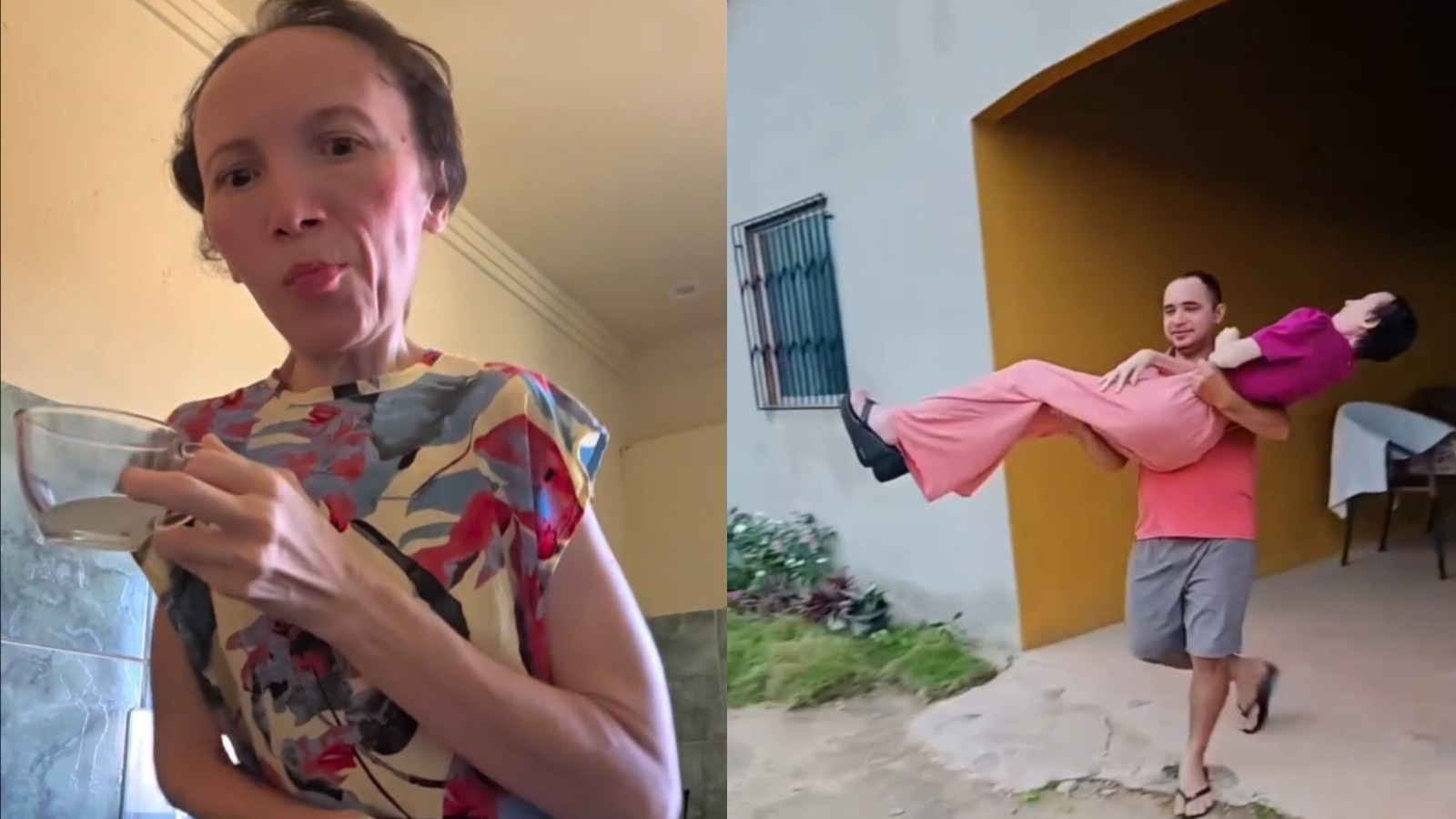
‘Living statue’: Influencer goes viral with routine talking about rare disease that turns muscles into bones
⚡ Quick Summary
Influencer goes viral with routine talking about rare disease that turns muscles into bones Influencer Maria Luiza de Brito, known as Martinha Brito, decided to use social media to raise awareness about an ultra-rare disease.
Influencer goes viral with routine talking about rare disease that turns muscles into bones
Influencer Maria Luiza de Brito, known as Martinha Brito, decided to use social media to raise awareness about an ultra-rare disease. 15 years ago, she was diagnosed with Fibrodysplasia Ossificans Progressiva (FOP), a condition that affects around one in two million people (understand more about the disease below).
Martinha lives in Viçosa do Ceará, in the interior of the state, and has more than 200 thousand followers on Instagram. On her profiles, she publishes videos showing her routine with the disease, which, in many moments, she faces with good humor.
🧬 Progressive Fibrodysplasia Ossificans (FOP) is a genetic disease in which muscles and soft tissues are gradually replaced by bone tissue. Estimates indicate that, in Brazil, there are 120 to 150 cases.
Click here to follow the g1 Ceará channel on WhatsApp
On social media, Martinha answers questions from followers about how she bathes, eats or sleeps. "I started to publish my videos, to deepen my knowledge about my pathology. This way, I started to gain followers. Today, for me, it is an honor to show about this rare condition and also to motivate people to continue fighting", he highlighted.
"Today I am a rare person. I have a pathology that has no cure. The muscles become bones, the nerves become stiff and the person loses all mobility, transforming the body as if it were a living statue", explained Martinha.
READ ALSO:
'Trapped in my body': Brazilian woman with rare genetic disease that turns people into 'statues'
On a stretcher, a man with a rare disease that ossifies the body 'takes' his mother to a Roberto Carlos show
Late diagnosis
Martinha Brito, 47 years old, lives in Viçosa do Ceará, in the Serra da Ibiapaba region.
Social networks/Reproduction
Martinha said that she was born with the first symptom of FOP: a malformation in the "big toes" of her feet. However, symptoms worsened at age 6.
"I was born a normal child and, at the age of six, after a vaccine in my arm muscle, this problem developed. But I was born with it, but no one knew," he said.
➡️ The application of injections is one of the causes of ossification in FOP patients (understand below).
Martinha recalled that her mother noticed a variation in her arm after receiving the vaccine. "When she went to bathe me, she noticed it in my arm. It was as if the needle had broken. Then the muscles started to wither, and I started to become stiff", he said.
“It started in the neck, then in the arm and, at the age of 16, I could no longer sit down, I was already having difficulty moving around”, he recalled. At that age, she was misdiagnosed with muscular dystrophy.
The correct diagnosis of FOP only came at the age of 32, after a consultation with a doctor in Sobral, in the north of Ceará.
The disease and treatment
Image shows foot with rare disease that turns muscles into bones
Reproduction/ Ifopa
Doctor Leonardo Colares explained that FOP is a genetic disease caused by changes in a gene. "It is an ossification of tissues, such as muscles, tendons, ligaments. Those tissues that help us with locomotion end up undergoing an ossification process," he said.
According to the orthopedist, the disease causes loss of movement. "When the patient has any insult, be it a vaccine, trauma or surgery, this causes an inflammatory response. Ossification occurs from this inflammation", he added.
The disease has no cure, and treatment seeks to alleviate and avoid complications, with the aim of improving quality and increasing life expectancy. "The treatment consists of the use of corticosteroids to reduce inflammation, anti-inflammatories. It needs multidisciplinary treatment with an endocrinologist, pulmonologist, orthopedist, a geneticist", he detailed.
The doctor stressed that the sooner the diagnosis is made, the greater the chances of delaying FOP complications. “We can’t stop the disease, stop it. We can slow down the progression”, he concluded.
Fight for rights
Martinha is currently a social work student and says she started her degree to learn more about the rights of people with rare diseases.
“To fight not only for myself, but for other vulnerable people, who don’t have knowledge, who don’t know where to look,” he said.
The influencer discovered that she is not listed in Ceará's public health systems as a patient with a rare disease. “I am fighting for my CID to be registered and for me to be recognized by the Ceará Health Department as a person with rare diseases,” he stated.
g1 contacted the Ceará Health Department (Sesa) about the complaint, but did not receive a response until the publication of this report.
Reporting for prejudice
The influencer had to deal with rejection from an early age. Her father abandoned her when she was 3 months old. On social media, she also faces prejudiced comments.
At the end of April, Martinha reported to the Civil Police offensive comments made by a person from Rio de Janeiro in one of her videos. “I was insulted on the internet with two bad words. I found it very heavy,” he said.
In a statement, the Civil Police of Ceará reported that it was investigating a report of a crime of insult and that the Viçosa do Ceará Police Station opened an investigation to investigate the case.
Decades of change
Image shows person with FOP
Reproduction/Ifopa
In 2025, a law was passed in Brazil for the FOP test to be carried out during neonatal screening, when the heel prick test is carried out. Early diagnosis can help patients' quality of life, as injections (common in children) can accelerate the ossification processes of muscles.
This is one of the achievements that doctor Patrícia Delai has followed for more than 20 years in the fight to raise awareness about rare diseases. She is also one of the founders of the FOP Brasil association. The entity mainly uses social networks to disseminate information about the disease; both to help patients and to raise awareness among the general public.
“We felt the need to create an association, so that we were legally united, could take part in clinical studies, receive donations, and have representation. Today we have more than 100 patients in Brazil. We know that there must be more people who are unknown”, explained Delai.
The dermatologist became involved with the cause of FOP patients in the 2000s when she treated the first person with the disease. At the time, she couldn't find much information about FOP in Brazil. The alternative was to contact an association in the United States. From this contact came an invitation to travel and obtain more information about the disease.
I came back with a mission, which was to find all the FOP patients in Brazil. Something that is not easy.
She mentioned that, in 2003, a meeting was held in São Paulo with 28 families with patients from different countries in Latin America. “The great need we had at the time was to find a family that had more than one generation affected by FOP, because, until then, it was not known which gene caused the disease,” recalled the doctor.
Dermatologist Patrícia Delai with a FOP patient and two doctors from the United States, in São Paulo, in 2003.
Personal file
“At this meeting we managed to bring together a Brazilian family that was crucial to the discovery of the gene that causes this disease. So, Brazil was part of a discovery that in the future will be the answer to many diseases”, he reinforced.
The FOP gene was discovered globally on April 23, 2006. In 2022, the Brazilian government established the date as Fibrodysplasia Ossificans (FOP) Awareness Day. Last year, President Lula sanctioned the law that established the commemorative date. “Brazil is the only country to have made FOP day official and to have also made it official to observe the big toes when they form at birth”, highlighted Delai.
“So, Brazil entered the map not only for FOP, as it discovers new patients, guides, informs, educates, but it also entered the map for FOP research, because like it or not, Brazil is one of the countries that has the largest number of patients with FOP in the world”, he reinforced.
An article published in the United States National Library of Medicine pointed out that the country has the largest number of registered FOP patients. China and Brazil appeared in second and third place, respectively.
Watch the most viewed videos from Ceará
📰 Related Articles
From outsourcing to prisons: see the chronology of the investigation involving the UPAs of Palmas
G1 Globo
“Portugal in the USA” with the most watched flight of the World Cup and...
Observador
Cake with medals, masses and community wedding: see the schedule for Saint Anthony's Day in Paraibuna and Caraguatatuba
G1 Globo
Beatification of a priest mobilizes the municipality of MT to receive an audience greater than double the population
G1 GloboIara no Carf and the true test of artificial intelligence in the State
JOTA