


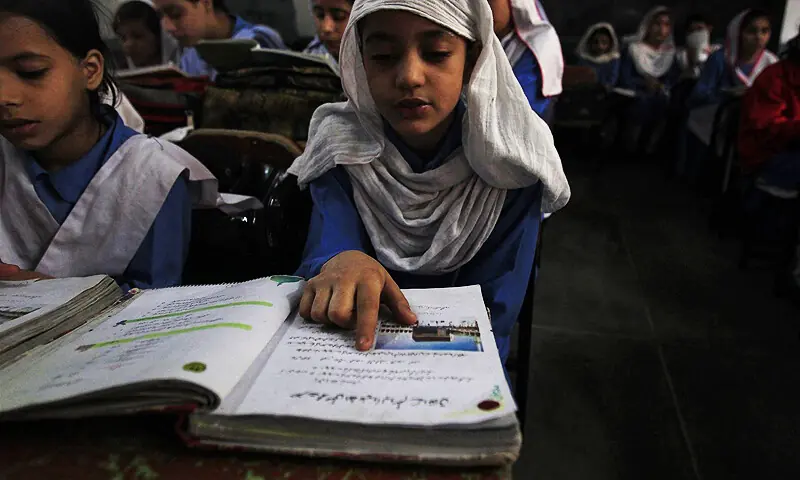
Literacy rate improves by 2pc, but education spending falls in 2025
⚡ Quick Summary
ISLAMABAD: The literacy rate for individuals aged 10 and above in Pakistan rose from 61 to 63 per cent, while spending on education faced a decline, according to Economic Survey 2025-26.
ISLAMABAD: The literacy rate for individuals aged 10 and above in Pakistan rose from 61 to 63 per cent, while spending on education faced a decline, according to Economic Survey 2025-26.
It stated that male literacy was 73pc and female at 54pc, reflecting a gradual progress and narrowing gender gap.
Urban areas continued to have higher literacy rates with a total of 74 per cent (81 per cent for males and 68 per cent for females), while rural areas had a lower rate of 55 per cent (67 per cent for males and 44 per cent for females).
Rural female literacy showed the most significant improvement. Punjab recorded the highest literacy rate at 68 per cent, followed by Sindh and Khyber Pakhtunkhwa, both at 58 per cent. Balochistan had the lowest rate at 49 per cent. The urban–rural divide persisted with urban Punjab at 78 per cent and rural Sindh at 39 per cent. Overall, the data highlighted steady but uneven progress with rural female literacy playing a key role in the observed improvements, despite continuing regional and gender disparities.
Expenditure
The survey stated that education expenditure stood at Rs962 billion during the financial year 2025 compared to Rs1251.06 billion in the previous year. Expenditure in year 2024-25 remained 0.8pc of GDP while in year 2022-23 it was recorded at 1.5pc of GDP. In 2021-22, it was 1.7pc of GDP, showing a constant decline.
In the year 2020-21, education expenditure was recorded at 1.4pc of GDP, while it was 1.9pc of GDP in 2019-20.
Meanwhile, the survey highlighted the issue of out-of-school children (OOSC), stating that OOSC in Pakistan had declined from 38 per cent in 2023 (male: 35 per cent, female: 42 per cent) to 28 per cent in 2025 (male: 25 per cent, female: 31 per cent), demonstrating significant progress across all provinces particularly in Balochistan where the proportion decreased from 69 per cent to 45 per cent, followed by Sindh (47 per cent to 39 per cent), Punjab (32 per cent to 21 per cent), and Khyber Pakhtunkhwa (30 per cent to 28 per cent).
Highlighting the issue of missing facilities, the report said around 65 per cent of schools in the country had access to electricity though there were disparities among provinces. Punjab and ICT have higher access, while Balochistan reports substantially lower coverage and therefore requires focused attention. Punjab and ICT also lead in the percentage of primary schools with water facilities, while Balochistan and AJK face challenges with only 23 per cent coverage. Toilet access in schools varies widely among provinces. Pakistan shows moderate access to boundary walls in schools with Punjab, Khyber Pakhtunkhwa and ICT at the forefront. As schools progress to higher levels, the availability of electricity, drinking water, toilets and boundary walls improves.
“Education is the foundation of a better future for every child and a strong society. Pakistan’s large youth bulge can be transformed into a productive resource through effective investment in education. However, this requires improved access to quality and equity across all levels of education. In the face of demographic changes, technological advancements and governance challenges, education remains a vital tool for social stability and sustainable development. Recognising its importance, the government continues to prioritise the education sector through policy reforms and targeted investments,” read the report.
Published in Dawn, June 12th, 2026
🗞️ 1 sources covered this story

📰 Related Articles

The Morning After: Apple's quest to make AI useful to its users
Engadget
Amazon Founder Calls AI Pessimism Wrong, Blames "Smart" People
NDTV
Retail Inflation 3.93% In May, Up From 3.48% In April
NDTV
Calls For Fine-Tuning As Weather Alert Wakes People Up After Midnight
NDTV
Kiev forces lose over 2,135 troops in a week in Battlegroup Center responsibility zone
TASS