Parallel budget: TCU investigates use of 'forgotten money' from workers in banks for Desenrola 2.0
⚡ Quick Summary
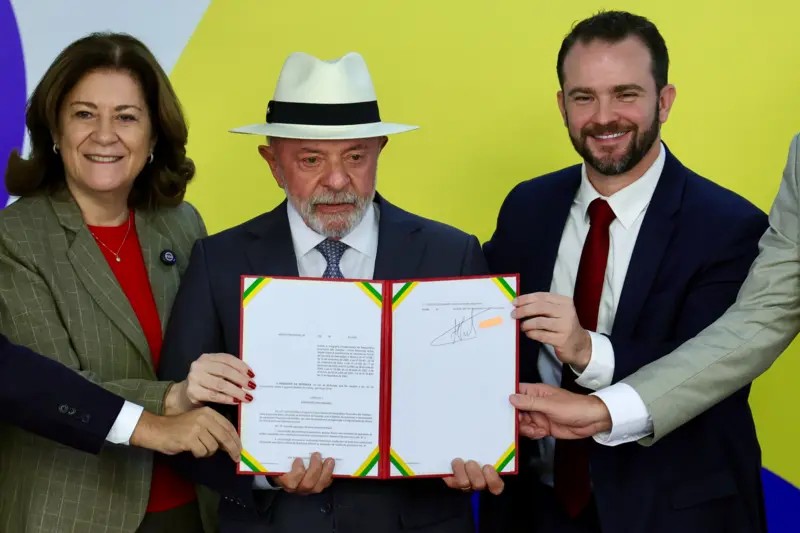
Lula government announced second phase of Desenrola Fabio Rodrigues-Pozzebom/ Agência Brasil The Federal Court of Auditors (TCU) is investigating the transfer, by the government, of money forgotten in banks to a fund that is being used to guarantee the operations of Desenrola 2.0 — a debt renegotiation program launched in an election year.
Lula government announced second phase of Desenrola
Fabio Rodrigues-Pozzebom/ Agência Brasil
The Federal Court of Auditors (TCU) is investigating the transfer, by the government, of money forgotten in banks to a fund that is being used to guarantee the operations of Desenrola 2.0 — a debt renegotiation program launched in an election year.
To date, R$5.7 billion has already been transferred to the so-called Operations Guarantee Fund (FGO), a private fund in which the government also makes contributions, which will guarantee the renegotiation of workers' debts.
➡️ Court technicians investigate the use of resources for federal programs outside the public budget.
As it does not go through the Union budget, the resources are not within the spending limits that must be obeyed. According to the rules, expenses cannot grow more than 2.5% per year (above inflation).
If it were formally included in the budget, and consequently in the spending limit, the government would have to block an equal amount in other free (discretionary) expenses, increasing the difficulties in an election year.
Last month, the government reported that, precisely to comply with the existing spending limit, R$23.7 billion of the ministries' budget had already been blocked this year.
Limited resources are already affecting important areas, such as inspection activities, investments in technology and the provision of services to the population, such as regulatory agencies.
➡️The audit evaluates the accounting, budgetary and financial treatment given to the values under law 14,973, of 2024, which determines that, after the deadline for redemption by workers, the resources should pass directly to the public coffers.
➡️The law says that deposits should be "appropriated by the National Treasury as primary budget revenue and considered for the purpose of verifying compliance with the primary result target provided for in the respective budget guidelines law".
🔎This section of the law, however, was revoked by the Provisional Measure of Desenrola 2.0, which is in force. Once published by the government, provisional measures have the force of law. However, they must subsequently be analyzed and confirmed by the National Congress, which can change them.
Federal Government announces new edition of debt renegotiation program
What the government says
➡️Questioned by g1 whether the use of workers' resources without formal transit through the budget for a public policy in an election year does not constitute disrespect for the law, the Ministry of Finance informed that these are "strictly private values and that they will maintain this condition even after their transfer to the FGO [fund that guarantees the operations of Desenrola 2.0]".
"It is important to note that Desenrola 2.0 comprises an initiative by the federal government in partnership with the private sector, and renegotiations of defaulted debts are also of interest to participating financial institutions as they increase the prospects of repayment on loans that, in general, had low recovery capacity or were already fully provisioned", added the Ministry of Finance.
Similar cases
At the beginning of June, the TCU concluded a process on the carrying out of public expenses through resources that do not pass directly through the Union's budget, something that, according to the court, "could lead to a loss of credibility and transparency in the Union's budgetary and fiscal management".
The following were analyzed:
Retention by Petróleo Pré-Sal S.A. (PPSA) of part of its revenue for the operation of the federal public company, before transfer to the social fund. The TCU determined that payments be made in "full accordance with the legal-normative framework that governs public finances, in particular the Unit's budgetary principles".
People's gas program: TCU questioned the use of resources outside the budget, in an operation intermediated by Caixa Econômica Federal. After criticism from the president of the court last year, the government formally incorporated policy spending into the budget in 2026.
Ibama environmental fines: TCU investigated the conversion of environmental fines into services for preserving, improving and recovering the quality of the environment when the defendant executes the project, or are allocated to other approved projects. The court determined that Ibama and the Ministry of the Environment "adopt measures to ensure that resources arising from the conversion of fines into the indirect modality comply with the Union's budgetary and financial rules."
AGU's legal fees: TCU questioned the payment of "loss fees" by the defeated party to a Board of Trustees, which passes the amounts to public servants outside the federal budget. Last year, more than R$6 billion were paid. The court noted the risk of the resources becoming a "parallel and uncontrolled budget for the execution of expenses that have no relation to the remuneration of public servants", but noted that the case is being dealt with in another process. As a result, he made no decision.
Scientific, Technological and Innovation Institutions (IFES) of Scientific and Technological Institutions (ICTs): TCU criticized the possibility of making expenses covered by its own revenue and resources from agreements and concluded that legal and operational loopholes, although legally supported, weaken the control and transparency of public expenses, and determined measures to increase the transparency of these operations.
Accounts linked to public service concessions: questions why only 25% of the value of the privatization grant for part of BR-040 went to the National Treasury, with the remaining 75% allocated to an account linked to the concession, under indirect management by the National Land Transport Agency (ANTT). There is a process about this under analysis, without a decision on the merits.
This week, the TCU approved the government's accounts for 2025 with reservations. Among the points with restrictions is precisely the allocation of resources administered by Pré-Sal Petróleo S.A. (PPSA) outside the Union budget.
The Ministry of Finance, in turn, stated that these operations "were implemented following current legislation and legal understandings".
"In any case, the Ministry of Finance respects the Court's guidelines with the aim of increasing transparency regarding the conduct of the respective public policies and will support their implementation, to the extent that falls within its regulatory powers", added the Ministry of Finance.
📰 Related Articles
Why did PIX upset global giants and generate a silent dispute in the market?
G1 Globo
How much do the football boots of the World Cup's biggest players cost?
G1 Globo
Formula 1: time and where to watch the Barcelona-Catalunya Grand Prix
CNN Brasil
Influencer kidnapped in luxury car in Vitória: what is known and what remains to be clarified about the crime?
G1 Globo
Yellow-green eyebrows and nails with the Brazilian flag: beauty professionals bet on creativity during the World Cup
G1 Globo