'Disservice to feminism': creator of the Maria da Penha Law criticizes 'forgiveness' to Henry Borel's mother
⚡ Quick Summary
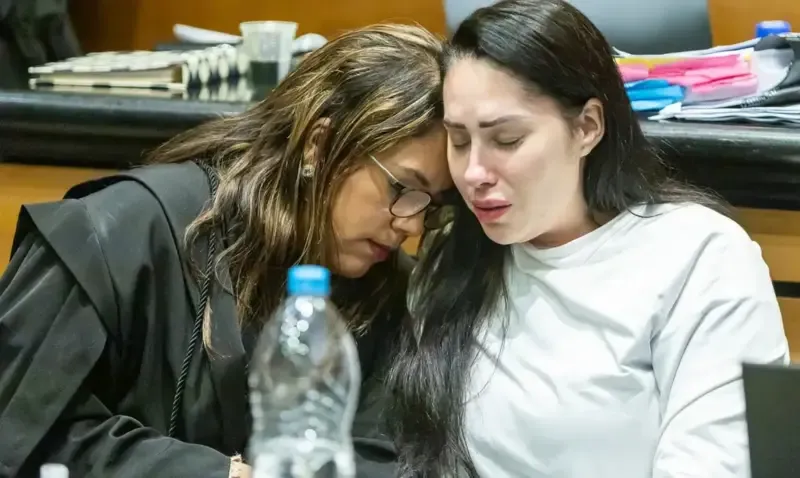
Monique Medeiros (right) received a judicial pardon after being convicted of the intentional homicide of her son Henry Borel, aged 4 Brunno Dantas/TJRJ One of the protagonists in the formulation of the Maria da Penha Law and former president of the United Nations Committee for the Elimination of Discrimination against Women (Cedaw-UN), professor Silvia Pimentel states that the judicial pardon granted to Monique Medeiros, Henry Borel's mother, is inappropriate from a legal point of view and a disservice to feminism.
Monique Medeiros (right) received a judicial pardon after being convicted of the intentional homicide of her son Henry Borel, aged 4
Brunno Dantas/TJRJ
One of the protagonists in the formulation of the Maria da Penha Law and former president of the United Nations Committee for the Elimination of Discrimination against Women (Cedaw-UN), professor Silvia Pimentel states that the judicial pardon granted to Monique Medeiros, Henry Borel's mother, is inappropriate from a legal point of view and a disservice to feminism.
"The judicial pardon was unreasonable, it was not legal and it meant kindness from the judge", says Pimentel, in an interview with BBC News Brasil.
"This decision is against the interests of an enlightened feminism, because we don't want gender goodness, we want gender equity. We [women] don't want to be patronized."
Last week, judge Elizabeth Machado Louro sentenced Henry's stepfather, the then Rio de Janeiro councilor Jairo Souza Santos Jr. (Solidariedade), known as Dr. Jairinho, to 43 years, 9 months and 20 days in prison for the boy's murder in 2021.
Henry died at the age of 4, after being admitted to the hospital with multiple injuries and cardiorespiratory arrest. At the time, the autopsy report from the Legal Medical Institute (IML) indicated that the child suffered 23 injuries due to violent action, which led to a liver laceration and internal bleeding.
Monique Medeiros received a judicial pardon after jurors downgraded the charge against her from intentional homicide to culpable homicide (when there is no intention to kill).
Medeiros was accused of intentional homicide (when there is intent to kill) because, in Brazilian criminal law, a person can be held responsible for this crime even without delivering the blows that caused the death. The Public Ministry's thesis was that Medeiros knew about the attacks carried out by Jairinho, had a duty to protect his son and, even so, allowed the situation to continue. Therefore, she was charged with failure to provide assistance and qualified homicide in the form of omission.
At trial, however, the Jury Court downgraded the crime to manslaughter, understanding that there was no intention to kill on Medeiros' part, but rather negligence.
As the jury only judges intentional crimes against life, the decision about Medeiros was then passed to the judge, who chose to grant her a judicial pardon. In it, the judge recognizes that there was a crime, but does not apply the penalty provided for by law.
In the sentence, when justifying the pardon, the judge cited topics such as gender discrimination and motherhood, assessing that Medeiros had been a victim of misogyny, as he suffered a "social massacre" after the death of his son, with attacks on social media and assaults during his prison term.
Elizabeth Louro also stated that there was a "disproportionate reaction from society, influenced by patriarchal culture", and that a man would not have suffered the same treatment.
Judge Elizabeth Louro stated in her sentence that Monique Medeiros suffered a 'social massacre' after her son's death, with attacks on social media and assaults
Tomaz Silva/Agência Brasil
In addition to manslaughter, Medeiros was also convicted of omission in relation to the torture suffered by Henry. In this case, the judge imposed a sentence of 1 year and 4 months of open detention. The judge acknowledged, however, that this punishment had already been fully served for the period in which she remained imprisoned during the process — around four years.
In the case of conviction for manslaughter, the sentence varies from 1 to 3 years. So, probably, even adding the two sentences, Medeiros would have been released after the trial. Or she would have served the remaining few months in an open regime, if she had been sentenced to the two maximum sentences.
Judge Elizabeth Louro's decision for judicial pardon was widely criticized. Minister Cármen Lúcia, of the Federal Supreme Court (STF) was one of those who went public to express her disapproval of the verdict.
"The jury came to a conclusion. So it has nothing to do with being male or female. Gender is not a safe-conduct for committing crime", said the minister in an interview with the Globonews podcast POD_i.
"I don't know if it was a case of judicial pardon or not, but the impact it causes is the lack of explanation. How can someone who was immediately condemned be forgiven? Judicial pardon exists in cases provided for by law. It has nothing to do with misogyny, nothing", added the only woman currently on the STF.
'Judicial pardon was not created for this'
Jurist Silvia Pimentel shares Cármen Lúcia's opinion on the judicial pardon for Monique Medeiros.
Now 86 years old, the postgraduate Law professor at the Pontifical Catholic University of São Paulo (PUC-SP) has an unblemished record in defending the right to justice for women.
She played a fundamental role in the feminist movement against the acquittal of Ângela Diniz's murderer in 1976; helped rewrite the Civil Code, changing articles that discriminated against women; and participated in the consortium that formulated the bill that resulted in the Maria da Penha Law, the country's main legal instrument to curb violence against women.
Amid growing attacks from the radical right on what they call "gender ideology" and several setbacks in women's rights in Brazil and around the world, Pimentel does not shy away from saying that she is a "card-carrying feminist."
And it is with these credentials that he feels completely free to criticize the decision of the judge in the Henry Borel case.
'Nothing justifies, nor can it allow for, an omission of behavior with serious consequences to be forgiven', says jurist Silvia Pimentel
Claudio Margini Junior/UN News
The lawyer remembers that the nanny warned Monique that Jairinho locked himself in the room with the child, turned on the television and did not respond when she knocked on the door.
According to the case records, the nanny Thayná Ferreira also said that she heard the boy saying that Jairinho tripped him and kicked him. While bathing, the child would have asked the nanny not to wash his head, as he was in pain.
The Civil Police investigation concluded that Henry was a victim of routine physical and psychological torture carried out by his stepfather, and that the boy's mother was aware of the attacks.
"The mother is clearly a woman in an abusive relationship with this man", assesses Pimentel.
"But, in my opinion, nothing justifies, nor can it allow, to be forgiven a behavior of omission with the serious consequences that it ended up having."
"With all due respect to the judge who made this decision and, even, having human respect for this mother, I only have to regret the mistake of both — the serious judicial mistake on the part of the judge and the very serious existential mistake on the part of a mother."
Professor of Philosophy of Law and Feminist Criticism of Law and coordinator of the Law, Gender Discrimination and Equality Research Group at PUC, Pimentel assesses that judicial pardon was not created for cases like this.
"Judicial pardon, provided for in article 121, fifth paragraph of the Penal Code, was designed for situations of a culpable nature in which the consequences of the crime affect the agent so seriously that the criminal sanction becomes unnecessary", recalls the jurist.
"The classic example is the mother who, through negligence, runs over her own son in the garage," he says.
She cites the example of actress Christiane Torloni, who in 1991 lost her 12-year-old son in a domestic tragedy, in which she lost control of her car while reversing. The vehicle plummeted into the garage from a height of 5 meters and the boy, who was with her in the car, suffered a head injury and died.
"In Monique's case, applying judicial pardon on the grounds that she suffered from the massacre on social media or from the attacks in prison is to confuse the intrinsic consequences of the crime — the loss of her child — with the consequences of the criminal process and the social reaction in the face of brutal violence against a child", says the teacher. "So, although judicial forgiveness finds support in legislation and jurisprudence in cases of culpable homicide, it is certain that there are relevant differences from Monique's case to other cases in which the institute is normally applied."
Thus, Pimentel observes that, although judicial forgiveness exists in legislation, it does not apply to any case. "Each and every norm needs to be justifiably interpreted for the unique case to which it is applied."
Court condemns Jairinho and releases Henry's mother after judicial pardon
Judgment with a gender perspective
Pimentel recalls that since 2023, the National Council of Justice (CNJ) established the Protocol for Judgment with a Gender Perspective. This is a mandatory guide for the Judiciary, which guides magistrates to analyze processes considering structural inequalities and avoiding stereotypes, prejudices and discriminatory decisions against women.
"The protocol is wonderful, it is an instrument that helps to draw attention to a society still full of stereotypes and prejudices towards us women", says Pimentel.
"But this protocol proposes gender equity, not 'gender kindness'."
The jurist highlights, however, that it is now necessary to avoid the massacre of both Monique and the judge.
"Let's leave these two women, the judge and this poor mother alone. But that doesn't stop us from saying that legally, it was a wrong decision on the part of the judge in the case."
Pimentel also notes that Louro's decision is dangerous, as it opens up a flank for criticism of concerns about gender issues, in a world increasingly averse to this debate. She remembers that this has practical consequences.
“Neoconservative and far-right political forces have transformed the gender category into a manufactured threat to the traditional family and social order,” says Pimentel.
"This panic translates into the dismantling of public policies and the boycott of education on human rights for women and other oppressed groups."
🗞️ 1 sources covered this story

📰 Related Articles

G1 Globo

Somali referee is received as a hero in his country
ObservadorMan is arrested on suspicion of trying to kill his brother by stabbing him in the head and neck with glass, in Alagoas
G1 Globo
World Cup: see a list of the biggest football stories to watch
CNN Brasil
Grupo A é o mais multicultural da Copa? Entenda escolas do futebol
CNN Brasil