Why does an approved vaccine have a record of rare events and how does this impact safety? Experts explain the suspension of Butantan-DV
⚡ Quick Summary
Expert explains next steps after suspension of dengue vaccine The Ministry of Health announced on Monday (8) the temporary suspension of the dengue vaccine developed by the Butantan Institute.
Expert explains next steps after suspension of dengue vaccine
The Ministry of Health announced on Monday (8) the temporary suspension of the dengue vaccine developed by the Butantan Institute. The decision was taken after 42 cases of severe adverse reactions and two deaths were recorded among the 500,000 people vaccinated since January.
The relationship between deaths and serious cases and the vaccine has not yet been confirmed. Even so, the Ministry decided to interrupt immunization with no scheduled return date.
The decision raises a number of questions: Has the vaccine been tested enough? What do these cases reveal about the process that led to their approval? And what should those who have already been vaccinated do?
The Butantan vaccine arrived on the market with a robust track record. More than 16 thousand volunteers were followed over five years, with an overall effectiveness of up to 80.5% protection against severe dengue (a condition that leads to hospitalization or death). Throughout the study, no serious adverse effects or deaths linked to the vaccine were recorded.
🔴 What experts interviewed by g1 explain is that no clinical study, no matter how broad, can anticipate everything.
Rare adverse effects are unlikely to appear in phases 1, 2 or 3 of a clinical trial because there are not enough participants to make them visible. The number of serious cases among the more than 500 thousand people immunized represents 0.008% of the total.
That is why there is the pharmacovigilance process, which is also part of the regulatory protocol. After the approval of a new vaccine, immunization begins gradually, precisely to facilitate the monitoring of possible adverse events — with restrictions and target audience being reevaluated as new data emerges.
This has happened before, with alerts and even suspensions for specific groups with Covid-19 vaccines.
Below, g1 explains what was found in the research, what the reported cases and suspension say about the vaccine regulatory process in the country and what to do if you have been vaccinated.
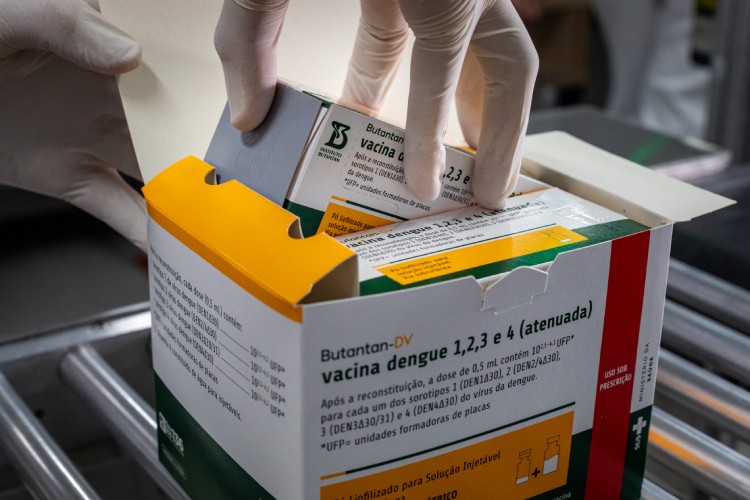
Butantan DV is the world's first single-dose vaccine against dengue
Disclosure / Butantan Institute
What did the study show before approval?
Butantan-DV went through all mandatory phases of clinical studies before reaching the SUS — safety assessment, immunological response and efficacy in volunteers. The phase 3 study, published in the scientific journal "Nature Medicine", followed more than 16,000 participants aged 2 to 59 for five years.
The overall effectiveness against symptomatic dengue confirmed by examination was 65%. Against serious cases or those with warning signs, protection reached 80.5%.
🔴 Throughout the study, no deaths related to the vaccine were recorded. In total, 42 deaths were recorded among people who received the vaccine, but none of the cases were related to the vaccine. These were deaths caused, in general, by Covid-19.
More than half of the research participants who received the vaccine — 58.6% — reported some reaction. The most common symptom was headache, but all cases were mild to moderate in intensity. In other words, there was no serious reaction among the people who were observed, even for a long period.
Based on this set of studies, Anvisa approved the vaccine in November 2025. The campaign began in January 2026, with the first 417 thousand doses applied to healthcare professionals. And it was on this scale that the first warning signs appeared.
And what was not seen in the research that has now appeared?
Since the beginning of the campaign until now, 500,000 people have been immunized. In this volume of people, problems that had not appeared until then began to be registered.
Experts interviewed by g1 point out that these numbers need to be read carefully. This is not to minimize what happened, but to understand what the numbers mean. According to a survey by the Ministry of Health, the following were recorded:
3,700 people with mild symptoms, similar to dengue, but which were not described in the leaflet. This volume represents 0.7% of the total number of people who received the vaccine.
42 people with reactions considered an alarm signal, including two deaths. The records correspond to 0.008% of the total number of people vaccinated.
➡️ And you may wonder: why hasn't any of this been seen before? Infectious disease specialist Leonardo Weissmann explains that this may happen because clinical studies are comprehensive, but have limitations.
When the vaccine begins to be applied on a large scale, people with very specific health conditions may experience reactions that did not appear in clinical studies.
This is all monitored in a rigorous pharmacovigilance process that not only identifies cases, but also discusses with a committee that involves several experts to understand the next steps.
What led to the suspension was the analysis of reactions that were not foreseen in the leaflet and that need to be investigated.
"What science does is ensure that as many people as possible will be safe and protected from the vaccine. The research analyzes the scenarios, but has limitations that are later monitored when larger doses are applied. If there is an effect that occurs in one person every 100,000 or 1 million doses, this will only appear when the vaccine is applied on a large scale. The suspension is not a failure, but the system working", explains Weissmann.
The infectious disease doctor and president of the Brazilian Society of Immunizations (SBIm), Isabela Balalai explains that there is yet another analysis: a possible contraindication for people with a specific and rare health condition.
In the case of Butantan-DV, it came to people as a restriction: it was not recommended for immunocompromised people. These are patients who have a weakened immune system, either due to illness or treatments that reduce the body's defenses. This is the case, for example, of chemotherapy patients, transplant recipients who use immunosuppressive medications and some people living with HIV.
As the dengue vaccine uses a live attenuated virus — that is, a weakened version of the virus capable of stimulating the immune response without causing the disease in most people — it was already contraindicated for this group since its approval.
Isabela explains that the analysis may also reveal a new group with vaccine restrictions that has a very rare condition.
"This is the process and it is precisely through this process that a vaccine becomes safe. We cannot panic now. We are not ignoring that there are investigations into deaths, this still needs to be clarified and this is what is being done. But it is through this careful process that the available vaccines are safe”, he explains.
Is this a glitch in the system?
The suspension raised doubts about whether the vaccine approval process was rigorous enough. For experts, the answer is no and they point out that the reasoning is almost the opposite: the fact that cases were identified and communicated quickly is a sign that the system works.
“The vaccine as the cause is not yet confirmed,” says infectious disease specialist Alexandre Naime. “It’s important that cases are evaluated transparently — but it’s part of how the system works. If there wasn’t a surveillance system, these cases wouldn’t even have been reported,” he explains.
What is underway now is pharmacovigilance — a step provided for in the regulatory protocol for any immunizer. This system monitors vaccinated people across Brazil, receiving notification of adverse cases, from mild to severe. The procedure involves the Ministry of Health, Anvisa and other bodies responsible for health surveillance.
In the Ministry of Health's decision, Minister Alexandre Padilha explained that they followed the notifications, met the committee this Monday (8) and with the number of cases they decided to suspend until all are investigated. This isn't the first time this has happened:
In 2021, after the start of the large-scale campaign with the Pfizer vaccine against Covid-19, the first cases of associated myocarditis emerged. They did not appear in clinical studies, but were detected by pharmacovigilance. There was an alert for this, which was considered a rare event, affecting less than 0.01% of those vaccinated. The vaccine continued to be administered after the alert.
Then, the same happened with the AstraZeneca vaccine for pregnant women. In the studies, there was no risk for this public, but a serious case was identified during pharmacovigilance and the vaccine was restricted for this public.
Infectious disease doctor Alexandre Naime explains that caution is needed regarding any reading of the published data. Before assuming any failure, it is necessary to carefully investigate the cases, observing clinical factors, comorbidities, possible errors in the application and storage of vaccines before reaching any conclusion.
"There is still nothing to confirm that the vaccine is the cause. It is important that the cases are investigated, as is being done, and with transparency. Today, the Ministry released the cases, explained why it is suspending and people can follow what happens in this process", he explains.
What to do if you've been vaccinated
The Ministry of Health recommends that people vaccinated in the last 21 days pay attention to possible signs of an adverse reaction. Signs include:
Fever
Severe and continuous abdominal pain
Persistent vomiting
Dizziness
Bleeding
Intense drowsiness
Irritability
Signs of dehydration
Worsening general condition
Anyone who was vaccinated more than 21 days ago and did not show symptoms is not advised to seek care.
What does Butantan say?
The Butantan Institute informs that, following guidance from the Ministry of Health and Anvisa, vaccination against dengue will be, preventively, temporarily interrupted to reevaluate the vaccination strategy.
At the moment, healthcare professionals were being vaccinated. The guidance occurs due to some cases of adverse reactions detected, three of them with signs of severity, in a universe of approximately 500 thousand vaccinated people, which may or may not be related to vaccination. The measure aims to guarantee the safety of the population in the next stages of vaccination.
The Butantan Institute maintains its commitment and absolute rigor to science and the health of the population and will continue working to support the Ministry of Health and Anvisa, providing all available information about the vaccine, carrying out new studies and monitoring the pharmacovigilance work of those vaccinated. It is worth noting that the vaccine had an overall efficacy of 79.6% and 89% against severe dengue in a study published in an international scientific journal. In the three municipalities where there was mass vaccination of the population – Botucatu (SP), Maranguape (CE) and Nova Lima (MG), pharmacovigilance monitoring was positive, with no important cases of adverse reactions in the population.
The Butantan Institute, as already demonstrated in recent cases, will continue working with the utmost rigor to deepen information on the use of the vaccine so that, if its safety is confirmed, vaccination can be resumed soon, with complete peace of mind for the population served by the SUS. The Butantan Institute reaffirms its commitment to delivering safe and effective products to address Brazilian public health problems through the SUS.
🗞️ 4 sources covered this story

Does fighting crime involve reducing the age of criminal responsibility?
CNN Brasil
How much does FIFA pay the 2026 World Cup champion?
CNN Brasil
Agreement between Iran and the USA: does it mean decline for Trump?
ObservadorWhat does '8647' mean? The code that lit the alert in the USA
Correio Braziliense📰 Related Articles

Is supporting Brazil more expensive? The rise in the price of meat, beer and other items to watch the World Cup games
BBC Brasil
Show inspired by cordel literature will have free performances in São Pedro da Aldeia
G1 Globo
‘ANTA – The Film’: documentary portrays 30 years of struggle for the conservation of an endangered species
G1 Globo
Is it possible to play football again after tearing a ligament? Understand
CNN Brasil
SpaceX "is unique" but "many things have to go well"
Observador