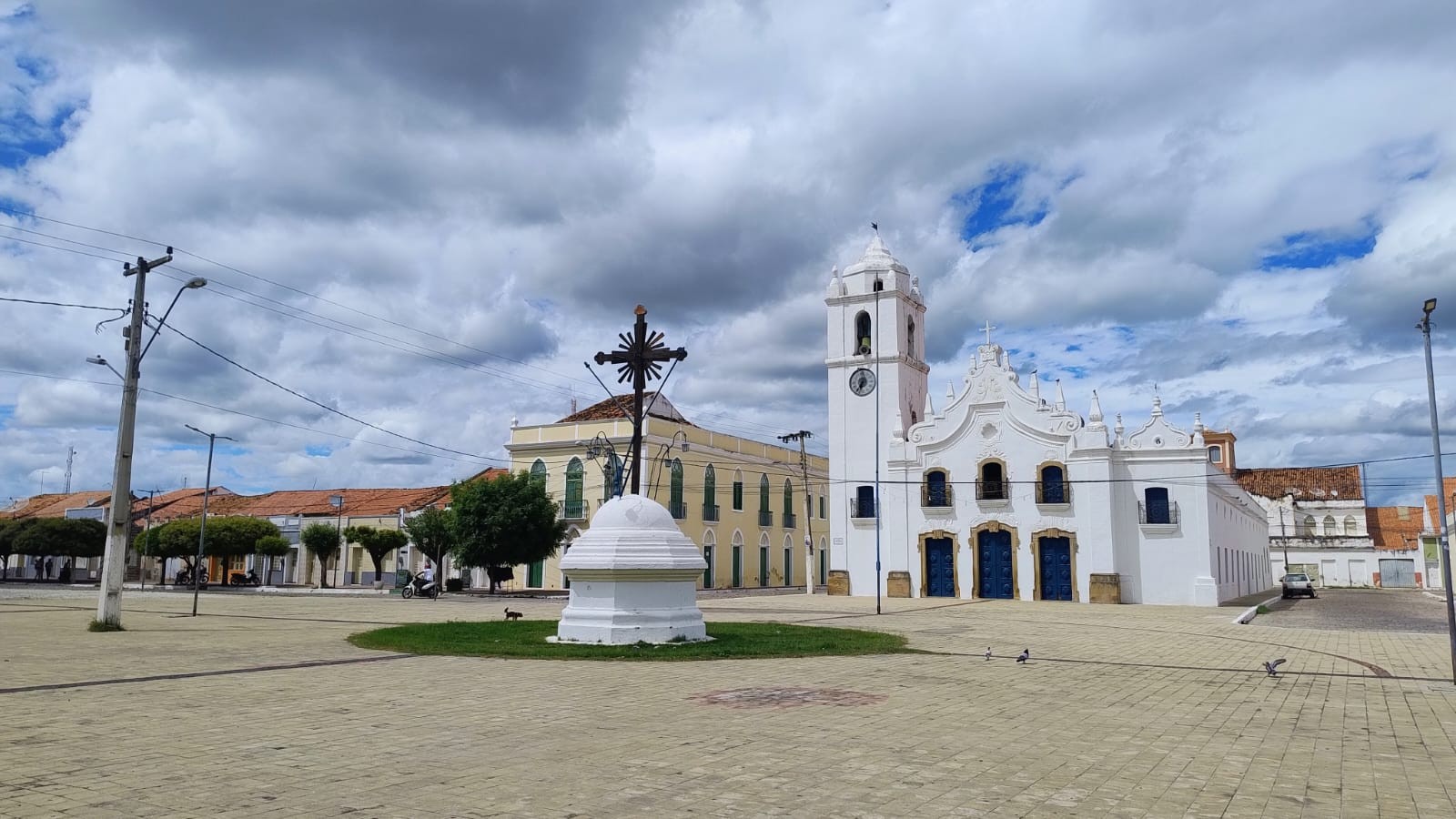
Preserved history: Icó, in the interior of Ceará, has more than 400 listed properties from the 18th and 19th centuries
⚡ Quick Summary
Church of Our Lady of the Rosary of Black Men, in Icó, Ceará.
Church of Our Lady of the Rosary of Black Men, in Icó, Ceará.
Claudiana Mourato/TVM Cariri
Anyone who visits the city of Icó for the first time, in the center-south of Ceará, is enchanted by the preserved historical and architectural heritage. There are more than 400 properties from the 18th and 19th centuries listed in the city's Architectural and Urban Complex, the first in the State to be listed by Iphan in 1998. Almost 30 years later, the municipality is still considered one of the most representative when it comes to traditional architecture in Ceará.
The city is one of the largest in the Center-South of Ceará, with around 62 thousand inhabitants. It went through difficult times at the end of the 19th century, due to the crisis in cotton production and the serious drought that hit the region between 1877 and 1879. Moments of socioeconomic instability interspersed with periods of development.
Click here to follow the g1 Ceará channel on WhatsApp
Formed by Portuguese and French, Icó inherited a rich architecture in the Baroque style, but with characteristics typical of the Northeast region and with French neoclassical lines. The village that gave rise to the city arose from the occupation of sesmarias (donated plots of land) along the Jaguaribe River, with the installation of cattle corrals and housing.
These lands were divided and formed the village of Icó de Baixo, which disappeared due to constant flooding, and the village of Cima, or Arraial dos Montes, which developed and later gave rise to the Village of Icó in 1726.
It was a strategic point at the intersection of three important colonial communication routes: the Estrada Geral do Jaguaribe (which connected Ceará to Pernambuco), the Estrada das Boiadas (which connected Ceará to Piauí and Paraíba) and the Estrada Nova das Boiadas (which started from Sobral and connected Ceará to Pernambuco and Paraíba). On May 4, 1738, the village was emancipated and became a city. 288 years of history.
Urban legislation
Icó also stands out as one of the first municipalities to have urban planning legislation in the country. A Provincial Resolution of 1850 inserted a plan into the city determining a new urban perimeter.
"Icó's urban plan was created through a royal charter that designated the entire urban layout, streets, public spaces, blocks. This brings great richness because it communicates with what Europe brought in urbanization, and also with the colonial occupation of the Portuguese crown, in the process of interiorization and the change in the economic process", says architect Márcio Rodrigo Coelho de Carvalho.
"It is a monumental layout, an architecture that remains preserved, intact. It is perhaps the best preserved in Ceará, in addition to being the largest among all the cities. It is a complex that expresses civil architecture, the way families live, and also the hierarchy of the economy that was established through the creation of cattle", he adds.
According to data from Iphan, the entire architectural complex of Icó is made up of properties with Portuguese-Brazilian, colonial, eclectic, art-deco and even neoclassical and rococo characteristics, in addition to contemporary architecture. Everything adapted to the backlands way of life, with the use of simplified forms and local materials.
It is not difficult for anyone walking through the city center to notice many of these characteristics. The variety draws attention: rows of houses that make up unique groups, with roofs of the same height and the same slope, townhouses, doors and windows with aligned heights; Even without knowledge of architecture, the beauty of art enchants anyone.
Below, learn a little more about the central architectural space.
Largo do Theberge and Teatro das Ribeiras
Largo do Théberge, considered the largest square in Latin America, measuring 955 meters long. Claudiana Mourato/TVM Cariri
According to researchers, Icó was planned by the Portuguese to have three streets: that of the court or elite, which was used for housing; the service street (of the enslaved); and Rua Larga, the street of commerce, where old traders met, coming from different locations to sell and buy goods.
Over time, some changes. The shopping street became Largo do Theberge - the largest architectural intervention carried out in the city in the 20th century. It is also considered the largest square in Latin America, measuring 955 meters in length.
This is the third version of the space that continues with cultural, religious and profane manifestations. There is a lot of activity at night, with a food court and other activities.
The large square is surrounded by the churches of Nossa Senhora da Expectação and Senhor do Bonfim, the old Town Hall and Prison, the Ribeira dos Icós Theater and the two-story houses of Barão do Crato and Canela Preta, as well as other important buildings.
House of Chambers and Jail, where the city council and public jail operated. The Confederation of Ecuador was planned in this place. Bárbara de Alencar was trapped at the scene. Today, the municipality's education department operates.
Claudiana Mourato/TVM Cariri
The square was named after one of the most important figures in the city's history, Pierre François Théberge, better known as Pedro Théberge, a French doctor and historian who arrived in Icó in 1848. His wife was a musician, and the family loved art.
Proof of this is the construction of the first theater in Ceará: the Teatro das Ribeiras, in 1860. The equipment has a great significance for Icoense society. With a neoclassical style and Palladian details, the theater was the stage for many companies from all over Brazil. A space that excites residents and visitors.
"Personalities like Gilberto Gil and Ariano Suassuna were also here. Ariano even said that if there was any work on his life, if Icó wasn't included, it would lose its meaning. For us it was something fantastic. Almost every weekend the theater hosts performances. It is undergoing an intervention, but it should soon be handed back to society", says researcher and deputy secretary of culture, Cláudio Pereira da Silva, emotionally.
First theater in Ceará: Teatro das Ribeiras, created in 1860, in Icó.
Claudiana Mourato/TVM Cariri
Occupation of historic buildings
Senhor do Bonfim Sanctuary, place of pilgrimage and devotion to the Crucified Christ, in Icó, Ceará.
Claudiana Mourato/TVM Cariri
A part of the city's historic properties is occupied by municipal public bodies. The Chamber and Jail House, a former administrative and judicial building and symbol of colonial power, is one of the most significant facilities in local history. The city council and public jail operated in the space.
In this same place, the Confederation of Ecuador was planned in 1824. Bárbara de Alencar, a revolutionary from Pernambuco, was one of the illustrious prisoners of this chain.
"Many revolutionaries were in the city, such as Tristão Gonçalves, son of Bárbara de Alencar, one of the revolutionaries of the movement. She encouraged her son to come to Icó to look for supporters of the revolution. Many women from Icó participated in the action. It was a libertarian movement: to live on your own two feet. Another important point in history is that Icó became the capital during this period, for around 3 months", says researcher Cláudio Pereira da Silva. It is in this space that the education department currently operates.
Another imposing building is the Palácio da Alforria. Milestone of the fight for the freedom of enslaved people in the municipality and the region. It was in this building that Antônio Pinto Nogueira Accioly was born, who governed Ceará three times, between 1896 and 1912. It gained the name Palácio da Alforria because, according to local historians, on March 25, 1883, the letter of liberation of the enslaved Icoenses was signed, one of the milestones in Ceará's history. The old palace is now occupied by the City Hall.
"The occupation of these mansions maintains a pulsating daily life linked to the needs of the people of Icoense. It is one of the purposes of cultural heritage: that it exists to maintain these emotional ties with those who live there, to keep the city alive for the people of Icoense and for them", reinforces architect Márcio Rodrigo Coelho de Carvalho.
The municipality's Culture secretariat and the technical office of the National Historical and Artistic Heritage Institute - IPHAN are located at Casa de Cultura Mariinha Graça.
The municipality's Culture secretariat and the Iphan technical office operate at Casa de Cultura Mariinha Graça.
Claudiana Mourato/TVM Cariri
Heritage education is also in the curriculum of the municipality’s schools. "Schools have conversation circles, lectures. Students visit heritage sites to bring out this feeling of belonging in their hearts, so that they can be citizens who protect the historical heritage", says the municipal culture secretary, Renan Moreira.
In another strategic point in the historic center is the Barão do Crato townhouse; the beautiful architecture stands out. An imposing construction that reflects the wealth and influence of the elites of the imperial period in the city. It belonged to Bernardo Duarte Brandão, Baron of Crato. Today, in addition to being a residence, the house houses two businesses.
Public Market
Icó Public Market. It was completed in 1873 and was last restored in 1998.
Claudiana Mourato/TVM Cariri
Public markets are social and cultural spaces, which carry traces of local identities. In Icó it is no different. The market was completed in 1873 and was last restored in 1998. Today it still houses traders who seek to maintain space amid socioeconomic transformations. They sell the most diverse products.
Anyone who visits the market feels the contrast and nostalgia of seeing the union between the past and the present, the market surrounded by contemporary businesses. He also sees the beauty that is the artistic function of space, of resisting time.
City of Our Lady of Expectation and Senhor do Bonfim
Parish Church of Our Lady of Expectation in Icó, in the interior of Ceará.
Claudiana Mourato/TVM Cariri
The Chapel of Nossa Senhora da Expectação was built almost 30 years before Icó became a city. In 1722, it became the Parish of Nossa Senhora da Expectação with great historical and religious value.
With traces of Baroque architecture, the internal space underwent some changes, such as the opening of arcades to the side corridors. But the church still preserves the original carved tabernacle, silverware and old images.
Celebrated in December, Nossa Senhora da Expectação receives faithful from several cities in the interior of the State.
But another religious temple also attracts hundreds of visitors. It is the Senhor do Bonfim Sanctuary, a place of pilgrimage and devotion to the Crucified Christ. Built by the first captain-general of ordinances, Bento da Silva Oliveira, it was a request from the captain's wife: payment of a vow for the healing of a beloved family member.
"Although Senhor do Bonfim is not the main church of the city, here is the place where people come together more, have more affection, a greater devotion to the image that came from Bahia. It was located in a closed oratory that only opened on Fridays for public worship. So, during the week, there was a great expectation to see it", says the parish priest of Nossa Senhora da Expectação and Rector of the Sanctuary of Senhor do Bonfim, Yedo Ian.
"In addition to the faith of the people, the spirituality of Senhor do Bonfim itself surrounds us. When I celebrate, I can't wait for the time to pass. Each person who arrives here is transformed, cries, puts out what they are going through; they find here a place of deep expression of spirituality, it is something heavenly. In the Senhor do Bonfim festivities, from December 22nd to January 1st, there is an average participation of 3 to 4 thousand people."
Claecy and Gustavo, built a family and heritage in Icó, in worship of Senhor do Bonfim.
Claudiana Mourato/TVM Cariri
Faith that involves those who come to Icó, whether to visit or live. Salesperson Claecy Vieira left her hometown, Acopiara, also in the center-south of Ceará, at the age of 18, hoping to get an opportunity in the job market. Twenty years later, with a husband and two children, she talks emotionally about everything she built with dedication and devotion.
"I already feel iconic. We learn to like, to have faith, a devotion to the Lord of Bonfim. At the same time as we receive, we go with faith, thanking him, always with great dedication, at his feet. It's very challenging to leave your place at a young age and have built all of this, it's a huge blessing. I don't even have words to describe it, it's a feeling of gratitude", says Claecy.
The husband is also not a native of the city. He came from further away, from Parnaíba, Piauí, 15 years ago. “I was welcomed by the city. We are from a very religious family and when I arrived here I saw that the people were very fervent in Catholicism. Today I built my family and we got our own house and we came to thank you. My reason is always gratitude", reinforces radio host Gustavo Veras.
The image of Senhor do Bonfim only leaves the altar on January 1st of each year. But a curious fact is that it was removed three times over the years for different situations.
"The first time, in a huge flood on the Rio Salgado. The riverside residents felt threatened and the faithful at the door of the sanctuary begged for the waters to subside. The priest at the time decided to take the image to the riverbed and place the image's feet in the water and, according to reports, after some time, the river began to calm down and decrease", says researcher Cláudio Pereira da Silva.
"The second time was during the Covid pandemic. The priest walked with the image through the streets of the city bringing the blessing and request for protection to the residents. And the third time for the image to be scanned; a copy is being made to be placed in the Horto do Senhor do Bonfim, which is under construction".
Faith in extension: churches hold architectural and cultural wealth
Church of Our Lady of the Immaculate Conception (Igreja do Monte), in Icó, Ceará.
Claudiana Mourato/TVM Cariri
More than 81% of the city's residents are Catholic, according to IBGE data. Faith also extends to other historic churches:
Church of Our Lady of the Immaculate Conception (Igreja do Monte): Temple that attracts with its beauty and the place where it was built, on a hill, which was a Catholic tradition in the construction of Marian shrines. From above you can see the city. It consists of an imposing brick staircase, where many people make promises. It was built around 1750, during Colonial Brazil. A cemetery was built next door.
Church of Our Lady of the Rosary of Black Men: In colonial Brazil, the black population did not have access to the churches that existed in the city: the Matriz and the Monte. Even during the period in which they were being enslaved, they decided to build the religious temple as a symbol of devotion, resistance, faith and cultural identity. It is the headquarters of the Parish of Our Lady of the Rosary.
Mansions and inhabited houses: identification and belonging
Houses and townhouses in Icó, Ceará, in February 1962.
IBGE/Reproduction
When strolling through the streets of Icó, it is possible to see the union between the past and the present. Inhabited houses and mansions are preserved. Artisan Vanusa Vitorino da Silva was born in the rural area of Icó and inherited a house listed by Iphan from her husband's family. He has lived in this residence for over 30 years. The house was renovated with authorization from the federal agency. For her, it is a pleasure to have a preserved home.
"The house was very old, we modernized it. And the street here is wonderful. For almost 30 years that I have lived here in this house, it has been listed for many years. Everything we are going to do, restoration, we ask Iphan for authorization. They serve us very receptively, they help a lot, they tell us how it is, we look for the office for everything we are going to do, be it painting or renovation", comments the artisan.
A city that is aware of its history and what it needs to preserve. “Residents are fully aware of the listings. They preserve even on their own initiative and keep the properties painted and well presented. It is visible to anyone visiting the city streets. It is a pride that manifests itself through the preservation of this asset. And families staying in these mansions is evidence of this bond of belonging and identification with the place", reinforces architect Márcio Rodrigo Coelho de Carvalho.
Artisan Vanusa Vitorino da Silva has lived in this house, listed by Iphan, for over 30 years.
Claudiana Mourato/TVM Cariri
Watch the most viewed videos from Ceará:
🗞️ 4 sources covered this story

SP: In-Edit festival debuts with more than 50 music documentaries
Agência Brasil
Russia issued more than 1,100 'antiwoke' visas in 2025
CartaCapital
PM seizes more than 30 balloons in just over a month in Rio
Agência BrasilIBGE competition: see positions, salaries and how to apply for more than 8 thousand vacancies
G1📰 Related Articles

You know that unexpected event? Forget
CartaCapital
What are the best speakers for each type of listener?
CartaCapital
Best robot vacuum cleaners for every budget
CartaCapital
Blueair PetAir Pro: the pet bed that also purifies the air in your home
CartaCapital
DropsTec 06/17/2026 | Your daily roundup of technology news
CartaCapital