


The kneeling apology that the Vatican made to people in Peru: 'They did what they wanted with us because we are poor'
⚡ Quick Summary
Catholic church authorities knelt down and apologized to Peruvian families. Vatican News via BBC On your knees.
Catholic church authorities knelt down and apologized to Peruvian families.
Vatican News via BBC
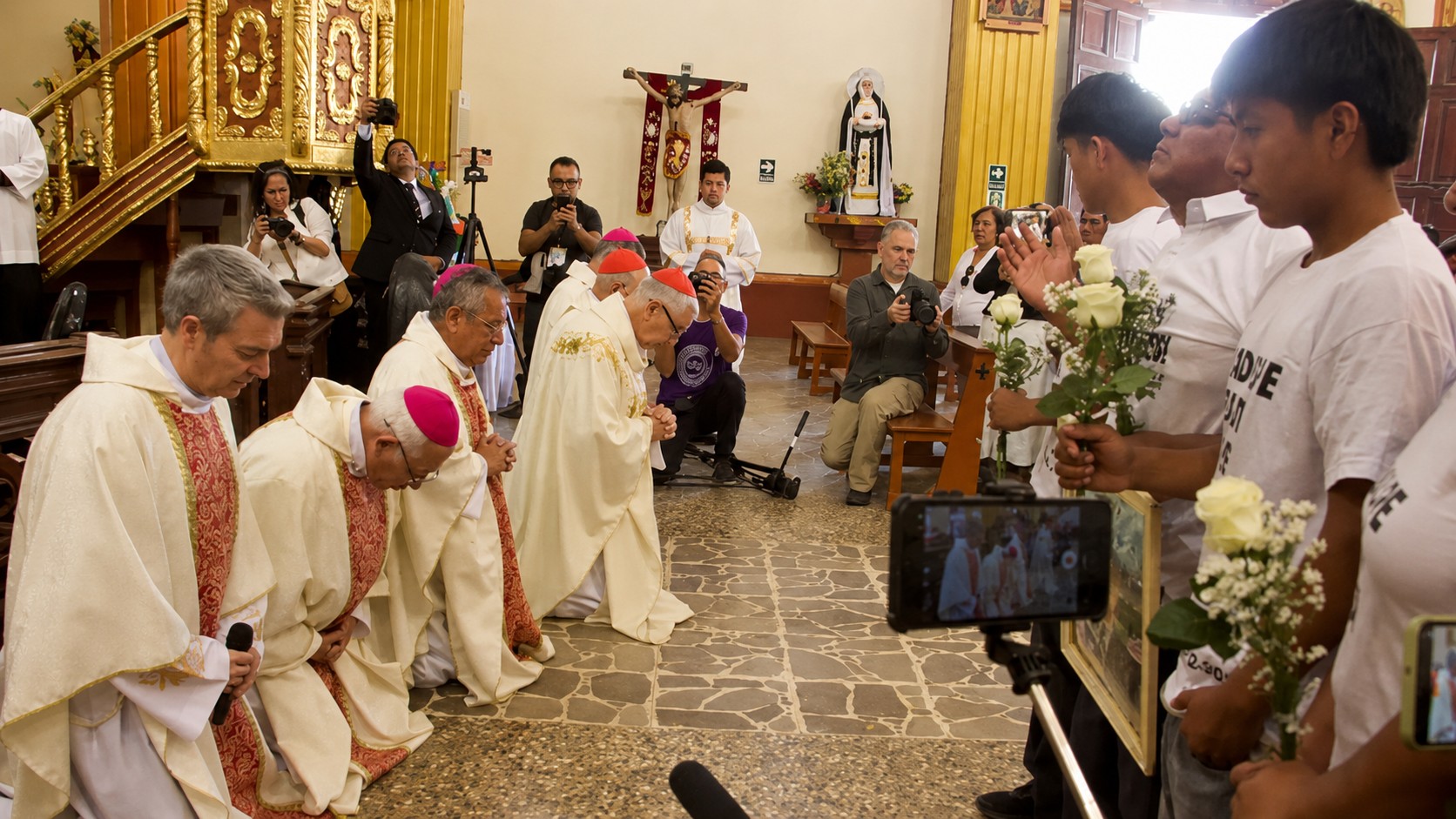
On your knees. With this unusual gesture, representatives of the Catholic Church asked for forgiveness at the end of May from the peasant communities inherited from the Tallán indigenous people, in Peru.
📱Bookmark g1 on Google and follow the main news of the day
For years, they have denounced the theft of their land and persecution by companies linked to the Sodalício de Vida Cristã, an ultra-conservative religious group founded in 1971 by Fernando Figari and which was suppressed by order of Pope Francis in April 2025.
The late pontiff's decision came after the investigation into allegations of sexual abuse and corruption that Sodalicio faced in the South American country.
"We are here to ask for forgiveness in the name of the Church. We arrived late, we should have arrived 20 years ago, and we are very sorry for that", said at the mass celebrated in the city of Catacaos, in northwestern Peru, Monsignor Jordi Bertomeu, the Vatican's special envoy for the phase of dissolution of the sodalitium in Peru.
Church representatives ask the San Juan Bautista de Catacaos community for forgiveness.
The homily was held at the request of the San Juan Bautista de Catacaos peasant community, after a listening process led by Monsignor Jordi Bertomeu.
The homily was held at the request of the San Juan Bautista de Catacaos peasant community, after a listening process led by Monsignor Jordi Bertomeu.
Courtesy of the Catacaos community via BBC
In conversation with BBC Mundo, the BBC's Spanish service, Bertomeu stated that it was an emotional moment in which he felt a historical weight on his shoulders.
"It was moving to be next to a representation of Peru's ecclesiastical authorities on their knees in front of such poor people, who never had institutional support from anyone," he stated.
"I felt sadness for having arrived twenty years late and, above all, shame for what people in the Church sometimes did and didn't want to admit... Sodalicio was an abusive structure that Francis suppressed for the sake of the victims. Leo 14 wants us to learn from the mistake, because this cannot happen again", he added.
Holding white flowers, members of the San Juan Bautista de Catacaos community witnessed the gesture that they classified as an act of justice.
"They are angels sent by God to hear the voices of our peasants, we have been shouting for help and justice", said Percy Maza, a member of the community who denounces having been persecuted and criminalized for defending his land.
"They did whatever they wanted with us because we are poor, we are from the countryside, we don't know the laws," said Paula Sandoval, 58 years old and mother of Percy Maza.
"That the priests, from so far away, came to ask us for forgiveness moved us. Thank God divine justice has arrived," he added.
Percy Meza gets emotional during the mass held in Catacaos.
Courtesy of the Catacaos community via BBC
A questionable transfer
Peasants, lawyers and journalists who investigated the case explained to BBC Mundo that the alleged seizure of land from the San Juan Bautista de Catacaos community dates back to 1998.
Its territorial rights, according to its members, derive from community recognitions from the time of the Viceroyalty of Peru (during the Spanish colonial period) and even pre-colonial ones.
They claim that the properties belonged to them collectively as heirs of the Tallán, considered one of the oldest indigenous peoples of northern Peru.
Because they did not have individual property titles, on December 18, 1998, an allegedly fraudulent transfer of these territories was registered in public records.
Residents denounced that, through a supposed assembly, the community had decided to transfer almost 10 thousand hectares of their land in favor of 100 peasants.
The curious thing — they say — is that the peasants themselves were unaware of this assembly. The peasant community of Catacaos lives mainly from cattle breeding, beekeeping and agricultural cultivation.
Courtesy of the Catacaos community via BBC
When accessing the records and comparing them, they realized that several of the people who allegedly participated were dead at the time of the transfer or claimed not to have signed the minutes.
The land was transferred in subsequent years by these 100 peasants in the form of a capital contribution to the company Pampa Loma Vega, which successively transferred them to other companies, including the Asociación Civil San Juan Bautista, linked to the Sodalício de Vida Cristiana.
"At that time, no one linked everything that happened in Piura (where Catacaos is located) to the Sodalício. It was not known that there was such a clear link between economic and religious power", journalist Paola Ugaz, who investigated for years the economic links of the religious organization in Peru, tells BBC Mundo.
The Asociación Civil San Juan Bautista was founded by one of the historical leaders of Sodality in Peru and former archbishop of Piura, José Antonio Eguren, who would later be expelled from the organization by decision of the Vatican.
And, although Eguren resigned from the company's board when taking on ecclesiastical duties, those who know how the company operates assure that the religious movement continued to exert broad influence on its decisions.
Eguren denied in 2024 that he was "a character in a land trafficking plot in Piura".
Consulted by BBC Mundo after the Vatican's apology, the Asociación Civil San Juan Bautista (ACSJB) rejected having participated in any type of illicit transfer of these lands.
"Land acquisitions in the Catacaos region were carried out in 2012 through purchases from owners who appeared as legitimate holders in the Public Records, in accordance with the legal framework in force in Peru."
"These operations were carried out within the legal circuit, with registration traceability, and are part of a process of prior transfers between individuals", stated the company's spokesperson and lawyer, Percy García Cavero.
"ACSJB categorically rejects the accusations of land seizure. A narrative has been constructed around this case that seeks to attribute responsibilities to ACSJB without legal support or verification of the facts."
"This narrative was publicly promoted by Mr. Jordi Bertomeu, despite ACSJB having responded expressly, documented and successively to these imputations in our communications since 2024," added the company.
The tipping point
The transfer of land in 1998 had no tangible impact on the communities.
But that changed in December 2011.
That month, peasants say they were surprised to see several groups of strangers installing fences on land they considered theirs.
Carlos Rodríguez, who provided legal advice to the Catacaos community from the Human Rights Coordination, stated that in response to this, the locals "grouped together and tore down the fence."
But the outsiders raised it again. "And when the groups realized this and confronted them, the response they received was gunshots," says Rodríguez.
It is in this incident that the death of Guadalupe Zapata Sosa was reported.
His wife was one of those present at the mass on May 23, in Catacaos. She attended with her two children.
Zapata was recognized by the Vatican as one of the "indigenous leaders who died after actively opposing land trafficking linked to Sodality companies", as stated in the statement released after the homily on its official press website.
There are still no definitive court rulings to prove this.
Fiorella Martínez (second from right) has been asking for justice for her husband's death for years.
Courtesy of the Catacaos community via BBC
'Don't let them steal your land'
The recent kneeling apology continued the message that Pope Francis conveyed in April 2024 to the community of Catacaos. "I know what happened to you. Defend the land, don't let them steal it," said the pontiff at the time.
A year earlier, the community had reported to Monsignor Bertomeu that companies linked to Sodalício were persecuting them.
The decision to dissolve the Sodality of Christian Life in 2025 was based by the Vatican, among other reasons, on alleged abuse in the administration of ecclesiastical assets, abuse of authority and cover-up of crimes.
Bertomeu states that, after two years of investigations, "the suspicion arose in the Vatican, based on the analysis of the economic documentation that Sodalício himself sent us, that this group had operated behind a façade legal structure, making economic decisions through intermediaries or front men."
Journalist Paula Ugaz explains that, according to her investigations, Sodalício implemented a sophisticated mechanism to get rich in Peru.
"They are like a large holding company that has profitable companies such as real estate companies, construction companies and agro-export companies and, at the same time, non-profit companies such as universities, schools and cemeteries. But between them they do business with each other", says the reporter.
And he adds that the religious movement took advantage of the agreement that exempted it from paying taxes to increase its gains in triangular operations. This was also denied by companies linked to Sodalício.
Percy Maza, right, talks with the Archbishop of Lima, Carlos Castillo Mattasoglio.
Courtesy of the Catacaos community via BBC
The judicial dimension
According to the Human Rights Coordination, in 2022 all cases against the peasants of Catacaos for trying to recover their land were archived.
But in May 2026 the communities suffered a legal setback.
The Peruvian court rejected an action for constitutional protection, a judicial mechanism designed to protect fundamental rights when they are violated.
The action sought, among other measures, the restitution of almost 10 thousand hectares that would have been taken.
In its decision, the 5th Civil Court of Piura declared the action unfounded in its initial analysis. The decision was appealed, but the 2nd Civil Chamber of Piura confirmed the sentence.
According to the peasants' defense, the Court justified its decision by stating that the case is related to an "alleged illegal act by peasants in collusion with a private company", thus being a controversy of "legal and not constitutional relevance".
But Carlos Rodríguez states that the civil route is not an alternative, as crimes in this context would be prescribed.
"What is alleged in the constitutional protection action is that this is an indigenous community and, as such, has constitutional protection and also under Convention 169 of the ILO [International Labor Organization], which guarantees that indigenous peoples are consulted for the transfer of their territories", he adds.
Recently, the San Juan Bautista de Catacaos Community was incorporated into the Indigenous Peoples Database of the Peruvian Ministry of Culture.
Church in Peru.
GETTY IMAGES via BBC
Now, say the locals, all they can do is appeal to the country's Constitutional Court, an instance in which they also do not place much hope.
For Ugaz — who was also sued by the Sodalício leadership after publishing, together with journalist Pedro Salinas, the book in which they revealed the abuses of power and sexual abuses committed by its members, Mitad monjes, mitad soldiers (Half monks, half soldiers, in literal translation) —, the Peruvian justice system failed the victims in this case.
"The commercial, economic and political power of Sodalício is more alive than ever, despite having been suppressed by the Catholic Church", he says.
Bertomeu agreed that Peruvian justice must do more.
"We detected a country with a serious institutional crisis, and this means that Catacaos' complaint, as well as that of other original peoples, may have signs of reality. The vulnerability of original communities in the face of the greed of some businesspeople should be more considered by Peru's political and judicial authorities", he stated.
BBC Mundo contacted both the Peruvian Public Ministry and the Judiciary to ask for a version of the communities' accusations in this case. As of the publication of this article, there has still been no response.
If they do not obtain a favorable verdict in the cases still pending, the families say they are considering appealing to international organizations.
But for now, they are left with the Vatican's apology and await a possible visit by Pope Leo the 14th to Peru at the end of this year.
As bishop of Chiclayo and, particularly, as prefect of the Dicastery for Bishops, the current Pope Leo 14 closely followed the Sodalicio case and played an important role in the Holy See's subsequent intervention.
EPA/Shutterstock via BBC
The Vatican promised them a path of reparation that was not only symbolic but also economic.
Bertomeu explained that the liquidation of the economic assets that the Sodalício owned is still pending, with which the Holy See seeks to compensate the victims who presented their claims.
"With Sodalício's assets, it is necessary to repair its victims, because they were the ones who caused the damage," he stated.
🗞️ 3 sources covered this story
The kneeling apology that the Vatican made to people in Peru: 'They did what they wanted with us because we are poor'
BBC
The kneeling apology that the Vatican made to people in Peru: 'They did what they wanted with us because we are poor'
BBC BrasilElections in Peru: Understand the vote review process that is happening now
CNN Brasil📰 Related Articles

Vinícius Júnior admits Brazil’s poor performance: ‘We need to improve’
CartaCapital
Futsal player suspected of ejaculating on a woman on the subway has his arrest converted into preventative arrest in BA
G1 Globo
In-game ads spark complaints about "Americanization"
Observador
'Holland B'? Only one player from Curaçao, a World Cup debutant, was not born in the European country; understand
G1 Globo
Rádio Nacional premieres 90-episode documentary about the 90th anniversary
Agência Brasil