


Hexa probability: what is the chance of Brazil being champion? Mathematics may have the answer
⚡ Quick Summary
What is the probability of Brazil taking the hexa? There are many factors that, together, result in a world champion team.
What is the probability of Brazil taking the hexa?
There are many factors that, together, result in a world champion team. Chemistry, individual quality and, why not, a bit of luck, are essential.
But it is inevitable that, with Brazil's debut in the 2026 World Cup next Saturday (13), the same question as in every World Cup since 2002 will be repeated: what are our chances of winning the sixth?
The most pessimistic can say that it is low, that the national team's football has not been the same for some time. On the other hand, those who prefer to see the glass as half full can remember that sport can always surprise us and we do have real chances of winning.
Mathematics, impartial and oblivious to the fans' feelings, has a more precise answer to this question: the probability of Brazil winning the 2026 World Cup is 9.14%.
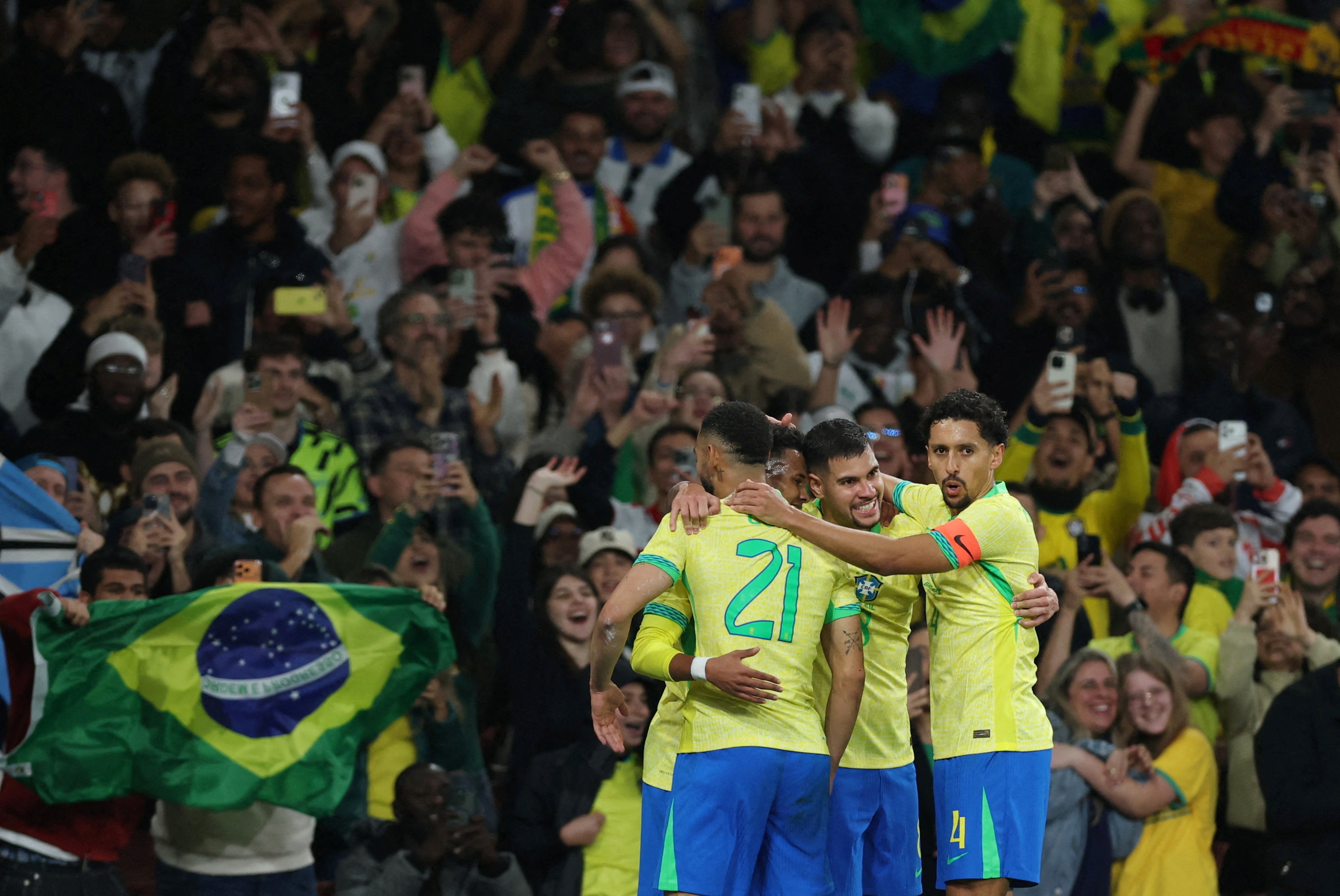
Brazilian team wins friendly against Senegal
Isabel Infantes/Reuters
➡️The data comes from Previsão Esportiva, a group made up of researchers and university professors in the areas of Mathematics and Computing that calculates, for each World Cup, the chances of the teams being champions.
It may seem very little, but mathematicians guarantee that, despite being low, the percentage still leaves the country among the top 5 favorites in the competition. (see ranking below)
Favorites to win the World Cup.
Juan Silva/Arte g1
And anyone who thinks that, because it is an exact science, the equation to achieve this result is simple is mistaken.
This is because the account does not simply consider the numerical chances, as if calculating this probability were a mere school mathematics problem, which assumes that all selections are on an equal footing. (understand below)
The simulation is statistical and involves thousands of repetitions of matches – the World Cup repeated a million times, to be more precise.
Ricardo Rocha, professor of Statistics and Artificial Intelligence at the Department of Statistics at UFBA and one of the coordinators of Previsão Esportiva, explains that the probability of a team being champion is based on the frequency with which the result occurs in these simulations.
"If all teams were equal, we would divide the 100% probability among the 48 nations, which would give an average of 2% chance for each one. But, in reality, this calculation involves many other factors that make the favorite have a 14% chance of winning", compares the professor.
Biceps femoris injury: understand the problem that took Militão out of the World Cup
The winning sum
As pointed out by the professor, the attempt to quantify the path of the teams in the competition involves many aspects. This is because the group understands that the reality is that teams are not equal and do not really have the same chances.
📊Therefore, the following factors are taken into account in simulations:
FIFA Ranking - official institutional score for each team.
ELO Ranking - measures current competitive strength based on international results.
Market value - sum of the market value of all players called up.
Current moment - variation of the selection in the ELO ranking over the last year.
History in the competition - how each team has historically performed in the World Cup.
Host factor - this is the well-known home factor, the positive influence of the fans in favor. Teams that will play in their home country receive a small strength bonus for this reason.
Francisco Louzada, professor at the Institute of Mathematical and Computer Sciences at USP in São Carlos and also coordinator of Previsão Esportiva, explains that these variables make the calculation more real, and not simply a theoretical probability.
"Brazil, for example, enters the tournament with a 'loaded' probability due to its historical and technical performance, as is the case with other even more favorite teams, such as France and England", he analyzes.
Few favorites
Largely because several factors are taken into consideration, favoritism for the title is concentrated in a very select list. In addition to the favorites, the group mapped out the teams that could surprise, by level of strength, considering all the variables used in the prediction. See below:
Strength of each selection.
Juan Silva/Arte g1
Ricardo also highlights that the top 10 has almost 80% of the chance of being champion, which exposes the inequality between the teams and the difficulty of the competition.
"The World Cup is a very difficult championship even for the favorites. Playing well only gives you the chance to compete against the other favorites", comments the professor.
Can mathematics predict the champion?
Although simulations can estimate the probability of a team winning, experts are categorical in stating that mathematical models do not predict the future.
Louzada states that, in football, accuracy rarely exceeds 60% to 70% due to the nature of the sport – especially because it involves few goals and has a high impact of chance.
"In football, chance has a disproportionate weight when compared to sports like basketball or volleyball, mainly due to the scarcity of goals. As the score is low, a single and random event has enough power to decide the fate of a team", compares the professor.
Rocha also reinforces that the unpredictability of the sport makes any prediction much more difficult.
"Of all sports, football is one of the most difficult to predict. No team is so weak as to be certain of losing or so strong as to guarantee victory, so anything can happen", he comments.
As the games go on and the teams advance, the group will redo the simulations, fixing the results that have already materialized. This process tends to make predictions more accurate for the following phases.
Despite this, as it is a short championship, there is not enough time for luck and bad luck to balance out throughout the rounds and the average results to help the statistics.
"Chance plays a central role: an individual error, a fortuitous deviation or an unlucky move can eliminate the best team in the world, making the tournament much more unpredictable", analyzes Louzada.
🗞️ 2 sources covered this story

📰 Related Articles

Brazil's debut in the World Cup this Saturday changes services in DF; see what works and where to watch
G1 Globo
From Neymar to Wesley: understand the injuries that took Brazil's players out of the 2026 World Cup
G1 Globo
Brazil debuts in the World Cup with a game in the United States; see all the national team's games
G1 Globo
US player is the first Harvard graduate to participate in a World Cup; remember other graduates
G1 Globo
World Cup in condominiums: see what can and cannot be done
G1 Globo