


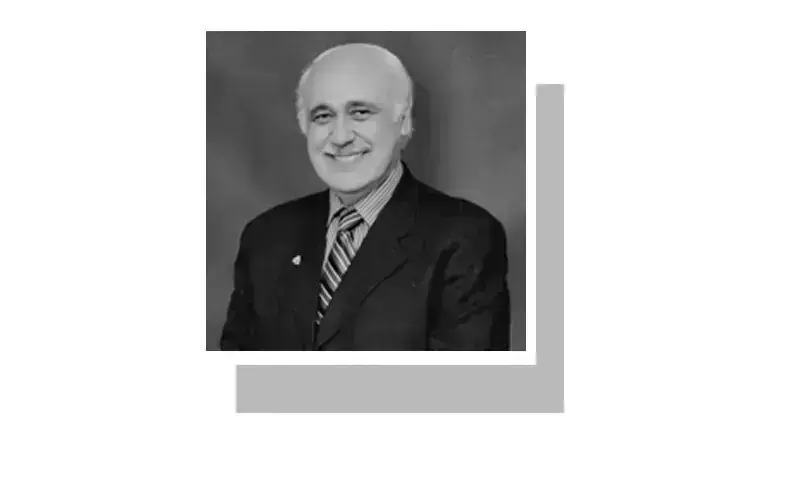
100, not out…
⚡ Quick Summary
It is a tribute to someone who is completing the first 100 years of a crowded, productive life. Syed Babar Ali was born on June 30, 1926.
THIS is not an obituary. Far from it. It is a tribute to someone who is completing the first 100 years of a crowded, productive life.
Syed Babar Ali was born on June 30, 1926. For the past few weeks, numerous relatives, friends, business associates and educationists have joined in celebrating his centenary. Eleven years ago, in 2015, he recounted his life in a published memoir Learning from Others. He compressed 89 years of his life into 237 succinct pages.
How does one compact 100 years of his life into 800 words? Yet, perhaps that is what he would wish — to have his life set down on a single sheet of paper. Every Pakistani — the living and the yet unborn — should read this memoir, if they wish to understand who was who, who did what and when, and how a single person has beneficially affected the lives of millions of us Pakistanis.
Syed Babar Ali was born into money. His father Syed Maratib Ali had a flourishing business in Ferozepur and post-1947 in Lahore. That enabled Babar to obtain the best education money could buy — Aitchison College, then Government College in Lahore, University of Michigan in the US, and in time Harvard Business School.
Could it have been the early slur of being “a contractor’s son” at the elitist ‘Chiefs’ College that spurred him to achieve beyond the creditable? Was it being the youngest of four brothers that drove him to seek a separate path for himself in business? Was it the blessings of his parents — particularly his mother the formidable Syeda Mubarik Begum — that tapped him for greatness? All three certainly, and more.
Babar Ali’s life runs parallel to the history of Pakistan. He belonged to an age when industrialisation and self-reliance were a national mission. He brought the Swedish Rausing group to Lahore where they established Packages Limited. His friendship with Ruben Rausing and his sons Hans and Gad spawned a number of profitable joint ventures like TetraPak.
With great wealth comes beneficence.
Faced with the spectre of Zulfikar Ali Bhutto’s blunderbuss nationalisation of the 1970s, Babar Ali agreed to help the subsequent rationalisation by heading the National Fertiliser Corporation of Pakistan (NFC), the second largest corporation after the Pakistan Steel Mills. Between 1974 and 1977, he established three large fertiliser complexes — Pak-Arab Fertiliser expansion in Multan, the grassroots Pak-Saudi Fertilisers in Mirpur Mathelo and the Pak-China plant in Haripur Hazara.
To run them, he set up a training institute at Daudkhel. To handle the huge volume of fertilisers being produced daily for a seasonal offtake, he envisaged the establishment of intermediate storages and a marketing network across four provinces.
In 1977, Babar Ali returned to the private sector, where he applied his talents to social imperatives like the environment and education. He worked closely with and later succeeded Prince Philip as president WWF International. He established the Ali Institute of Education for the training of teachers, and in 1985 he obtained a charter to establish Lums. Over the past 40 years, Lums has provided a generation of managers and successful entrepreneurs who have become the ‘steel frame’ of organisations here and abroad.
With great power comes great responsibility; with great wealth comes beneficence. Through the Babar Ali Foundation, he has amongst other benefactions endowed scholarships at Lums, established the Naqsh School of Art in his ancestral haveli, and at the seedling level, schools for underprivileged children in Syedanwala village outside Lahore.
Mr Babar Ali has spoken frequently of ‘learning from others’. For him, every day is a classroom from which he emerges with newer insights, afresh with ideas. Visiting the milk cooperatives in Indian Gujarat, he felt inspired to develop Pakistan’s huge but unorganised milk industry. [Pakistan is the world’s 5th largest milk producer, with production of over 65 million tons annually.] He filled this lacuna through a joint venture with Nestlé Milkpak to provide long-life milk in germ-free cartons.
Syed Babar Ali and I worked together closely in the NFC. I recall a meeting in Islamabad to decide on the Pak-Saudi project. The government committee held one opinion, Babar sahib another. “What happens if the plant goes wrong?” they asked.
Babar sahib replied: “You can have my head!” I whispered to him: “You may think your head is worth $200 million. The government clearly does not.” Babar sahib prevailed. The rest is fertiliser history.
Syed Babar Ali’s contribution to Pakistan is worth multiples of $200m. He once asked me after his brief three-month tenure as interim finance minister in 1993: “Did I achieve anything?” I reassured him: “You showed how it should be done.”
His long life is a lesson in how things should and can be done.
The writer is an author.
www.fsaijazuddin.pk
Published in Dawn, June 11th, 2026
📰 Related Articles

Fake FG task force stole 9km of pipelines – NNPC
Punch Nigeria
Army restores calm in C’River after Cameroonian troops’ border incursion
Punch Nigeria
Many European Companies Want to Return to Russian Market - Russia's Special Envoy
Sputnik International
Want a creaseless wide-foldable? An Android flagship option could be on the way
Android Authority
Microsoft's Xbox plans for major layoffs next month: Report
The Hindu