Who will win the World Cup? platform created by statisticians calculates title chances; understand
⚡ Quick Summary
Statisticians calculate selections with the most chances Brazilians are in the mood for the World Cup and are eager to follow the performance of the only five-time world champion team, so far, in the next matches.
Who can win the Cup? Statisticians calculate selections with the most chances
Brazilians are in the mood for the World Cup and are eager to follow the performance of the only five-time world champion team, so far, in the next matches. The biggest event in world football mobilizes fans, arousing curiosity as to who will be the great champion.
Which countries are most likely to take the title? And those who have fewer possibilities? An interactive 'Sports Forecasting' platform made by statisticians from five universities, including the University of São Paulo (USP) and the Federal University of São Carlos (UFSCar), and one company predicts the results of all games.
📱 Follow g1 São Carlos and Araraquara on Instagram
The Sports Forecast indicates that Brazil is among the 10th countries most likely to win the World Cup, but recently, the Quaest survey showed that 56% of the population does not believe in the Brazilian title in 2026. (see below for the complete list)
According to the survey, 35% believe in hexa. Another 9% did not know or did not want to answer. Despite the majority not believing in Brazil's victory, the survey shows an increase in optimism compared to April, when the previous round was held.
Vini Jr's individual play guaranteed Brazil a draw in the debut
Getty Images
Methods used 📝
Both models, Bayesian and power, use statistical methods to estimate how many goals each team is likely to score in a match, but the main difference between them is in the information used to make the predictions.
Bayesian model: combines objective indicators, such as the FIFA ranking score, and subjective indicators, such as experts' guesses about the scores of the games to be played.
Strength model: calculates the potential of each team exclusively based on objective indicators, such as the FIFA ranking, Elo ranking, recent performance of the team, history in World Cups, host status and market value of the squad.
🏆 10 countries with the most chances of winning *
According to the Bayesian edition - alternative probabilistic estimates using advanced Bayesian modeling:
Spain
France
Argentina
Germany
Portugal
Brazil
England
Belgium
Colombia
Netherlands
Considering the strength model, which are estimates based on the historical FIFA Elo ranking and classic strength simulation:
France
England
Spain
Brazil
Argentina
Portugal
Germany
Netherlands
Belgium
Switzerland
More news from the region:
HEALTH: New outpatient clinic will speed up cancer treatment in Santa Casa in the interior of SP
EDUCATION: Unesp students on strike protest during Tarcísio's visit to a hospital in the interior of SP
INVESTIGATION: Mother of missing pilot takes DNA test to find out if decapitated body is her son's
Brazil team posed for game against Morocco
Jeenah Moon/Reuters
😢 10 countries with the least chances of winning *
According to the Bayesian edition - alternative probabilistic estimates using advanced Bayesian modeling:
Curacao
Iraq
Haiti
Jordan
Cape Verde
Qatar
Panama
New Zealand
Uzbekistan
Tunisia
Considering the strength model, which are estimates based on the historical FIFA Elo ranking and classic strength simulation:
Qatar
Haiti
South Africa
Curacao
Cape Verde
New Zealand
Iraq
Jordan
Uzbekistan
Tunisia
*The above predictions were made before the start of the World Cup. However, the models available through Sports Forecasting are dynamic and, as games take place, the real results are inserted into the system, updating the probabilities. SEE UPDATES.
Sports Forecast Project 🔮
Sports Forecast website
Reproduction
Francisco Louzada, professor at the Institute of Mathematical and Computer Sciences (ICMC) at the University of São Paulo (USP), in São Carlos (SP), explained that the project was consolidated in the 2010 World Cup, although researchers had already been carrying out studies since the 2006 World Cup. "What has changed drastically since then is the power of our structure. If data is the fuel, today much richer and more detailed, and computers are the engine, now infinitely faster, our statistical modeling is the GPS that guides all of this", he stated.
Louzada said that in 2010 the team worked with the equivalent of a paper map, which was useful but static. Now, they operate with an intelligent GPS that recalculates the route for each game, learning from what happens at each stage to show the most likely path to the title.
"This evolution is vital for the 2026 World Cup, as the new 48-team format required a total recalibration of our route. What remains unchanged is our essence: combining academic rigor with the national passion for football," he said.
utebol - 2026 FIFA World Cup - Group E - Germany x Curaçao - Houston Stadium, Houston, Texas, USA - June 14, 2026.
Reuters
How do the calculations work? 🧮
According to Louzada, algorithms based on Bayesian Inference and Monte Carlo Simulations are used.
"The model does not try to 'guess' the score, it works by studying the attack and defense strength of each team to calculate the chances. Furthermore, we have the simulation structure. We run the entire tournament thousands of times on the computer. If Brazil wins the World Cup in 150 thousand out of 1 million simulations, we say that it has a 15% chance of winning the title", he said.
Louzada prefers the Bayesian methodology, which works with an objective approach to data and history, and a subjective approach with the opinion of experts.
"It allows you to combine these two sources of information. It is a structure that 'learns' from the tournament: we start with an initial belief and update it as new data appears, dealing much better with the uncertainties of a World Cup", he explained.
The project is a collaboration between researchers from UFBA, USP, UFSCar, UFRJ, UFMT and Neoma Business School (France). In addition to Louzada, the team includes Adriano Kamimura Suzuki, Diego Nascimento, Fernando Moraes, Lilia Costa, Nailton Santos and Paulo Henrique Ferreira, among others.
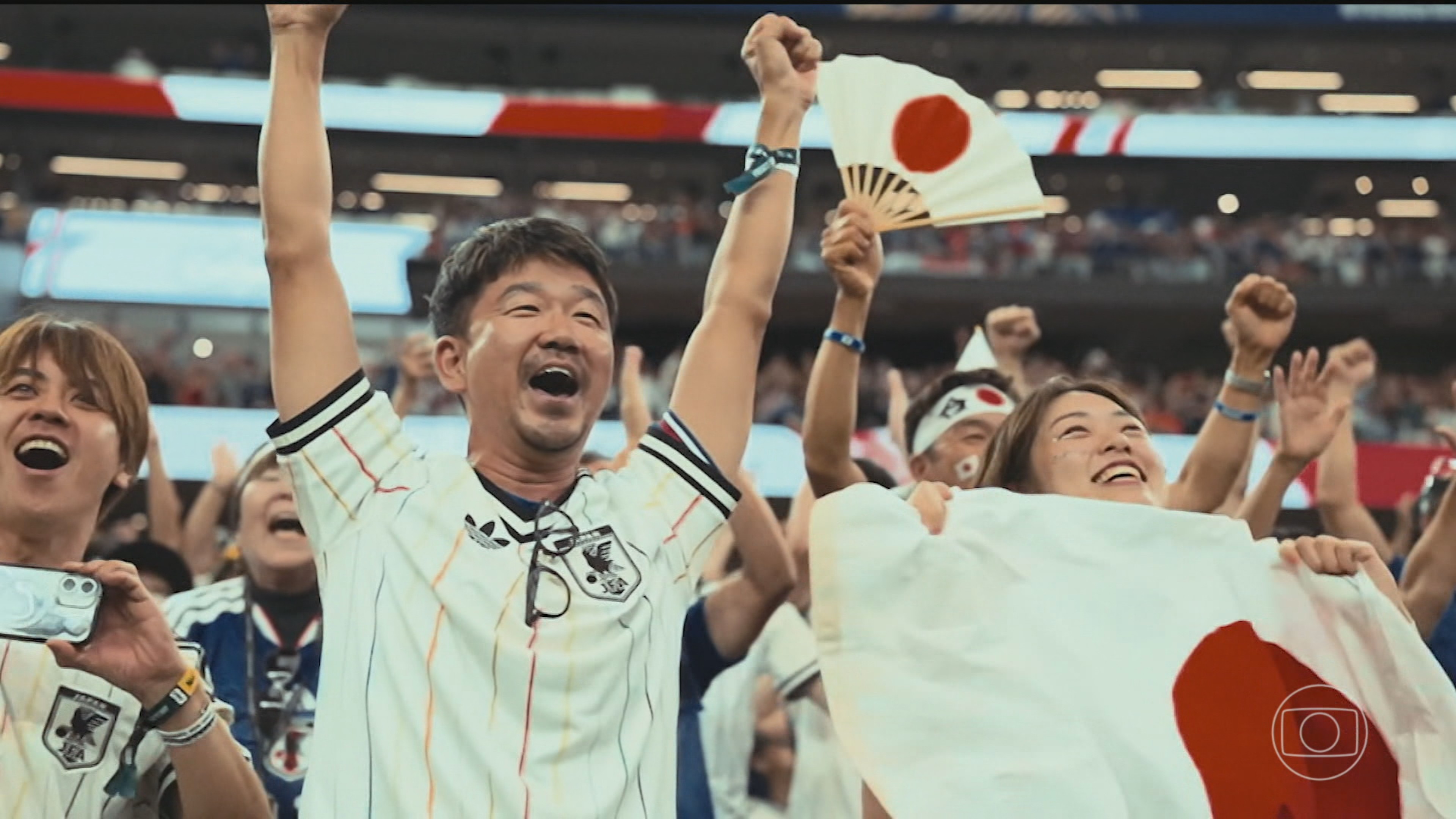
Netherlands x Japan - World Cup
Reuters
Analysis of results 👀
According to Louzada, the results for this year's world tournament, before the start of the competition, showed that Spain, France, England and Portugal are among the favorite countries to win the World Cup. According to him, due to the depth of the squad and recent performance.
"Brazil appears in the elite squad, floating between 5th and 6th position together with Argentina. Notoriously, the first four enter the tournament with odds based on historical and technical performances, as is the case with other teams, such as Brazil, Argentina and Germany, for example, which appear with a slightly lower intensity", he said.
Spain national team
Reproduction
However, the professor highlighted that, during the championship, at each stage, with the original data on the results of the competition, in addition to the help of the modeling used in the project, the results increasingly come closer to the true champion teams.
"In statistics, 'hit' means that the events occurred within the predicted probabilities. In 2010, our model was awarded nationally for its accuracy. In the 2014, 2018 and 2022 World Cups, the champion was always among our four favorites", said Louzada.
World Cup ⚽
The 2026 World Cup started on June 11th. This edition is the first in history to be held in three countries — the United States, Mexico and Canada. In total, 16 cities will host tournament matches, the majority of which are in the USA.
Spanish fans pose for photos in front of a giant World Cup ball outside the stadium before the match
Claudia Greco/Reuters
REVIEW EPTV VIDEOS:
🗞️ 1 sources covered this story

📰 Related Articles

PSD, Chega and PS respond about FPF invitations (and beyond)
Observador
Call-up, injury and exams: Neymar completes a month away from the pitch
CNN Brasil
Films and series to better understand the World Cup host cities
G1 Globo
All roads lead to Houston
Observador
Pink football boots in the World Cup are about rainbows, tube TV and the brain's 'gimmick'; understand mystery
G1 Globo