Court overturns Nunes decree that allowed noisier works in SP
⚡ Quick Summary
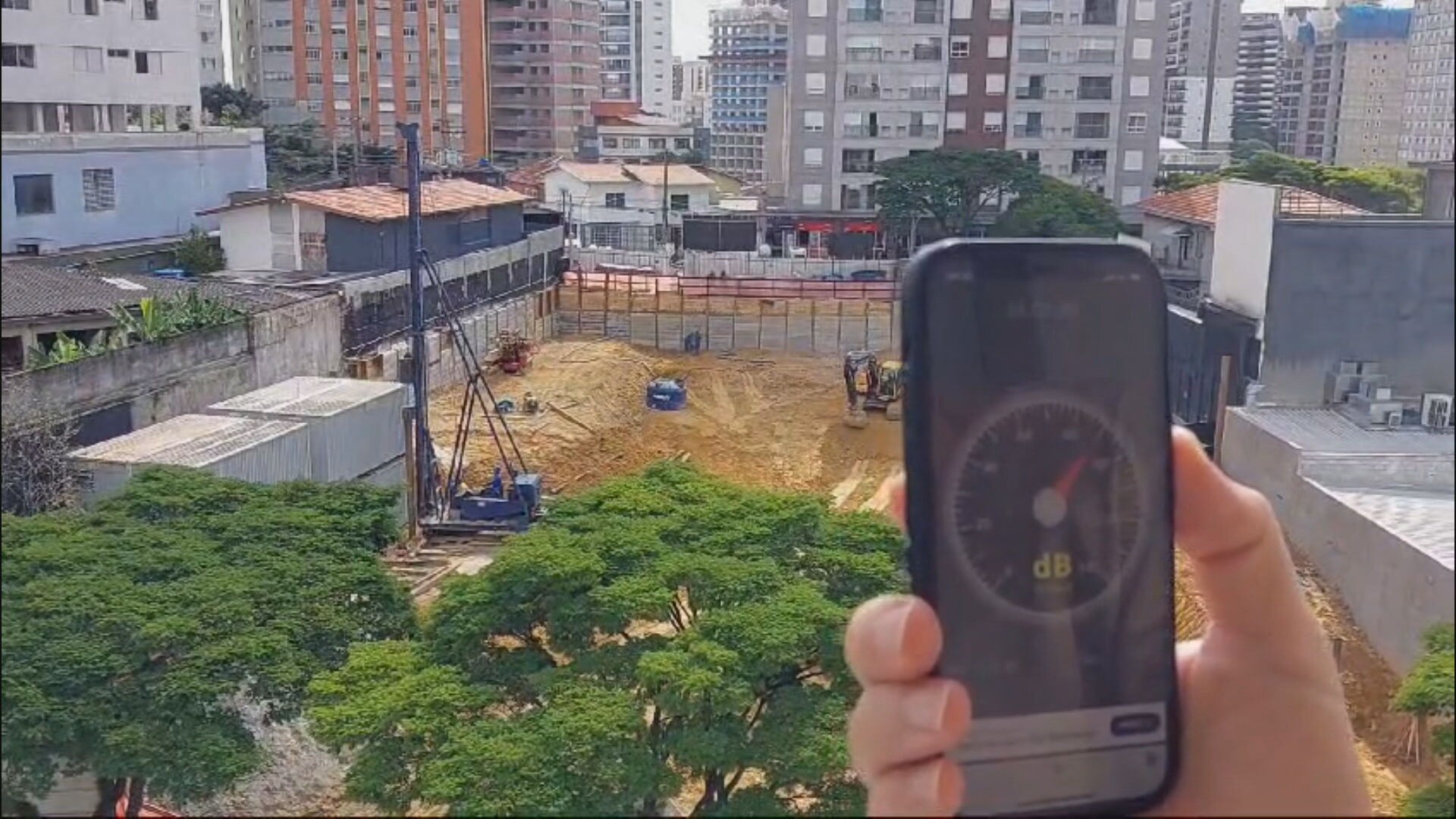
Resident measuring construction noise in front of the building she lives in, in the West Zone of SP Reproduction/Personal archive The Special Body of the Court of Justice of São Paulo (TJ-SP) judged decree 60.581/2021 to be unconstitutional, which made noise limits for civil construction works in the capital of São Paulo more lenient.
Resident measuring construction noise in front of the building she lives in, in the West Zone of SP
Reproduction/Personal archive
The Special Body of the Court of Justice of São Paulo (TJ-SP) judged decree 60.581/2021 to be unconstitutional, which made noise limits for civil construction works in the capital of São Paulo more lenient. The highest instance of the state Judiciary understood that the city hall exceeded its legislative competence by setting sound limits that were more permissive than those established by federal resolutions and national technical standards.
The action filed by the Public Ministry pointed to non-compliance with the federative pact and infringement of national guidelines on noise pollution, such as technical standards and resolutions of the National Environmental Council (Conama). The body, through the Attorney General's Office, argued that municipal competence to supplement federal laws cannot regress the level of environmental protection.
During the process, the administration of Mayor Ricardo Nunes (MDB) claimed that a regulatory decree should not be subject to direct unconstitutionality control, as it is secondary in nature and, in this case, complementary to the 2016 Zoning Law. According to the city hall, it would be impossible to monitor works in progress without the decree, as the previous regulation did not cover construction noise.
Noise complaints grow 35% in 2 years in São Paulo
The argument was rejected by judge Ademir Benedito, rapporteur of the action at the TJ-SP, and by the other members of the Special Body. The judges understood that the decree innovated in the legal system by setting limits and creating exceptions, being considered a rule of primary effect and being subject to constitutionality control.
"Therefore, the Decree's unconstitutionality is patent [...], insofar as it establishes maximum noise standards that are more degrading than those defined in federal standards, and, furthermore, exempts certain situations from established sound pressure levels, thus usurping the general legislative sphere of the Union in environmental matters, and violating the federative pact", says an excerpt from the ruling, published last Wednesday (10).
Judge Ademir Benedito highlighted that "nothing justifies that the local interest in environmental conservation is lower than that of other federative entities", and that the population of a megalopolis like São Paulo should not be subjected to more intense noise levels than those endured by inhabitants of other cities.
Buildings under construction in the city of São Paulo
Luiz Franco/g1
The questioned decree allowed the emission of noise of up to 85 decibels (dB) during the day and 59 dB at night by civil construction, while federal standards (such as NBR 10.151, from ABNT) provided for much stricter limits for residential areas: between 50 and 55 dB during the day and between 45 and 50 dB at night. The municipal rule also created a series of exceptions that completely exempt noise from some activities, such as earth moving and loading and unloading.
g1 asked São Paulo City Hall for a position on the TJ-SP decision, but did not receive a response until the last update of this report.
The mayor of São Paulo, Ricardo Nunes (MDB).
JFDiorio/Secom/Disclosure/PMSP
Project aims to transform overturned norms into law
A bill proposed by Nunes to change the rules of the Urban Silence Program (Psiu) reproduces part of the provisions overturned by the TJ-SP, such as noise limits for civil construction during the day and at night and exceptions for certain phases of work.
Although it was announced as tightening the inspection of noisy constructions, the proposal reduces the value of fines for repeat offenders and gives an extra chance before the city hall embargoes the work.
The project will be debated by the City Council this Monday (15) in a public hearing of the Urban, Metropolitan and Environmental Policy Commission, at 4 pm.
The discussion takes place amidst an increase in the population's calls to Psiu. Last year, the capital recorded a record number of noise complaints, with 50,000 records on channel 156.
📰 Related Articles

Lula x Flávio: how Catholics and evangelicals would vote in the 2nd round
CartaCapital
Man dies after being run over by car on Washington Luís Highway in the interior of SP
G1 Globo
iCities officially launches 3rd edition of Tomorrow.Blue Economy Niterói
G1 Globo
Man is found dead on the banks of Dutra in Lorena; police investigate suspected hit-and-run
G1 GloboPGR must give its opinion by Wednesday on Vorcaro's accusation and place of arrest
G1 Globo