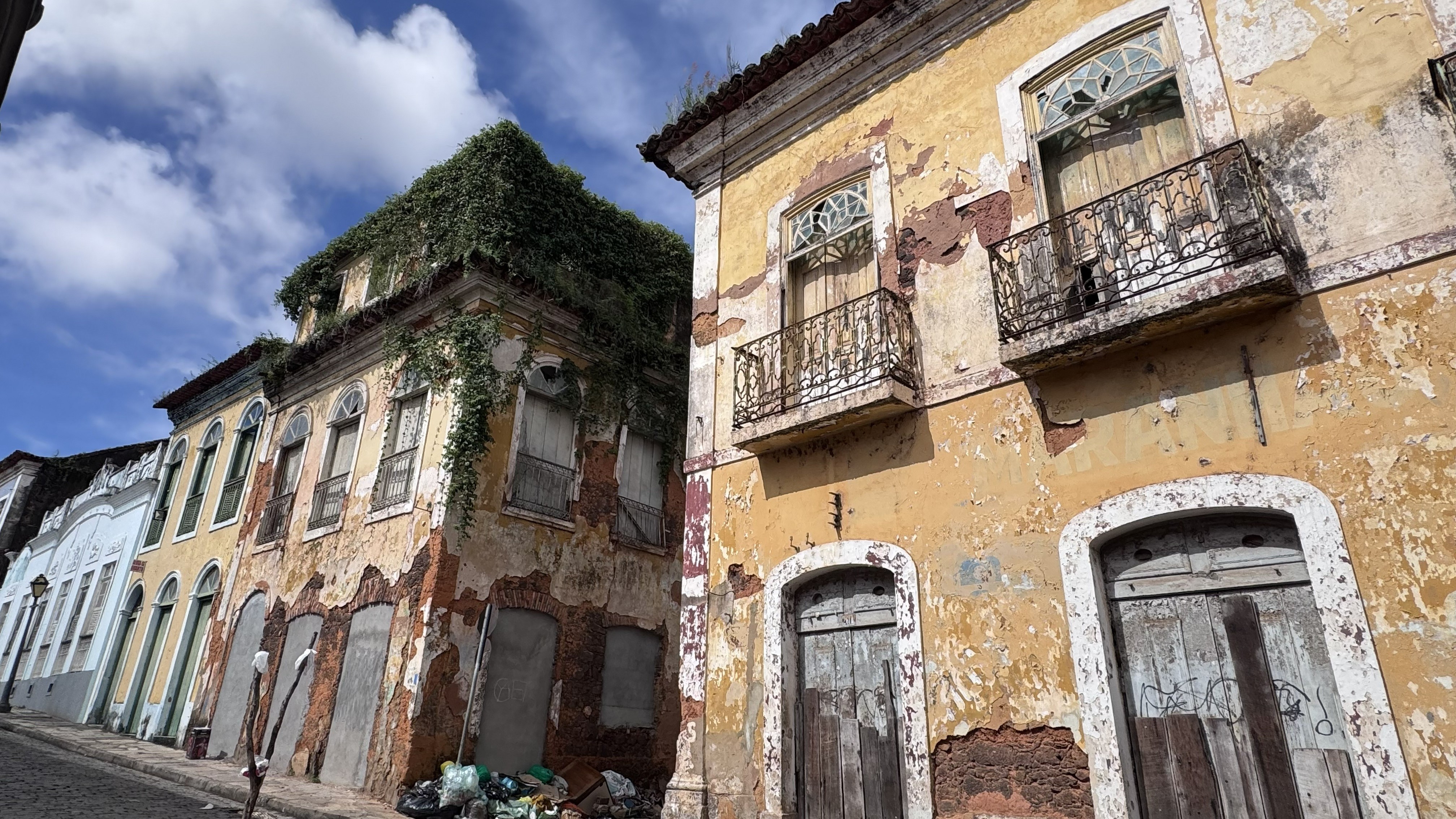
Historic Center of São Luís, a UNESCO heritage site, has 87 mansions at risk of collapsing
⚡ Quick Summary
Historic mansions in the center of São Luís are under threat In the Historic Center of São Luís, capital of Maranhão 📍, peeling facades, century-old tiles that come off and mansions supported by improvised supports reveal a scene of abandonment.
Historic mansions in the center of São Luís are under threat
In the Historic Center of São Luís, capital of Maranhão 📍, peeling facades, century-old tiles that come off and mansions supported by improvised supports reveal a scene of abandonment. The title of World Cultural Heritage, granted by UNESCO in 1997, has not been enough to protect the region, which is deteriorating at an accelerated pace.
Of the 144 properties monitored by Civil Defense, 87 are at critical risk of collapse and another 58 are at medium risk of property loss. In May, two mansions collapsed on Rua da Saúde.
📲 Click here and subscribe to the g1 Maranhão channel on WhatsApp
Experts interviewed by g1 warn that the combination of decades of lack of maintenance, absence of permanent public preservation policies, rainfall, high humidity and salinity threaten not only the thousands of mansions built between the 18th and 19th centuries, but also the international recognition that transformed São Luís into a world reference for historical heritage.
On the other hand, owners of the structures consider that, in addition to the costs, which are higher than those of a common renovation, historic houses depend on specialized design and bureaucratic steps for the works to be authorized. (read below)
As 90% of listed properties are private in the Historic Center of São Luís, the National Artistic and Historical Heritage Institute (Iphan) states that there is difficulty in holding people responsible for the lack of maintenance. Therefore, the issue was taken by the Federal Public Ministry (MPF) to the Court, where more than 80 actions trying to force the conservation of the mansions are being processed.
🧱The city's architecture has Portuguese influence. They conquered the city in the first half of the 17th century, the time of its foundation. The influence is visible in details such as tiles, as in colonial architecture. (see the x-ray in the infographic below)
The State Government announced in May that it will revitalize 22 historic properties in the capital with resources from the Federal Government. The package, however, does not cover properties flagged as most critical by Civil Defense. (understand below)
X-ray of the heritage of the Historic Center of São Luís
Art/g1
Civil Defense mapping has been carried out since 2018, through inspections of abandoned public and private properties in the Historic Center. The data is updated, mainly during the rainy season, between January and May. The last survey was carried out this year.
Private property, public property
Historic Center of São Luís has 87 mansions at risk of collapsing
The main responsibility for conserving and repairing heritage, even if listed, lies with the owners - according to the law. Iphan and other public bodies, such as Civil Defense or firefighters, are responsible for supervision, authorization of works and technical guidance.
For the owners of historic mansions in the Center of São Luís, the challenge of revitalization goes far beyond costs: there is a need for engineering projects to be previously approved by Iphan, and also spending on previous actions to stabilize the structures before starting a renovation.
Owner of two mansions, businessman Francisco Neto, explained what he had to do in the project to renovate his properties.
"The cost starts long before the renovation itself. It's in the surveys, projects and specialized consultancies. Another big challenge is reconciling historical preservation with the current requirements made by Iphan, related to security, accessibility, electrical and hydraulic installations and fire prevention. At the time these properties were built, none of this existed", explained the businessman.
Century-old mansions in the Historic Center of São Luís are undergoing a process of abandonment
Hillary Araújo and Jéssica Pinheiro/g1 MA
Francisco highlighted the complexity of restoring historic properties without compromising their original characteristics. The two mansions he acquired should be transformed into an inn and a restaurant.
"The challenge is great, but ruin cannot be the fate of properties that carry such an important part of the history of São Luís", he states.
The facades of the mansions in the Historic Center of São Luís are also the target of vandalism
Hillary Araújo and Jéssica Pinheiro/g1 MA
Impact on tourism and routine
Residents and tour guides are already feeling the impacts of the abandonment of mansions in the Historic Center. Actress, model and dancer Dandara Ferreira lives in the area and says she has seen plaster and tiles falling. According to her, the danger worsens during the rainy season, when infiltrations further weaken buildings.
"I have already stopped passing through some areas for fear of collapse, especially where the mansions have cracks and visibly damaged structures", reported the resident.
Multi-artist Rob Falcão, who has lived for eight years on Rua do Alecrim, close to Praça Deodoro, shares the same concern.
"There are many houses that are good enough to be renovated and brought back into use, you could live in them. Today they are houses that have no one and are being destroyed due to lack of care", he lamented.
The lack of conservation of centuries-old properties can be seen on the facade of buildings in the Historic Center of São Luís
Hillary Araújo and Jéssica Pinheiro/g1 MA
The degradation also affects the image of São Luís, according to those who work in the tourism sector. Guide Emanuelle Mesquita realizes that, while part of the public is enchanted by the architectural complex, another part questions the reason for the deterioration.
Emanuelle recalled the visit of a couple who were in the city in 2019 and returned in 2025 to spend their honeymoon. According to her, tourists expected to find improvements in the region, but were disappointed to see that mansions remained dilapidated and that cultural spaces that operated in these mansions are now closed.
She said that the structural risk also forces her to change the tourist itinerary, changing the stopping points of tourist groups to avoid areas that are visibly at risk.
"The situation of some mansions ends up directly impacting our work. But, even in the face of these challenges, we try to show tourists the grandeur of our Historic Center," he said.
Abandonment
Considered a World Heritage Site, the Historic Center of São Luís has dozens of mansions with serious structural problems
Hillary Araújo and Jéssica Pinheiro/g1 MA
The secular heritage of São Luís is continually deteriorating. There are properties propped up with improvised iron and wooden structures. The mansions have been losing windows, tiles and other original elements that make up the historical value of the architectural complex.
For experts, the loss of these characteristics compromises the criteria that guaranteed São Luís the title of World Cultural Heritage granted by Unesco.
Speaking to g1, historian Diogo Gualhardo, from Iphan, states that the lack of consistent preservation policies is one of the main risks for losing the title.
"The risk exists. We already have an example of a city that came close to losing this recognition, which was Olinda. At the time, because of neglect, UNESCO even considered withdrawing the title. And the loss of the title does not contribute to the preservation of the heritage. On the contrary, it could worsen the situation even further", he stated.
UNESCO and the Ministry of Tourism were contacted by g1 and did not return until the publication of this report to inform whether they were aware of the problem and were developing negotiations on the matter. São Luís City Hall also did not comment on the problem. History in ruins
Historic houses in São Luís are in ruins and face serious structural problems
Hillary Araújo and Jéssica Pinheiro/g1 MA
Founded in 1612 by the French and later colonized by the Portuguese, São Luís houses one of the most important colonial architectural collections in the country.
Historian Diogo Gualhardo explains that the mansions in Ludovicense, inspired by Portuguese architecture, have a difference in the adaptations of the buildings, made to withstand the humidity and heat, characteristics of the Maranhão climate.
The use of tiles in buildings, in addition to the aesthetic factor, was designed to protect the walls from humidity, help reduce heat absorption, and reduce the wear of the clay and mortar that covers the walls.
Today, the same Portuguese tiles that were previously used to help protect the structures of mansions are detached from the facades and disappear without any prospect of preservation.
Architect and researcher Igor Mendes Monteiro assesses that the capital's architectural complex is experiencing one of the most delicate moments in its history. He warns of the so-called "domino effect", caused by the proximity between historic properties.
"Every building that loses its roof has intensified its degradation due to the action of rain. Most mansions have semi-detached walls. When a property collapses, it can directly affect neighboring buildings, even those that are relatively well preserved", he said.
The historian points out the lack of an integrated plan between the municipal, state and federal governments to preserve the Historic Center. He defends policies that encourage the occupation of the historic center by different social profiles, including young people and new families, as a way of reactivating the region's economic and social dynamics.
“There is no point in restoring a property in isolation without thinking about the whole. It is necessary to bring the historic center into the 21st century, reconciling preservation with current urban life”, he argued.
He highlights that São Luís has a characteristic that increases conservation challenges: the size of its architectural collection, which is enormous.
Rua do Giz, among the most beautiful in the country, houses examples of the colonial collection that made São Luís a World Heritage Site.
Disclosure/Embratur
'Landscape rots'
On Rua do Giz, which is considered one of the 'most beautiful streets in Brazil', the scenery reveals the contrast between the past and the present. In front of Praça da Faustina, a historic mansion, abandoned for years, remains standing with the help of iron structures. The place is closed with siding.
Around the property, the phrase written in the middle of the landscape catches the attention of those passing by and summarizes the scene: “The landscape of this capital rots”. More than a record, the warning echoes as a denunciation of a process of deterioration that threatens to erase, little by little, the traces of a centuries-old history.
The Student House, formerly known as “Quinta”, located on Rua do Passeio, is also another example of the lack of maintenance. The building has not been renovated for around 20 years.
The same situation of abandonment and neglect of heritage is repeated in dozens of well-known streets in the area such as the streets of Palma, das Hortas, Celso Magalhães, Rio Branco, Senador João Pedro, de Santana, da Estrela and Afonso Pena, which have dozens of mansions monitored at risk of collapsing.
House located on a corner on Rua do Giz, one of the most beautiful in Brazil, stands the test of time amidst iron structures
Hillary Araújo and Jéssica Pinheiro/g1 MA
Other historic cities
When comparing São Luís with historical cities that maintain an architectural heritage such as Ouro Preto and Olinda, architect Igor Mendes Monteiro highlights that the difference is not only in the urban characteristics, but mainly in the volume of investments and the continuity of public preservation policies. Ouro Preto has consolidated, over decades, a strategy of valuing historical heritage associated with tourism and local economic development. Olinda has adopted policies that combine heritage preservation, occupation of historic spaces, cultural production and population education.
Ouro Preto has a vast architectural heritage and is a good example of preservation.
Ministry of Tourism/Disclosure
Olinda had its heritage restored after a process of abandonment similar to that of São Luís.
Eduardo Hanaza/Flicker Ministry of Tourism
Package of works
The Government of Maranhão announced on May 14 a package of works for the Historic Center of São Luís. The proposal envisages the revitalization of 22 historic properties, with renovation, restructuring and new uses for the buildings.
Part of the resources comes from the Federal Government, through the New PAC, which finances nine of the announced actions, in addition to state investments and partnerships with the private sector for the others.
However, the properties mentioned were not related, in the advertisement, to buildings monitored by Civil Defense in risk areas in the Historic Center. The State government explained that the choice met technical criteria, budget availability and feasibility of execution - especially considering that a large part of the properties at risk are private property. (read note below)
With more than 100 years of construction, historic mansions are in ruins in São Luís
Hillary Araújo and Jéssica Pinheiro/g1 MA
Among the interventions announced are:
Implementation of the Bumba Meu Boi Museum — Rua Portugal, nº 303;
Implementation of the New CACEM — Maranhão Performing Arts Center — Rua do Giz, nº 93;
Restoration of the Church of São João;
Implementation of the Technological Hub — Rua da Estrela, nº 585;
Restoration of the Church of Santana;
Renovation of Solar da Baronesa, with implementation of the Formando e Cozinhando project — Rua de Santo Antônio, nº 161;
Restoration of the facade and accessibility implementation of the Carmo Church;
Renovation of the new headquarters of the Maranhão Historical and Geographic Institute — Praça Antônio Lobo, nº 34.
According to the State Secretariat for Cities and Urban Development (Secid), the choice of properties to be restored also considered the physical conditions of the properties, the possibility of recovery and the planning of each responsible body.
The government highlighted that it is aware of the structural precariousness of part of the properties in the center of the capital, according to a survey by the State Civil Defense, but highlighted that a large part of these buildings are privately owned, whose renovation is the responsibility of the owners.
The State also informed that the Fire Department works to monitor and assess the risks of properties in the Historic Center in conjunction with municipal bodies.
The president of Iphan, Deyvesson Gusmão, informed that, since 2023, the Federal Government has allocated more than R$60 million to Maranhão for revitalization and restoration actions of cultural heritage.
Read the State Government’s note in full:
"The State Secretariat for the Cities of Maranhão (Secid) clarifies that the set of 22 actions announced by the State Government was structured based on technical criteria, budget availability and feasibility of execution, involving different state bodies responsible for the interventions, depending on the nature of each property and planned action.
The Secretariat is responsible for 13 of these actions. Among the planned initiatives, nine actions rely on resources from the New PAC, five are carried out with resources from the State Treasury and six properties were allocated to other institutions, which will assume responsibility for the works.
The definitions of interventions observe technical criteria, considering aspects such as physical conditions of the properties, feasibility of recovery, budget availability and execution planning of each responsible body. The objective is to guarantee planned, safe and compatible interventions with the complexity of each property. The actions are part of a gradual strategy of requalification and preservation of heritage, taking into account the technical specificities of each case.
Each work has an individual schedule, defined according to its technical and contractual specificities. The interventions are carried out within the deadlines stipulated in the contracts signed with the executing companies, observing the engineering, licensing and technical monitoring stages.
These interventions aim to preserve, restore and guarantee the structural safety of properties, reducing risks associated with the state of degradation of buildings. The State's work occurs in a planned manner, considering technical monitoring, maintenance and execution of priority works, according to identified needs.
In turn, the Maranhão Military Fire Department (CBMMA) works in collaboration with the competent municipal bodies, carrying out preventive actions, risk assessment and monitoring the structural safety of properties in the Historic Center and surrounding areas.
The inspections are the result of on-demand service and actions in support of other bodies. Among the main problems identified are infiltrations, humidity, degradation of wooden structures, lack of maintenance and inadequate renovations.
If irregularities are identified, notifications are issued to those responsible and the competent authorities, and the municipality is responsible for mapping the risks, providing assistance to the population and, in the event of non-compliance, taking the situation to court.
Currently, according to State Defense mapping, at least 70 properties in the region - under state and federal protection - present some structural precariousness. The properties are private and the owners are responsible for maintenance.
In relation to properties that are not part of the state list, the corporation notifies owners to remedy the identified problems. The reports resulting from these evaluations are sent to the competent bodies".
📰 Related Articles

Banned from the World Cup: fans of two teams are banned from entering the USA
G1 Globo
Qatari negotiators return to Iran to finalize agreement
Observador
Qatari negotiators travel to Tehran to finalize agreement between US and Iran
CNN Brasil
Increasingly anti-immigration, Europe will support children of immigrants at the World Cup
G1 Globo
Parintins Festival 2026: Commerce, economy and the impact of crafts on fashion and style
G1 Globo