'Paradox of the right': Flávio Bolsonaro loses strength, but rivals are unable to inherit anti-Lula votes, says director of Quaest
⚡ Quick Summary
What the June Quaest survey shows The new Quaest survey, released on Wednesday (10), exposes a paradox in the field of the Brazilian right, says Felipe Nunes, director of the consultancy.
What the June Quaest survey shows
The new Quaest survey, released on Wednesday (10), exposes a paradox in the field of the Brazilian right, says Felipe Nunes, director of the consultancy.
Although Senator Flávio Bolsonaro (PL) faces wear and tear and sees President Lula (PT) expand his advantage in the presidential race, no other name on the right or center-right has been able to take advantage of the loss of strength of Bolsonaro to grow consistently.
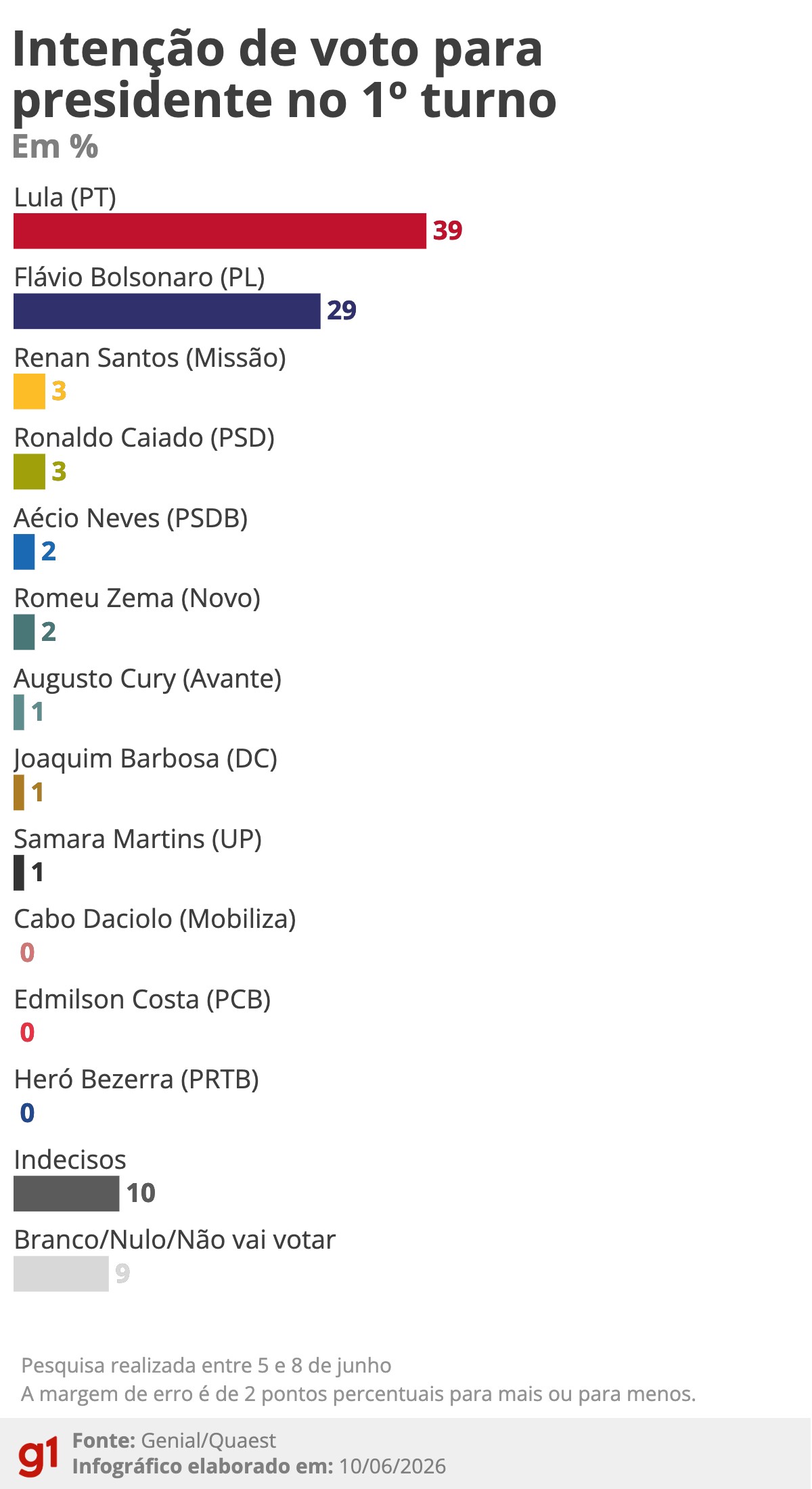
The June survey shows that the presidential race remains polarized and that the dispute between the names trying to establish a third way alternative is tangled. Lula leads with 39% of voting intentions in the 1st round simulation, while Flávio appears in second place, with 29%. The distance between the two is ten percentage points.
Quaest: Voting intention for president in the 1st round (June/2026)
Art/g1
At the same time, candidates who could be alternatives to polarization remain far behind in the polls. Together, the names of the right and center-right outside Bolsonarism reach only 12% of voting intentions.
The research brings some changes to this group. Renan Santos (Missão) has 3%, tied with Ronaldo Caiado (PSD) and ahead of Romeu Zema (Novo). Aécio Neves (PSDB), tested for the first time, records 2%, the same percentage as Zema. As the margin of error is two percentage points, everyone is technically tied.
The June survey is the first by Quaest after the revelation of messages in which Flávio Bolsonaro asks jailed banker Daniel Vorcaro for money to finance the film "Dark Horse", about former president Jair Bolsonaro.
According to Felipe Nunes, the scenario that allowed Lula to gain an advantage in the race is the result of a combination of three factors:
the negative repercussion of Flávio's role in the Banco Master scandal — considered a mistake by 65% of those interviewed and seen by 58% as a possible indication of irregular involvement;
the political effects of the measures announced by the United States after the senator's meeting with Donald Trump, which also impacted Brazil;
and the improvement in the perception of the Lula government, driven by economic measures such as the expansion of the Income Tax exemption range and the Desenrola program.
Lula, Flávio Bolsonaro, Renan Santos, Caiado and Zema
Disclosure and reproduction
According to the director of Quaest, the numbers show that Flávio continues to be the main name of the opposition, but has not yet managed to consolidate an undisputed leadership in the conservative field.
"Flávio is having difficulty doing this. Research shows that he continues to be the main name on the right, but he has not managed to transform this into hegemony within the opposition camp", he states.
According to Nunes, there are two factors that help explain the scenario.
"The first of these reasons is that he carries the surname Bolsonaro, which gives him a floor, but also imposes a ceiling on him. The second is that the other names on the right still do not have enough national strength or knowledge to replace him", he says.
In the opinion of the director of Quaest, the result is an impasse.
"What the research shows is that the right today is experiencing a paradox. Flávio is weakened to unify, but the others are too weak to occupy this space", he summarizes.
Quaest releases new poll with voting intentions for president
Data by segments of the electorate reinforce this diagnosis. Among the Bolsonarists, Flávio practically alone inherits the political capital of former president Jair Bolsonaro and concentrates 94% of voting intentions.
Among right-wing voters who do not identify with Bolsonarism, the scenario is more fragmented. Flávio leads with 59%, but Renan Santos appears with 11%, numerically above Lula (10%) and Caiado (6%).
"Bolsonarism remains firm with Flávio, but the non-Bolsonarist right appears much less supportive of him in the first round", observes Felipe Nunes. Quaest survey of voting intentions in the 2nd round between Lula and Flávio Bolsonaro considering only voters who say they are independent.
Art/g1
Another fact that draws attention is the behavior of independent voters, a group considered decisive in a possible national dispute.
In this segment, Lula leads with 28% of voting intentions in the 1st round, against 14% for Flávio Bolsonaro. Caiado and Aécio appear with 6% and 4%, respectively.
In the 2nd round, the score is 37% to 24% for Lula, and 30% say they would not vote in any of them.
For Nunes, it was precisely among independents that the main change detected by the research occurred. "The most significant change happened among the independents, who replaced Flávio with Lula", he states.
📰 Related Articles

Saint Anthony's Day: find out why the patron saint of Caraguatatuba and Paraibuna became known as 'matchmaker'
G1 Globo
SpaceX IPO puts the financial market at the center of the technological dispute between the US and China
G1 Globo
Rosário and Tiago like "difficult" countries
Observador
Spring: Gorillaz, as vital as in 2001
Observador
At 8am. Alfama wins the Lisbon Popular Marches
Observador