Why are students booing artificial intelligence at US university graduations?
⚡ Quick Summary
US university graduates boo AI speeches; understand why The classic graduation scene, in general, includes applause for each of the (many) names called to the stage, motivational messages, thanks, reflections, tears of relief and mortarboards being thrown in the air.
US university graduates boo AI speeches; understand why
The classic graduation scene, in general, includes applause for each of the (many) names called to the stage, motivational messages, thanks, reflections, tears of relief and mortarboards being thrown in the air.
In recent months, however, what has been heard in the United States in specific cases has been… boos. Yes, in the middle of the graduation ceremony, loud and clear, every time the expression “artificial intelligence” was mentioned.
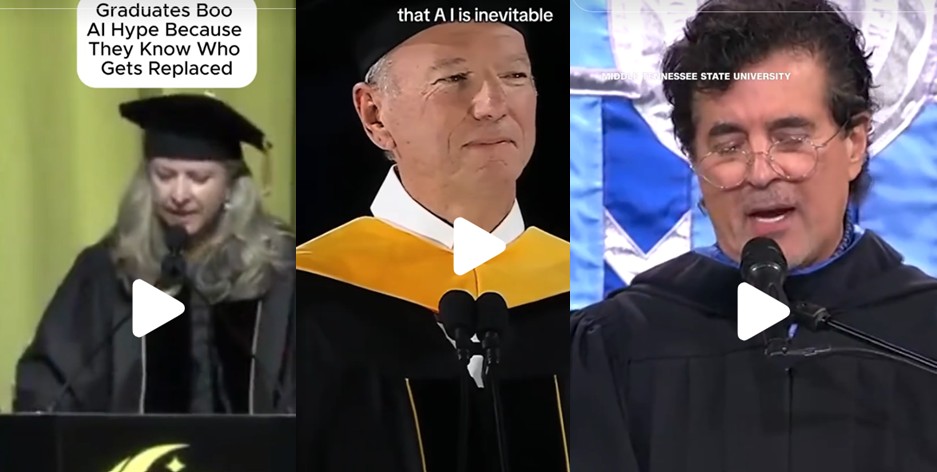
At the University of Central Florida, when real estate executive Gloria Caulfield gave a speech to graduates and called AI “the next Industrial Revolution,” it sparked student outrage. She was booed.
At the University of Arizona, Eric Schmidt, former CEO of Google, spoke of the “architects of artificial intelligence”, named by “Time” magazine as “people of the year”. Booed.
And at Middle Tennessee State University, music executive Scott Borchetta dared to tell graduates that AI is “rewriting the production process.” Booed too.
In all three cases, videos showing the students' discontent went viral on social media.
“Students expect speeches of encouragement, optimism, wisdom or cheer, as usually happens at all graduations”, says Adriano Peixoto, professor and member of the artificial intelligence committee at the Federal University of Bahia (UFBA).
"Then they hear a reference to AI. It's like sticking a knife in their chest, on such an important day."
But, after all, why does hearing praise for this technology at graduation hurt so much?
According to experts interviewed by g1, there are the following hypotheses:
fear of not getting a job after graduating;
feeling of dependence on AI;
revolt towards these spokespeople, who represent “big techs” (large technology companies);
frustration of expectations regarding the real use of artificial intelligence;
protest against damage to the environment.
Read below.
💥Fear of not getting your first job
Speakers booed at US graduation ceremonies
Reproduction/Social media
According to Paulo Blikstein, professor at Teachers College and affiliated with the Education department at Columbia University, in New York, the advancement of artificial intelligence already raises the fear of humans being replaced by machines. And, from the perspective of recent graduates, the jobs of those at the beginning of their careers may be the hardest hit.
“Younger people feel threatened, because they know they will be impacted”, says the expert.
Financial difficulties, compounded by student debt, add weight to these concerns.
"In the case of the United States, students have probably taken out a loan and have a series of debts. They see the rising level of unemployment and realize that entry-level, 'entry' jobs are being replaced by AI," says Peixoto, from UFBA.
"So, it's that thing: 'I've done all this, now what? What's going to happen?'. It's a feeling of frustration. And then this is combined with a speech from some big name in the industry talking about artificial intelligence in an optimistic tone. This creates a disconnect between what the student is feeling and what the speaker is saying."
💥Feeling of dependence on AI
The current point at which society is regarding AI makes it clear, according to the experts interviewed by g1, that the consequences of using this tool go far beyond just facilitating everyday tasks.
“There is already a duality: students realize that yes, artificial intelligence is useful, but, on the other hand, they also notice that they are becoming dependent on it,” says Blikstein.
The boos would translate this anguish. “Something that started out empowering people also ends up making them hostage.”
💥Revolt towards 'big techs'
It is important to note who the people being booed are: they all represent large technology companies. The protest by recent graduates is probably related to this profile.
“Their reaction may not even be to the technology itself, but to the economic interests involved and the possible lack of ethical limits”, explain Carlson Luís Pires de Toledo and Alexandre Marcondes, directors of Colégio Visconde de Porto Seguro (SP).
Speeches given at ceremonies may sound fanciful.
"Students know that it's not just a desire to contribute to the future of humanity. Big tech obviously wants to reduce personnel costs, for example. AI agents don't go on strike, they don't ask for a raise, they don't complain about working 24 hours a day, 7 days a week", says Blikstein, from Columbia University.
The fact that these private sector interests are not explicitly mentioned — but rather remain disguised by the discourse of “advances in society” — would contribute to this revolt.
“People have lost patience with this Silicon Valley talk of ‘let us hand over the future to you’”, says the professor.
Andrea Jotta, a psychologist specialized in cyberpsychology at PUC-SP, agrees that the distance between what is said in company speeches and what is actually perceived by students increases this rejection.
"We want AI as a tool, not as the owner of our thoughts. And the line that divides this is not clear. We have to expect an uprising [against big companies] until everything adjusts," he says.
💥Frustration of expectations
Another factor that may help explain the booing is the change in public perception about what artificial intelligence promised to deliver.
When tools like ChatGPT gained popularity about two or three years ago, it was common to hear optimistic predictions about their potential to solve humanity's big problems.
“There was an expectation that artificial intelligence would help cure cancer, combat global warming, democratize education and expand access to knowledge,” says Blikstein.
According to him, however, the discourse changed quickly.
"Over a year or two ago, it became clearer that utopia was becoming a dystopia. The conversation went from 'let's cure cancer' to 'let's replace all the company lawyers' or 'let's replace professors at universities'."
For the expert, students notice this change in focus and start to view technology with more suspicion.
"There is a race to see who can explore this space of replacing human work first and best. And these graduates are no longer looking at this favorably", he says.
💥Protest against damage to the environment
Concerns about the environmental impact of artificial intelligence may also be behind the graduates' demonstrations.
In the United States, debate is growing about the enormous energy and water consumption of data centers, structures responsible for storing and processing AI systems.
According to Peixoto, from UFBA, many students associate these environmental costs with the economic interests of large technology companies.
In the professor's assessment, part of the dissatisfaction arises from the perception that the benefits of technology are concentrated among a small group of people, while the costs are shared across the entire planet.
"The gains go to the billionaires. At the same time, the population is struggling to pay the bills and get a job," he says.
📰 Related Articles

Iran attacks US bases in Bahrain and Kuwait
Observador
Starbase: what life is like in the city formed by Elon Musk's employees
G1 Globo
Disney ball in Maré became a focus for drug sales, stolen products and TCP money laundering, police say
G1 Globo
Caminhada do Forró, show by Geraldinho Lins and Concurso de Quadrilhas liven up the weekend of São João do Recife; check it out
G1 Globo
US releases video of missiles fired in attacks against Iran; look
CNN Brasil