


Wars in Congo and less health cooperation favor Ebola outbreak
⚡ Quick Summary
The wars that have torn apart the East of the Democratic Republic of Congo (DRC) for decades and the reduction in international cooperation in the area of health have favored the proliferation of the current Ebola outbreak in Africa.
The wars that have torn apart the East of the Democratic Republic of Congo (DRC) for decades and the reduction in international cooperation in the area of health have favored the proliferation of the current Ebola outbreak in Africa. The disease is returning to haunt the continent amid the shortage of healthcare professionals in the region.
The epicenter of the outbreak occurs in the province of Ituri, in the Northeast of DRC, which accounts for 93% of the total confirmed cases (676) in the country, followed by the provinces of North Kivu and South Kivu, which are the departments most affected by the Congolese wars.
Related news:
SP rules out second suspected case of Ebola.
Three die in Kenya in protests against US Ebola center.
WHO and CDC Africa launch response plan to the Ebola outbreak in the region.
Almost 2,000 kilometers away from the country's capital, Kinshasa, this is a region disputed by around 100 paramilitary groups fighting for control of DRC's mineral activities. It is estimated that millions of people are refugees from local wars.
“The outbreak is unfolding in a complex and conflict-affected humanitarian context, characterized by highly mobile and frequently displaced populations,” says a report from the World Health Organization (WHO), which adds that the outbreak continues to evolve rapidly.
Ituri province is the epicenter of the Ebola outbreak in the Democratic Republic of Congo (DRC) - Photo: Reuters/Gradel Muyisa Mumbere/File/Reproduction prohibited
African history professor at the Federal University of Rio de Janeiro (UFRJ) Nuno Carlos de Fragoso Vidal explains to Agência Brasil that the current outbreak emerged in a marginalized region of the DRC that is under the influence of Rwanda, which finances the main paramilitary group in that region, the M23.
"It is a latent conflict that has already caused tens of thousands of deaths over the years. It is a no man's land, a zone of armed groups and Rwandan influence, which exploit natural resources in their favor. These groups exploit, for example, coltan [critical mineral] and then it is exported via Rwanda", says the expert.
Originally from Angola, the professor adds that health teams have difficulty accessing areas controlled by hostile paramilitary groups. He recalls that the supposed peace agreement reached by the President of the United States (USA), Donald Trump, with the governments of Rwanda and the DRC, in June 2025, has not been implemented.
"These agreements do not come to fruition because a president [Paul Kagame] emerged in Rwanda with intentions of controlling a vast region and resources that do not belong to the country. And he is very protected by the West, by the USA, but, above all, by England. There is, in fact, an undue appropriation of resources from that area of Congo", he comments.
In addition to the Democratic Republic of Congo, the outbreak also affects Uganda, a neighboring country. “In Uganda, the outbreak remains epidemiologically linked to transmission originating in the Democratic Republic of Congo,” says the WHO.
Less international cooperation
In addition to the wars in the east of the DRC, experts add that the reduction in international cooperation in the area of health in recent years also favors the Ebola outbreak and cites, as an aggravating factor, the departure of the United States from the WHO. Washington was the organization's largest donor.
Furthermore, US international aid foreseen in the budget for the Democratic Republic of Congo fell by around 90%, from US$1.41 billion in 2024 to US$0.14 billion in 2026. This is one of the results of Donald Trump's policy of reducing US international aid in the world, in particular that provided through the US Agency for International Development (USAID).
Despite the reduction in global health funding, the US presents itself as the largest donor country to combat the Ebola outbreak, with around US$338 million in humanitarian assistance to the DRC, South Sudan and Uganda. Health professional measures the temperature of an M23 rebel at the entrance to the Rodolphe Merieux Laboratory, of the National Institute for Biomedical Research (INRB), where samples from suspected Ebola cases are examined, as part of the response to the epidemic in Goma, North Kivu province, in the Democratic Republic of Congo - Photo: Reuters/Arlette Bashizi/Archive/Reproduction prohibited
The president of the Brazilian Public Health Association (Abrasco), Rômulo Paes de Sousa, adds to Agência Brasil that the US stance of emptying multilateral organizations, such as the WHO, in favor of bilateral cooperation structures, brings uncertainty to the fight against the new outbreak.
"In addition to the reduction in the level of transfer of resources to the health sector, there is the dismantling of global health governance structures. The transfers, which previously occurred through known structures, have now become linked to bilateral negotiations contaminated by commercial interests, especially in relation to rare earths, which are of economic interest to the USA", explains the epidemiologist.
The coordinator of ESPM's Center for African Studies and Business (Nenaf), Natalia Fingermann, highlighted that changes in international cooperation channels make it difficult to monitor the application of these resources.
"It was very easy for the USA to take these resources via the WHO, as this transfer was completely transparent. Today we know that the Africa CDC has not yet received any North American transfer of this announced amount", he explained.
Last week, the WHO reported that three laboratories in the DRC had run out of supplies for testing to detect the Ebola virus.
Powers increase defense spending
The increase in defense spending by European powers is highlighted as an additional factor that complicates the response to the global health emergency represented by Ebola in Africa, as highlighted by the professor of international relations at the Escola Superior de Propaganda e Marketing (ESPM) Natalia Fingermann.
“Since last year, the European Union and some important countries within Africa, such as the United Kingdom and France, have chosen to reduce international aid resources to increase internal military spending”, comments Natalia Fingermann.
In 2025, European countries, under pressure from the USA, agreed to increase defense spending from 2% to 5% of Gross Domestic Product (GDP). As a result, there was a 20% increase in total defense spending by European countries, and by Canada, compared to 2024, according to the Annual Report of the North Atlantic Treaty Organization (NATO).
To combat Ebola, the European Union announced €15 million in additional humanitarian assistance to the Africa Center for Disease Control and Prevention (Africa CDC).
Movement of people in Kampala, Uganda, a country also affected by the Ebola outbreak - Photo: Reuters/Abubaker Lubowa/Archive/Reproduction prohibited
Shortage of professionals
The African Union and the World Health Organization (WHO) published a plan to contain the spread of the virus, in which they request financial contributions of US$517 million for the next six months.
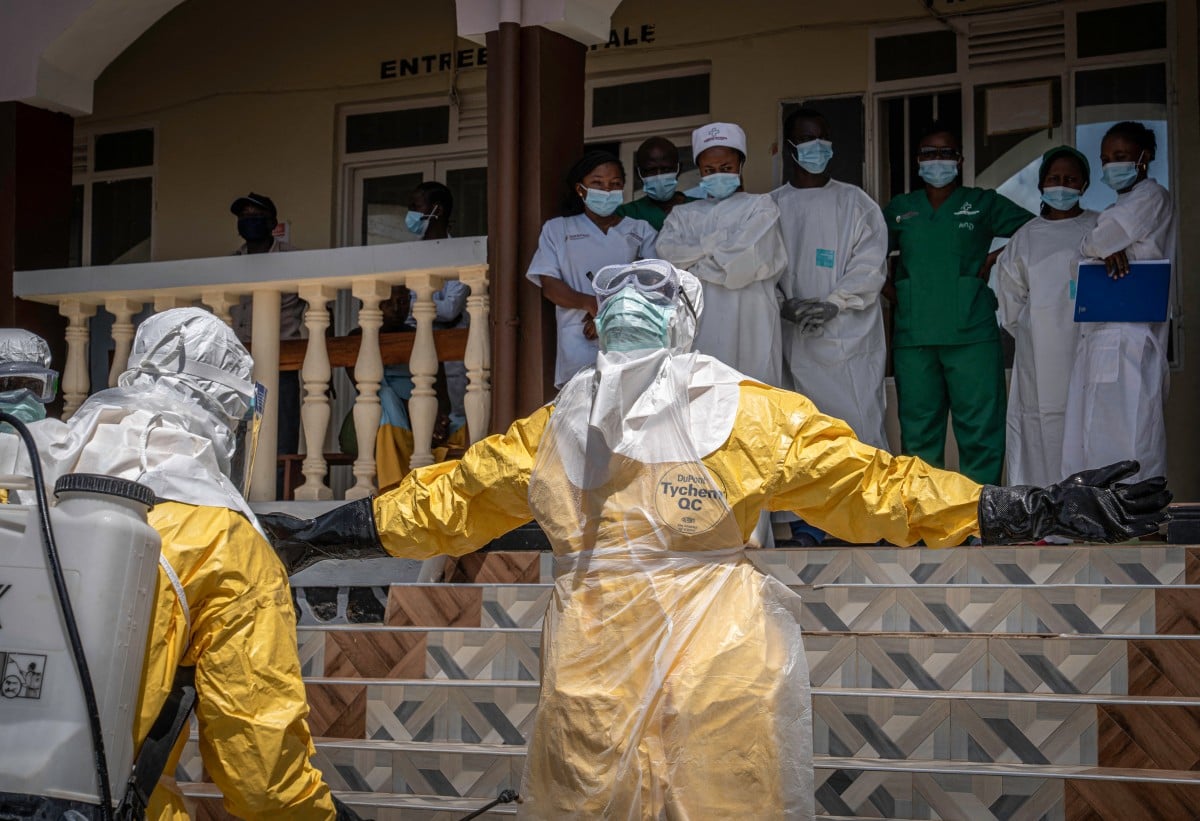
In a statement, CDC Africa, a continental disease control body, highlighted that, among the main problems in controlling the Ebola outbreak, is the shortage of professionals, such as epidemiologists, clinicians and laboratory specialists.
For the CDC Africa Advisory and Technical Board, priorities are, among others, expanding the capacity for rapid diagnostic testing of the disease and improving “humanitarian access and civil-military coordination to ensure that response teams can safely reach affected communities”.
For UFRJ African history professor Nuno Vidal, as they occur within the African continent, Ebola outbreaks do not arouse the interest they deserve. "From an exclusively health point of view, the fear is that this could eventually spread outside of Africa. Until it leaves Africa, or does not spread much beyond that region, it does not trigger all the alarms at an international level", he assesses.
Cases and deaths in DRC and Uganda
WHO data recorded up to June 10th reports that 676 cases of the Ebola virus were confirmed in the Democratic Republic of Congo, with 136 deaths.
In Uganda, as of June 11, 19 confirmed cases and two deaths were recorded. “Uganda has not reported any new cases in the last six days,” says the WHO. At least 37 people have recovered from the disease in both countries.
🗞️ 1 sources covered this story
📰 Related Articles

Basketball team accident survivor mourns death of friends: 'I miss you'
G1 Globo
Understand why Neymar cited K-pop when announcing Biancardi's third pregnancy
CNN Brasil
Fires, smoke and paint; see how the three revelation teas of Neymar and Bruna Biancardi's daughters went
G1 Globo
Governador Valadares will be the new capital of Minas Gerais this week
G1 Globo
Enem 2026: deadline for payment of the registration fee ends on Wednesday
Agência Brasil