


Can a smart watch detect heart problems? Understand when the alert on your wrist should become a consultation
⚡ Quick Summary
Alert on watch for elevated heart rate takes technology analyst to ICU An alert issued by a smartwatch led a resident of São José do Rio Preto (SP) to seek medical attention and discover atrial fibrillation, an arrhythmia that can increase the risk of stroke and other cardiovascular complications.
Alert on watch for elevated heart rate takes technology analyst to ICU
An alert issued by a smartwatch led a resident of São José do Rio Preto (SP) to seek medical attention and discover atrial fibrillation, an arrhythmia that can increase the risk of stroke and other cardiovascular complications.
Smart watches are becoming capable of identifying physiological changes and, in some cases, prompting users to seek care even before symptoms appear. But how much can you trust these devices?
According to cardiovascular surgeon Ricardo Kazunori Katayose, from BP - A Beneficência Portuguesa de São Paulo, smartwatches can function as tracking tools, but they do not replace medical exams nor are they capable of confirming diagnoses.
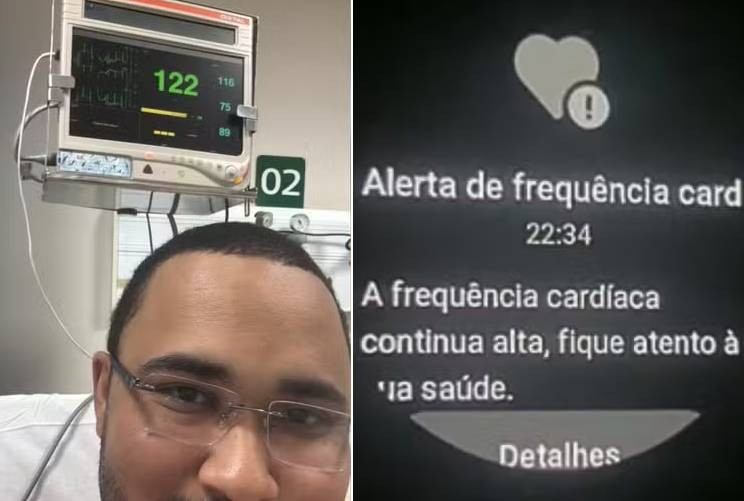
That's what happened in the case of Robson Cardoso, 35 years old. The watch registered a higher-than-normal heart rate and issued two successive alerts while he was at rest. Confirmation of atrial fibrillation came only after an electrocardiogram was performed at the hospital.
The normal resting heart rate usually ranges between 60 and 100 beats per minute in most adults. Persistently high values, especially outside situations such as physical exercise or stress, deserve medical investigation.
Smartwatch misses most hypertension diagnoses
What can watches identify?
The latest smartwatches continuously monitor physiological signals such as heart rate, blood oxygen levels, body temperature, sleep quality and physical activity.
Some models also offer a simplified electrocardiogram and features capable of identifying patterns compatible with certain arrhythmias, including atrial fibrillation.
This does not mean, however, that the watch is capable of diagnosing heart disease.
In Robson's case, for example, the device only detected a change in his heartbeat and issued an alert. The diagnosis was later made by the medical team, through specific tests.
Wireless Power Consortium/Reproduction
The potential and limits of technology
In recent years, manufacturers have started to invest more and more in functions focused on cardiovascular health.
In February, an analysis published in the Journal of the American Medical Association (JAMA) evaluated the Apple Watch's hypertension notification function and concluded that the tool would detect about 41% of people with undiagnosed high blood pressure. In practice, this means that almost six out of ten cases would go unnoticed.
At the time, Katayose assessed that the technology is promising, but still insufficient as an isolated tracking strategy.
"The study shows that the device can help detect almost half of patients who do not know they are hypertensive. However, the high percentage of patients who were not detected makes the methodology insufficient to detect hypertension in the general population," he told g1.
According to him, the main risk lies in so-called false negatives: situations in which the person presents a health condition, but does not receive any notification from the device.
"It is not acceptable. Half of hypertensive people would miss the opportunity to carry out adequate control. I consider it inappropriate to use it as an isolated screening method", he said.
Although the research analyzed blood pressure, not arrhythmias, the conclusion helps to understand the role of smart watches in clinical practice: they can serve as a warning signal, but they do not replace validated diagnostic methods.
Robson de Oliveira Cardoso
Reproduction
When does an alert deserve attention?
The guideline is to observe the context in which the notification appears.
Your heart rate may temporarily increase for a variety of reasons, including physical activity, stress, anxiety, fever, pain, consumption of alcohol, caffeine, or certain medications. But repeated warnings, especially when they appear at rest or are accompanied by symptoms such as palpitations, shortness of breath, dizziness, fainting or chest pain, should prompt a medical evaluation.
It is also not recommended to interpret the absence of alerts as a guarantee that everything is fine.
Just as devices can issue notifications without a disease occurring, they can also fail to identify changes that are actually present.
What is atrial fibrillation?
Atrial fibrillation is one of the most common cardiac arrhythmias. In this case, the atria — upper chambers of the heart — begin to contract in a disorganized way, causing irregular beats.
Some people experience palpitations, tiredness, shortness of breath or chest discomfort. Others, however, may remain asymptomatic for long periods.
The main risk of the condition is the formation of clots inside the heart, which can migrate to the brain and cause a stroke.
Therefore, early diagnosis and adequate treatment are considered essential.
Ally but not substitute
The expert's assessment is that smart watches should be seen as complementary tools.
They can help identify changes early, encourage the search for care and increase awareness about one's own health. At the same time, they still have important limitations and depend on confirmation by medical examinations.
In Robson's case, the alert did not bring the diagnosis. But it served to show that something was not normal and was enough to put him in front of a medical team capable of identifying the problem.
This is the role that many cardiologists see for smartwatches today: not replacing the doctor, but helping the patient reach them sooner.
📰 Related Articles
Dario Durigan gains support from Gilmar Mendes against bombshells; dean of the STF says they are unconstitutional
G1 Globo
Truck falls 50 meters down a cliff and two men die in MG-494
G1 Globo
Court condemns Amarante do Maranhão to renovate indigenous school and fines mayor more than R$ 522 thousand
G1 Globo
Judicial auction brings 70 thousand hectares of land to the market in MT and SP
CNN Brasil