What is the Strait of Hormuz, essential for global oil; Iran may reopen crossing after agreement with US
⚡ Quick Summary
The United States and Iran reached a peace agreement on Sunday (14) to end the almost four-month conflict between the two countries — the signing is scheduled for Friday (19).
The United States and Iran reached a peace agreement on Sunday (14) to end the almost four-month conflict between the two countries — the signing is scheduled for Friday (19). According to Iran, the Strait of Hormuz could be opened within 30 days.
The Strait of Hormuz is an "artery" of the oil industry through which around 20% of all the world's oil passes. Its closure during a period of conflict had a strong impact on the global economy. The announcement of the peace agreement, in fact, dropped oil prices at the opening of Monday's trading session.
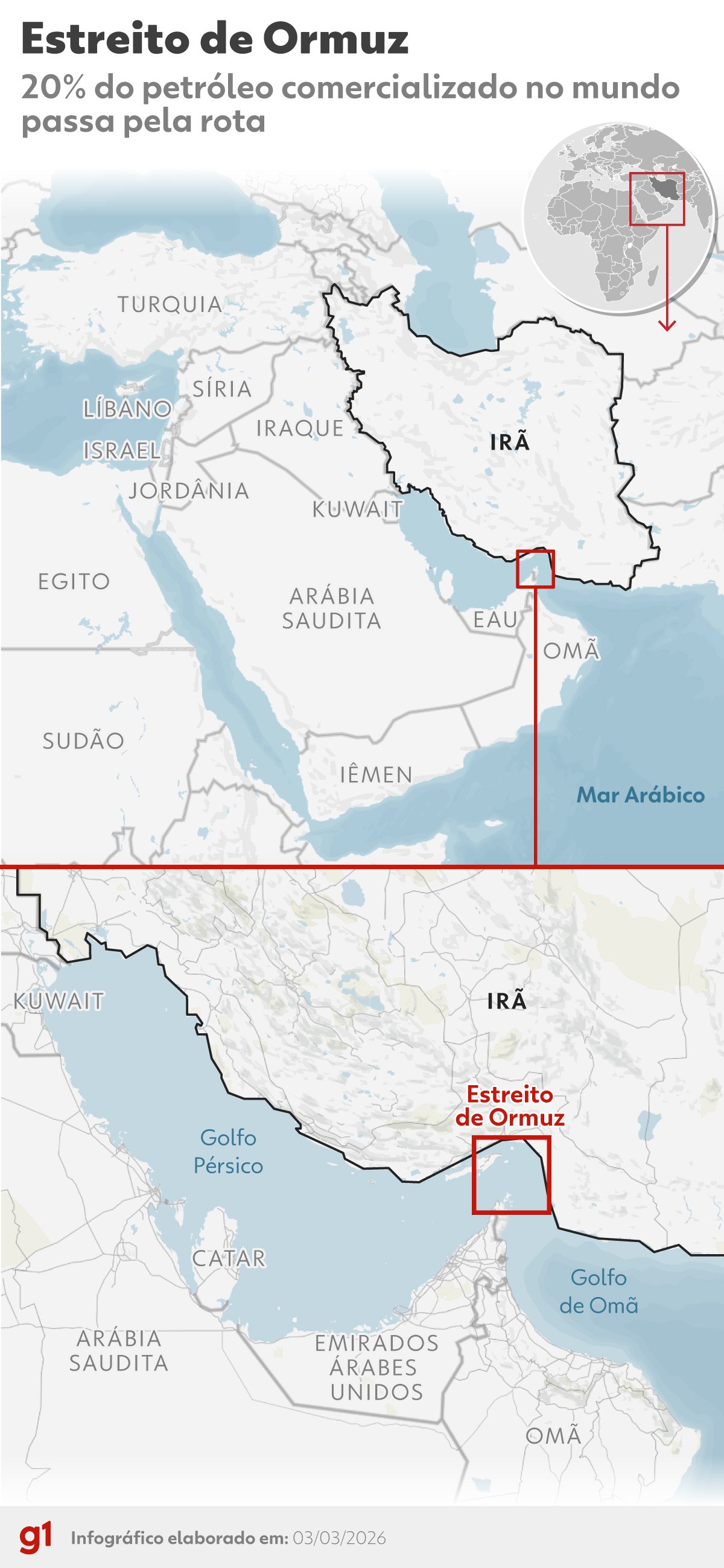
See below for other details about the strait.
Infographic - Strait of Hormuz
Art/g1
'Artery' of global oil transit
The Strait of Hormuz connects the Persian Gulf (to the north) with the Gulf of Oman (to the south), and "flows" into the Arabian Sea. At its narrowest, the strait is 33 km wide, with navigation channels just 3 km in each direction.
About a fifth of all world oil consumption passes through the strait. Between early 2022 and May 2025, approximately 17.8 to 20.8 million barrels per day of crude oil, condensate or fuel flowed through the site daily, according to data from maritime monitoring platform Vortexa.
Conflict in the Middle East: the strategic role of the Strait of Hormuz
Members of the Organization of the Petroleum Exporting Countries (OPEC) such as Saudi Arabia, Iran, the United Arab Emirates, Kuwait and Iraq export most of their oil through the strait, mainly to Asia.
The closure of the Strait of Hormuz caused serious problems in the world's oil supply.
Getty Images via BBC
The United Arab Emirates and Saudi Arabia are looking for alternative routes to avoid depending on the strait.
Qatar, one of the world's largest exporters of liquefied natural gas, sends almost all of its production through the strait.
According to the US Energy Information Administration, there was about 2.6 million barrels per day of spare capacity in these countries' existing pipelines that could be used to bypass Hormuz (data as of June 2024).
Ship passes through the Strait of Hormuz
REUTERS/Hamad I Mohammed/File Photo
📰 Related Articles

Trump may resume attacks if there is no final agreement
Observador
Hearing discusses project to transform the school into the new administrative center of Ribeirão Preto; see how to participate
G1 Globo
Rodeo in Americana brought together finals in three barrels, Cutiano and Iron Cowboy; check winners
G1 Globo
On the eve of the G7, Trump threatens to impose a 100% tariff on French wines if the country does not eliminate taxes on big techs
G1 Globo
Embroidery by Tibaldinho, a woman's art
Observador