


On the eve of the G7, Trump threatens to impose a 100% tariff on French wines if the country does not eliminate taxes on big techs
⚡ Quick Summary
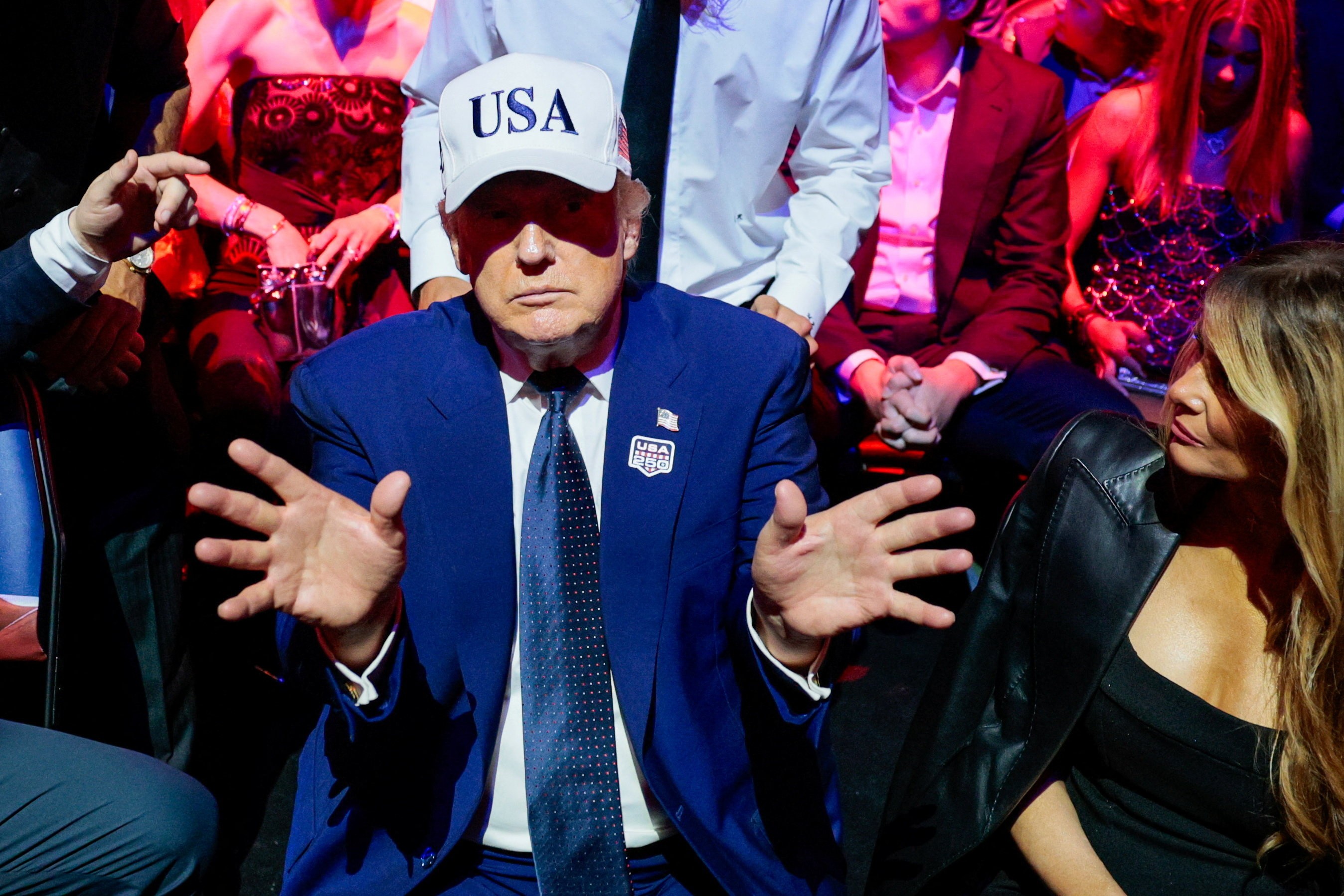
Donadl Trump alongside Melania Trump at UFC Casa Branca Evan Vucci/Reuters United States President Donald Trump has warned that France risks facing a new trade war with the Americans.
Donadl Trump alongside Melania Trump at UFC Casa Branca
Evan Vucci/Reuters
United States President Donald Trump has warned that France risks facing a new trade war with the Americans. In an exclusive interview published by The New York Post, the White House leader declared that unless Paris eliminates the digital tax on US technology giants, Washington "will have no choice" but to impose 100% tariffs on French wines.
According to the article, Trump made the warning directly to French President Emmanuel Macron. The American demands that the 3% tax charged on Silicon Valley companies be abandoned. Otherwise, the French wine industry will face devastating barriers in the US market, which currently accounts for a fifth of the sector's global sales, turning over more than US$2 billion annually.
"I asked him not to charge American companies, and if they do, I will have no choice but to impose a 100% tariff on all champagne and wine coming from France," Trump said in an interview with The New York Post. "All [Macron] needs to do is eliminate the sales tax, and he wouldn't have that kind of pressure."
The North American president's ultimatum sets the stage for a fierce confrontation at the G7 summit this Monday (15), in Évian-les-Bains, France. The annual meeting brings together seven of the world's richest democracies (United States, France, Canada, Germany, Italy, Japan and the United Kingdom) to define global rules for trade, security and economics.
Now on g1
Diplomatic impasse and the 'GAFAM' tax
According to the report by The New York Post, Trump's statements contradict the Elysee Palace. Last week, Macron's office said the two nations had quietly resolved their long-running dispute over technology taxes. A source close to the French president even told journalists that the issue was "no longer up for debate", information that an American government official immediately classified as "inaccurate", according to the newspaper.
France's digital services tax, known as the GAFAM tax, has been in effect since 2019 and sets a 3% rate on local revenue from companies such as Alphabet (Google's parent company), Amazon, Meta and Apple. As it affects gross revenue and not profits, the measure severely affects American companies, having raised around US$700 million last year, according to data from the French Ministry of Finance obtained by The New York Post.
In October, pressure increased when the French National Assembly voted to double the tax to 6%, targeting exclusively the largest global companies, although the measure was later vetoed by ministers. The then French Economy Minister, Roland Lescure, had already warned at the time that a "disproportionate" tax would provoke "disproportionate" reprisals from the USA.
Emmanuel Macron at a press conference before the G7
Emma Da Silva/Pool via REUTERS
The retaliation is now gaining strength by resuming the 100% tariff proposal originally formulated by the US Trade Representative in 2019. When contacted by The New York Post, White House spokesman Kush Desai limited himself to pointing to a presidential memorandum from February 2025, which states that American companies would no longer “support bankrupt foreign economies through exorbitant fines and taxes”.
The document ordered the Treasury Department and US Trade Representative Jamieson Greer to consider reopening a formal investigation into the French rate.
History of tariff pressures
This is not the first time that the French beverage industry has been targeted by the American president as an instrument of political pressure. In January 2026, Trump had already threatened to apply an even higher tariff, of 200%, on French wines and champagnes. On that occasion, the strategy sought to force President Emmanuel Macron to join the "Peace Council", an initiative proposed by Washington to act in global conflicts, such as the war in Gaza, but which Paris signaled to refuse.
At the same time, Europe's regulatory and fiscal siege against Silicon Valley has intensified globally in recent years. Regulatory bodies on the continent have been imposing billion-dollar fines and opening investigations against companies such as Google, Apple, Meta, Microsoft and TikTok, on accusations involving violations of digital market laws, privacy rules, data security and antitrust practices.
📰 Related Articles

Competitions, jobs and courses: check out the opportunities open in Ceará this Monday (15)
G1 Globo
Iran demands release of billions from US to negotiate nuclear program
CNN Brasil
"Trump has lost control over Israel"
Observador
G7 leaders meet in France after US and Iran announce agreement
CNN Brasil
Shipowners await information about Hormuz
Observador