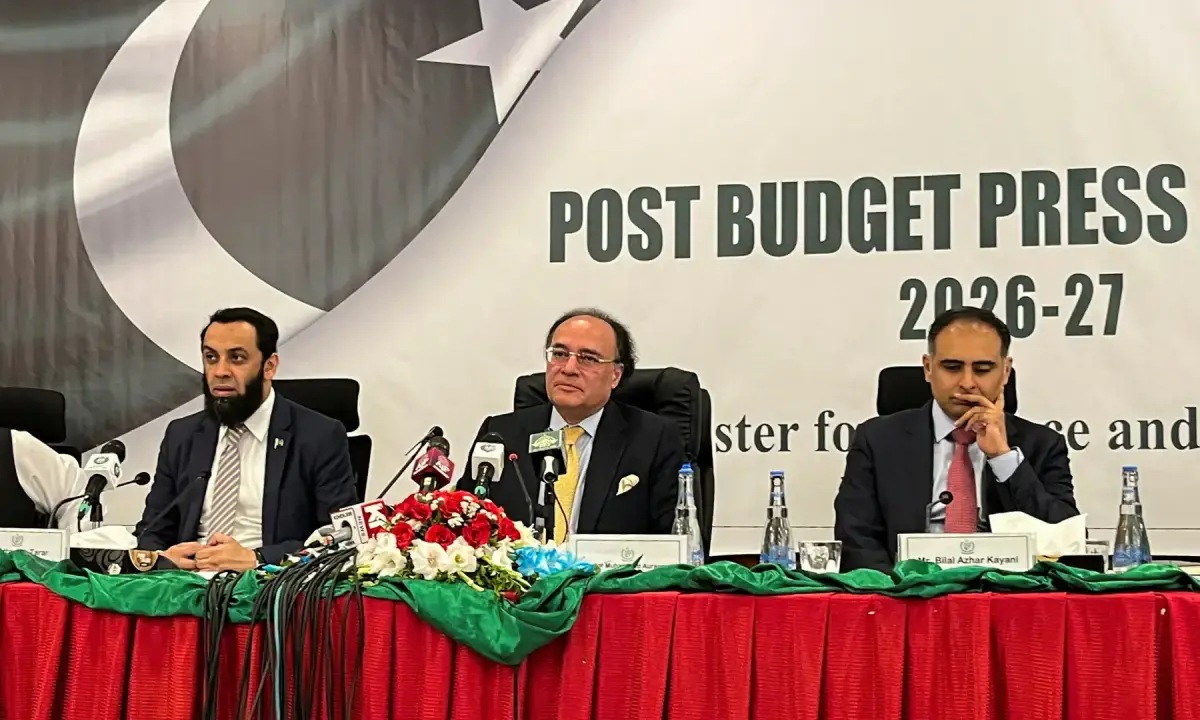
Budget presser
⚡ Quick Summary
OFFICIAL post-budget media briefings in Pakistan are carefully choreographed affairs, full of reassuring phrases like ‘moving in the right direction’, ‘resilience’, and ‘enabling business and investment environment’ delivered by the keepers of the public exchequer.
OFFICIAL post-budget media briefings in Pakistan are carefully choreographed affairs, full of reassuring phrases like ‘moving in the right direction’, ‘resilience’, and ‘enabling business and investment environment’ delivered by the keepers of the public exchequer.
After the briefings end, journalists walk away with little they did not already know. The post-budget presser by Finance Minister Muhammad Aurangzeb was no different.
While talking with the characteristic confidence of a bank executive, he could not quite paper over the tension at the heart of the new budget: a document trying to be a relief budget, a growth budget and a consolidation budget all at once — and only partially succeeding at each.
The presser’s main theme was that the stabilisation phase was over and that this budget marks the journey towards growth. That narrative has political logic; the government has attracted much flak over the last three years of IMF-mandated punishing austerity and now wants credit for turning the corner.
The relief measures are real enough. Salaried class tax cuts, the abolition of the super tax for companies, subsidised export financing, etc — these are not cosmetic. They are a response to the business community’s grievances and to the formal economy’s most beleaguered segment — the documented taxpayer who has been carrying everyone else’s weight for years.
But generosity has a cost, and this is where the press conference got noticeably vague. When the finance czar was asked about the revenue hole created by these concessions, the answers drifted towards enforcement optimism. The FBR will do more faceless audits. Mandatory e-invoicing will document supply chains. Digital monitoring will plug leakage.
The Rs15.3tr tax collection target, a 17.6pc jump over revised estimates, rests overwhelmingly on the assumption that the same institution which missed its target this year — and in preceding years — will now outperform it dramatically, and largely through mechanisms not yet tested.
This is not a minor accounting risk. This is the load-bearing pillar of the entire fiscal framework. If the FBR falters, the government will find itself in hot water sooner rather than later.
Concessions for exporters and the IT sector and bank financing for smallholder farmers are good policy choices. What is missing is tax reform. Pakistan’s tax-to-GDP ratio remains among the lowest in the region. The budget does not widen the tax base in any sense. Large segments of the economy — retail, real estate, agriculture and so on — effectively remain out of the tax system.
The provinces continue to be asked to generate cash surpluses to help finance federal expenditure without a renegotiated NFC framework. These issues are not new and have defined almost every budget for a decade now.
But a government claiming to have moved from stabilisation to growth cannot keep postponing the conversation indefinitely.
Published in Dawn, June 14th, 2026
📰 Related Articles

Brazil begin World Cup bid with Morocco draw as Scotland edge Haiti
Punch NigeriaWorld Cup: Australia stun Turkey 2-0 in Group D clash
Vanguard Nigeria
Indira Gandhi's historic address at 1st UN conference on environment a milestone: Jairam Ramesh
The Hindu
Signature forgery case: Abhishek Banerjee reaches CID headquarters for questioning
The Hindu
Hajj 2026: Nine states complete return airlift
Premium Times