SpaceX IPO puts the financial market at the center of the technological dispute between the US and China
⚡ Quick Summary
SpaceX takes a bet to the stock market that goes beyond rockets The 21st century space race does not just place the United States and China on opposite sides on the Moon.
SpaceX takes a bet to the stock market that goes beyond rockets
The 21st century space race does not just place the United States and China on opposite sides on the Moon. It also opposes two distinct financing models for technologies considered strategic on the geopolitical board.
On the one hand, Beijing advances through state-owned companies, long-term planning and public resources. On the other, SpaceX raised US$75 billion (R$382.6 billion) directly from Wall Street to finance projects ranging from global communications networks to artificial intelligence and orbital infrastructure. (understand more below)
🗒️ Do you have any reporting suggestions? Send it to g1
With the IPO of Elon Musk's company taking place at a time when the two largest economies on the planet are competing for leadership in areas considered decisive for the coming decades, the IPO expands the participation of the financial market in a technological and geopolitical race that goes beyond space.
🔎 An IPO (Initial Public Offering, in English) is the first public offering of a company, when it sells part of its shares and starts to be traded on the stock exchange. The objective is to raise funds to expand operations, invest in projects or reduce debt.
Same race, different financing models
For much of the history of space exploration — especially in the Cold War — technological advancement was financed mainly by governments. Both the USA and the then Soviet Union treated the sector as a matter of national interest, allocating public resources to the development of rockets, satellites and manned missions.
➡️ In the USA, this model is still present. Created in 1958, the National Aeronautics and Space Administration (NASA) is financed by the federal budget approved annually by Congress. For 2026, for example, parliamentarians allocated US$24.4 billion (R$124.5 billion) to the agency, an amount equivalent to around 0.35% of American government spending.
Part of these resources finances programs conducted by NASA itself, but another portion reaches the private sector through contracts. The Artemis II mission, for example, involved the participation of companies such as Boeing, Northrop Grumman and Lockheed Martin in the development of equipment and systems.
Gif shows astronauts from the Artemis mission in zero gravity
Reproduction
In recent years, however, the American model has started to incorporate a new element. In addition to working in partnership with the government, private companies began to turn to the financial market to finance their own expansion projects. SpaceX is perhaps the most visible example of this transformation today.
📡 The company built the Starlink network, expanded its presence in government and military contracts, and incorporated assets linked to artificial intelligence. At the same time, Musk expanded his influence within the American government during Donald Trump's administration, in which he came to command the Department of Government Efficiency (DOGE).
For Álvaro Machado Dias, professor at the Federal University of São Paulo (Unifesp), projects such as Starship, future data processing centers in orbit and initiatives linked to lunar infrastructure require a scale of resources that can hardly be sustained by traditional private investors alone.
Furthermore, according to him, the company already occupies a strategic position for American interests, which increases the relevance of its expansion plans.
"It is worth noting that Musk does this at a time when SpaceX has long operated as a strategic infrastructure for the American state: it launches Pentagon satellites, supports the main orbital military communications system and has become a decisive player in conflicts such as Ukraine. "
On the other hand, in China, the logic remains more concentrated on the State: the space program is driven based on goals defined by the government, with the participation of state-owned companies and long-term public investments aimed at expanding the Chinese presence in space.
It is precisely at this point that SpaceX's IPO becomes more than a financial operation. While the Chinese model continues to be supported mainly by state resources, Musk's company intends to turn to the financial market to finance a new stage of growth.
Diogo Cortiz, professor specializing in technology and innovation at PUC-SP, observes that this movement takes place at a time when the technological dispute between the USA and China is intensifying.
In his assessment, SpaceX occupies a unique position because it brings together, under the same group, areas considered strategic in the dispute between the two largest powers on the planet. According to the professor, this competition today focuses on three main fronts:
space exploration;
control of communication systems;
and the processing capacity necessary for the development of artificial intelligence.
“When we look at these three dimensions together, it becomes clear that SpaceX is not just a rocket company. It is present in fundamental areas for any country that intends to compete for technological leadership — whether in the space race, global connectivity through Starlink or the advancement of artificial intelligence”, he states.
China and SpaceX accelerate space race
China races to catch up with the Americans — and SpaceX itself
If SpaceX became the main showcase for the American model of space exploration, China today appears as its main competitor. The dispute involves everything from lunar missions to satellite networks and launch capacity.
A survey by astrophysicist Jonathan McDowell, a researcher at the Harvard-Smithsonian Center for Astrophysics, shows that China was the second largest space power in the world in terms of number of orbital launches in 2025, with 92 missions.
The result puts the country well ahead of other space powers, such as Russia, but still far from American leadership. In the same period, the US carried out 181 launches — almost double the Chinese total.
More than that: alone, SpaceX was responsible for 170 missions, a number higher than that recorded by any other country. See below:
US extends lead over China in space race
Art/g1
According to Franco Granda, senior analyst at PitchBook, competition is likely to intensify as the two countries advance in their lunar programs.
“SpaceX is working towards the goal of carrying out an unmanned lunar mission in 2027, while Beijing aims to take Chinese astronauts to the surface of the Moon by 2030.”
The dispute over satellite constellations
The dispute, however, does not just happen in outer space. It's also underway in Earth orbit, where SpaceX has built an advantage that's hard to ignore.
➡️ More than a dispute for presence in space, it is a competition for control of communication networks that will be able to support internet, defense and artificial intelligence services in the coming decades.
Data compiled by McDowell shows that, at the end of last year, the Starlink network accounted for around two-thirds of all active satellites on the planet. Of the 14,100 pieces of equipment in operation, approximately 10,000 belonged to the SpaceX system.
The difference also appears in the pace of satellite launches for these orbital networks. In 2025 alone, the US manufactured and placed into orbit around 3,400 large communications satellites, almost all of them destined for the Starlink constellation (3,267). In the same period, China launched 195 satellites of the same category.
But Beijing is trying to reduce this distance. According to PitchBook, the country focused its efforts on two large projects: Guowang, a state constellation expected to contain approximately 13,000 satellites, and Qianfan, a commercial initiative planned to bring together more than 1,296 units.
In addition to its industrial scale, China has an important geopolitical advantage outside the traditional circle of US allies.
According to experts consulted by g1, the country has been combining industrial capacity, subsidized prices and diplomatic relations built through the Belt and Road initiative — a global infrastructure, trade and cooperation megaproject that brings together more than 150 partner countries, with a greater presence in Africa, Asia and Latin America.
This international capillarity, however, does not eliminate the obstacles faced by Chinese companies in other markets. Geopolitical restrictions and export rules adopted by Western countries — especially historical US allies — make it difficult to access commercial contracts in several regions.
“China’s commercial sector is still five to ten years behind SpaceX in terms of reusability, and geopolitical segmentation means that the Chinese and Western markets are, in practice, separate competitive arenas,” notes Granda.
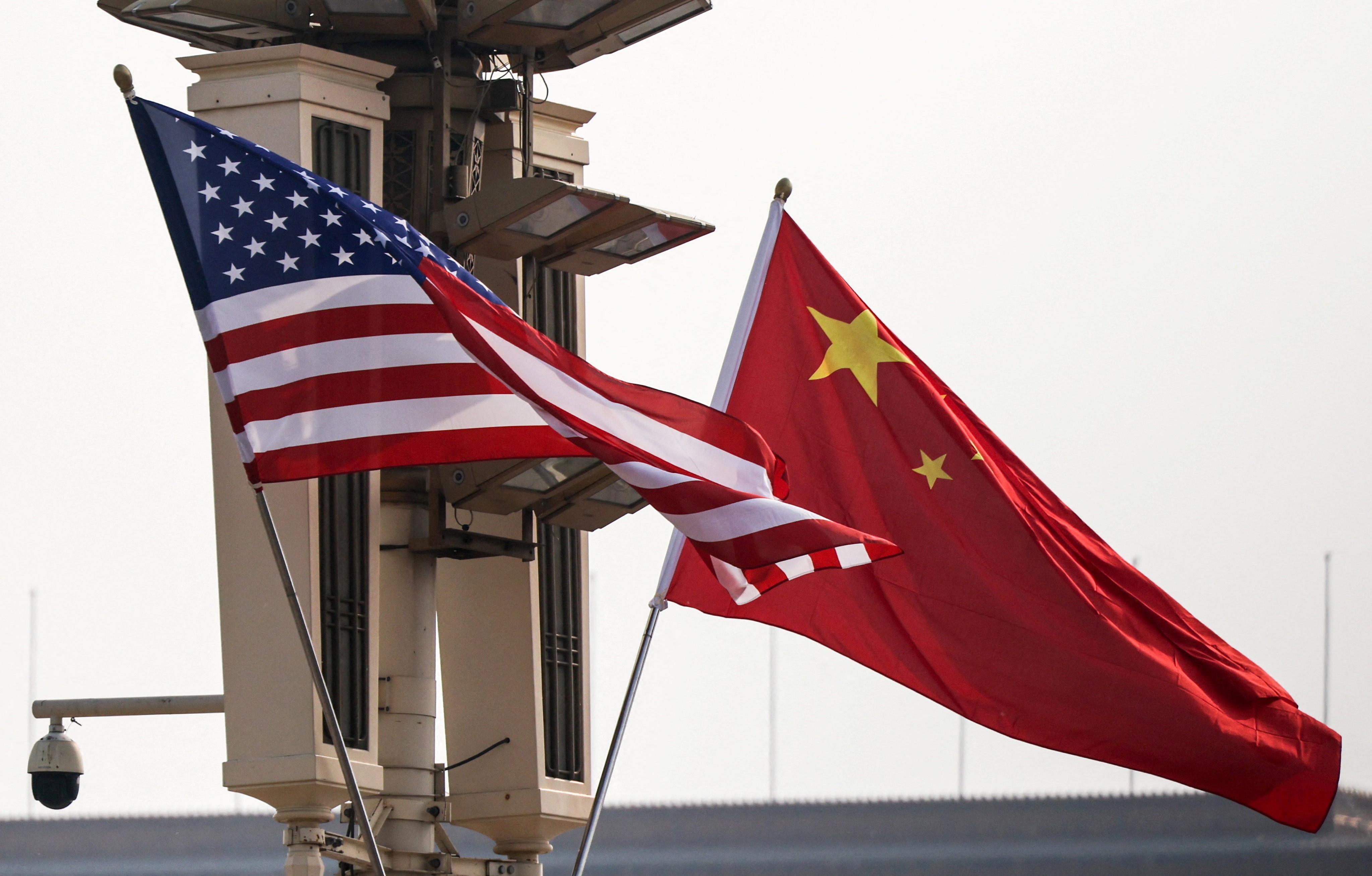
Flags of China and the United States on a Chinese street before Donald Trump's visit to the country, May 13, 2026
Reuters/Maxim Shemetov
🗞️ 1 sources covered this story

📰 Related Articles

Is supporting Brazil more expensive? The rise in the price of meat, beer and other items to watch the World Cup games
BBC Brasil
Show inspired by cordel literature will have free performances in São Pedro da Aldeia
G1 Globo
‘ANTA – The Film’: documentary portrays 30 years of struggle for the conservation of an endangered species
G1 Globo
Is it possible to play football again after tearing a ligament? Understand
CNN Brasil
SpaceX "is unique" but "many things have to go well"
Observador