'Times Square' in SP: city hall tries to unblock the project in court and says that the injunction harms the revitalization of the Center
⚡ Quick Summary
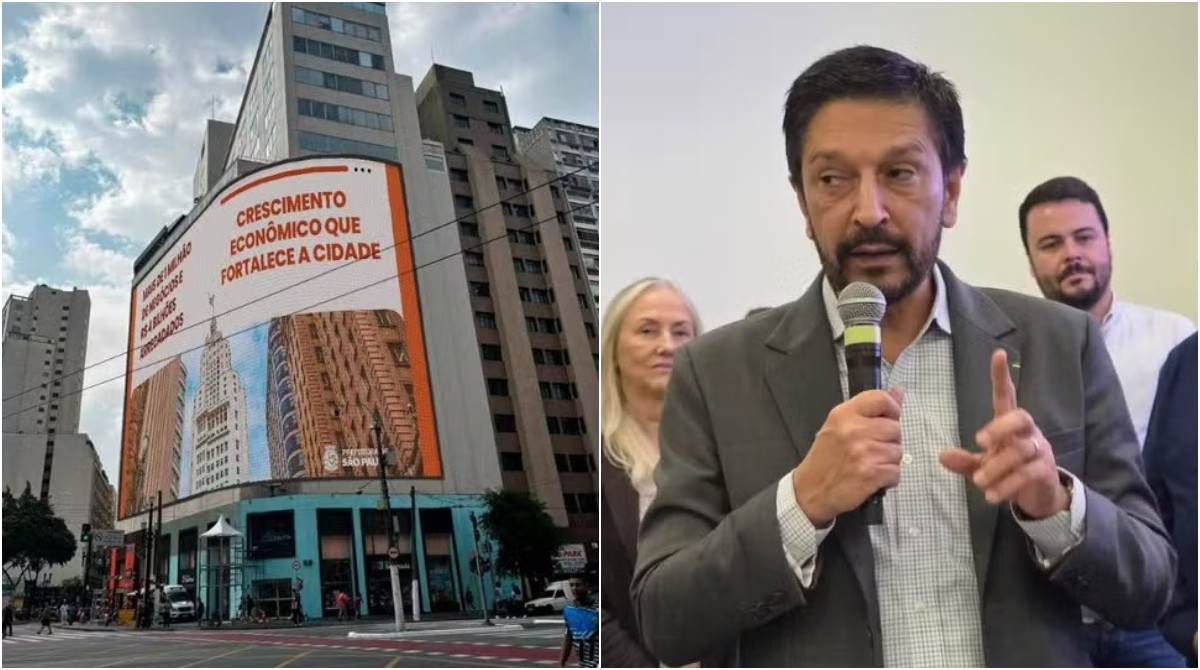
Bright screen project in the New York building, in the center of São Paulo, and mayor Ricardo Nunes Reproduction/Instituto Sarasá and TV Globo The City of São Paulo went to court to try to overturn the injunction that suspended the Boulevard São João project, known as "Times Square in São Paulo", at the intersection of Ipiranga and São João avenues.
Bright screen project in the New York building, in the center of São Paulo, and mayor Ricardo Nunes
Reproduction/Instituto Sarasá and TV Globo
The City of São Paulo went to court to try to overturn the injunction that suspended the Boulevard São João project, known as "Times Square in São Paulo", at the intersection of Ipiranga and São João avenues.
In the appeal, presented to the Court of Justice this Tuesday (9), the municipality says that the decision was based on generic arguments and ignored technical studies. The Ricardo Nunes (MDB) administration also states that the strike hinders the revitalization of the Center and threatens the model of partnerships with the private sector.
The injunction, granted on May 27, prohibited the start of work to install LED panels on the facades of four buildings at the intersection. Judge Celina Kiyomi Toyoshima cited "the magnitude of the project, the impact on the region, as well as the potential harm to the entire population" to justify the measure. The decision was taken in a popular action that questions the legality of the project and its impacts on the urban landscape.
In the appeal, the municipal management states that the strike actually poses a "danger of reverse damage" to the community by hindering the restoration of historic assets and urban improvements. The cooperation agreement signed with the Fábrica de Bares group foresees the investment of R$8 million by the company for the restoration of monuments and the installation of benches and trash cans on the boulevard, at no cost to the public coffers. The cost of the screens is estimated at R$42 million, entirely financed by the private sector.
City Hall presents project for Boulevard São João, which received the nickname Times Square Paulistana
"Such interventions will solve problems that have persisted for decades due to lack of public resources", argued municipal prosecutor Sérgio Barbosa Júnior, denying favoritism to private interests.
The city hall states that the partnership with the private sector is provided for in the Clean City Law for "urban, environmental and landscape improvements" and opposes the interpretation that the device would only be used for "small improvements", such as the adoption of squares – this was one of the central arguments of the popular action that stopped the beginning of the works.
The administration classifies Boulevard São João as a "differentiated project", a category provided for by law to accommodate new technologies and means of serving advertisements, and says that the LED panels will be an "aesthetic modernization asset, aligned with the concept of a smart city".
"The urban dynamics of a metropolis like São Paulo requires constant updating of regulatory instruments", says the text.
Illustrative photo of Times Square in São Paulo, which appears in the project approved by the Urban Landscape Protection Commission (CPPU).
Reproduction/PMSP
The resource also highlights that the project was approved by different technical bodies, such as the Urban Landscape Protection Commission (CPPU), the Heritage Council (Conpresp) and the Traffic Engineering Company (CET).
The city hall cites similar cases already authorized in the city, such as digital art panels in buildings on Avenida Paulista, Faria Lima and other regions, stating that the use of technology is not unprecedented. In these interventions, however, there is no authorization to broadcast advertising, while the screens on Boulevard São João will have a 30% quota of display time for sponsor advertisements.
To counter criticisms about visual impacts and safety risks, the city hall mentions the 29 conditions imposed by the CPPU, including brightness limits, mandatory shutdown at 11pm and prohibition of videos with continuous movements or flashes that could hinder drivers.
Project foresees installation of light panels in buildings at the intersection of São João and Ipiranga avenues, in the center of SP
Edson Lopes Jr/Secom PMSP
Management emphasizes that the equipment will be removed at the end of the contract, lasting 36 months, and that the buildings must be returned to their original state. The document guarantees that the metal structures that will support the screens will be independent and reversibly anchored, without damaging the facades. "There is absolutely no mischaracterization of the built heritage", states the Attorney's Office.
The city hall also classified the injunction as a “worrying precedent of judicial interference” and “an affront to the separation of Powers”. According to the appeal, the measure creates legal uncertainty and undermines the credibility of the partnership model of the Clean City Law, "discouraging private investments in the city's urban requalification."
What will “São Paulo’s Times Square” be like?
The project foresees the installation of LED panels in four buildings on the axis of Ipiranga and São João avenues: Cine Paris República, Edifício Herculano de Almeida, Galeria Sampa and Edifício New York. The Independência Building, where Bar Brahma (from the Fábrica de Bares group) operates, was removed from the project as it is listed as a historical heritage site. Instead of the big screen, it should receive projections on its facade.
Each building will receive a panel with specific dimensions. The largest of them, in the New York Building, will be 40 meters wide by 25 meters high, occupying almost the entire facade. The structures must be fixed to independent metallic structures.
Location of the light panels on Boulevard São João
Reproduction/TV Globo
The agreement established that advertising may occupy a maximum of 30% of the screen's viewing time, with only the institutional identification of supporting brands being permitted. The responsible company may sell up to 10 simultaneous sponsorship quotas, valid for six months. The price was not disclosed.
The other 70% will be allocated to cultural and public information. Retail advertisements, gambling and betting, display of adult content, images of violence and messages with political or religious content will be prohibited.
The operation will be monitored by the city hall and the Urban Landscape Protection Commission (CPPU). Among the rules are:
panels only operate between 5am and 11pm;
reduced light at night;
prohibition of animations that simulate movement or quick cuts;
minimum stay of 10 seconds per image displayed.
The term gives power to the city hall to determine light reduction, content adjustment and even suspension of activities, if necessary. Nunes stated, however, that he will ask the CPPU to reevaluate the restriction that prevents the screens from operating in the early hours of the morning.
Restoration of the Nichile Clock, in Praça Antônio Prado, is one of the counterparts planned in the Boulevard São João project
Leonardo Zvarick/g1
Urban counterparts
As part of the agreement, Fábrica de Bares is expected to invest around R$8 million in urban improvements in a perimeter of 42 thousand m², between Largo do Paissandu and Praça Júlio de Mesquita, within a period of up to three years. The main interventions planned are:
conservation and restoration of the facade of the Nossa Senhora do Rosário dos Homens Pretos Church, in Largo do Paissandu; the Statue of Mãe Preta, also located in Largo do Paissandu, and the Nichile Clock, in Praça Antônio Prado;
installation of 72 benches and 30 trash bins along Avenida São João, in the section defined for the project;
implementation of a landscaping project focused on planting trees on the São João-Ipiranga axis, following the Urban Afforestation Guideline and the Atlantic Forest Municipal Plan;
company should promote Cultural Heritage Caretaker workshops
The agreement provides that, in the event of termination or at the end of 36 months, the screens will have to be removed, with the facades restored, and all improvements will become part of public assets.
🗞️ 1 sources covered this story

📰 Related Articles

France accuses Israeli company of interfering in elections
Observador
Agreement between Iran and the USA: does it mean decline for Trump?
Observador
Doctor arrested for domestic violence in Ribeirão Preto
CNN Brasil
US-Iran agreement will establish 60 days for “technical” negotiations, says source
CNN Brasil
Toffoli denies extradition of Iranian woman to protect Brazilian daughter
CartaCapital