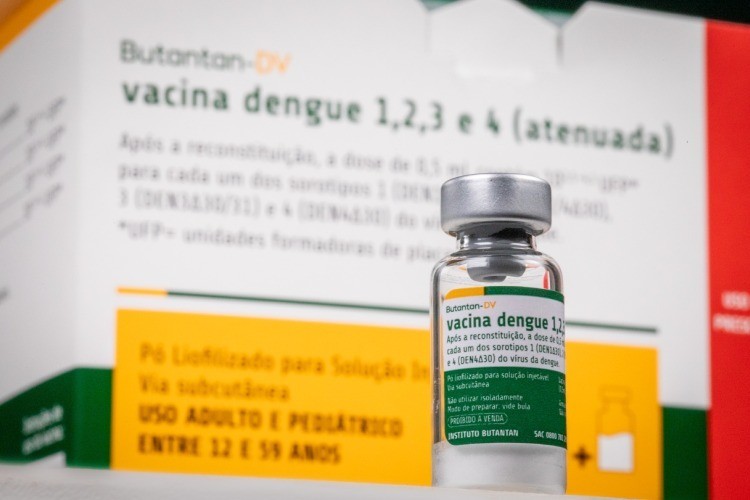
Municipalities must store Butantan vaccine until further decision
⚡ Quick Summary
Municipalities and states must keep dengue vaccines from Butantan until further guidance from the Ministry of Health, informed the director of the Department of the National Immunization Program of the Ministry of Health, Eder Gatti.
Municipalities and states must keep dengue vaccines from Butantan until further guidance from the Ministry of Health, informed the director of the Department of the National Immunization Program of the Ministry of Health, Eder Gatti.
Last Monday (8), the Ministry of Health temporarily suspended the application of the vaccine after recording 42 cases of serious reactions and two deaths, which are under investigation to find out if there is a correlation with the vaccine.
Related news:
Ministry of Health suspends Butantan dengue vaccine.
"The guidance is that municipalities place the immunobiological in reserve within their cold chain, that is, we will not distribute any more dengue vaccines per hour. States that have dengue vaccine in their stock must hold on to this vaccine. Municipalities that eventually have vaccines in their territory must also store these vaccines until further notice", explained Eder Gatti, in an interview with Rádio Nacional.
It was routine surveillance by the National Immunization Program (PMI) that identified the 42 people who presented abdominal pain, persistent vomiting, bleeding episodes and even loss of consciousness.
In addition, three serious cases were found that presented a typical picture of severe dengue and required hospitalization. Two people died.
As of May 30, more than 501,000 people had been vaccinated with the vaccine, including healthcare professionals and the public over 15 years of age from three cities: Botucatu (SP), Maranguape (CE) and Nova Lima (MG), in addition to the region of Araguaína (TO).
Unusual cases
The temporary suspension was a precautionary measure by the Ministry of Health, to avoid risks until the identified cases were elucidated. The government reported that the suspension does not mean that the vaccine is no longer effective in preventing dengue cases and deaths.
Adverse cases are considered unusual as they did not appear during the clinical testing period.
"Once we start using it on a large scale, that's when very rare events start to appear. The program's surveillance is what captures these cases. What happened now was something unexpected, identified in a routine surveillance action, which also demonstrates that the National Immunization Program's surveillance is working very well. The program takes care of the quality and safety of the vaccination that is carried out in our population," he said.
The expectation of the National Immunization Program is that after the disclosure of adverse reaction cases and vaccine suspension, new notifications can be identified.
"After publicizing the occurrence of these cases, it is expected that surveillance will become more aware, that is, it will begin to capture more cases, because people who eventually presented something and did not seek assistance or were not notified, will now seek notification", he explains.
Who should pay attention
The group of people who received the vaccine in the last 21 days need to be aware of symptoms such as fever, body pain, skin spots, bleeding and vomiting. If they appear, the advice is to seek medical attention.
This period is when the weakened form of the disease virus is still in the blood, and therefore can cause reactions.
"They need to be alert for the appearance of symptoms such as fever accompanied by other symptoms such as, for example, pain in the body, spots on the body, signs of bleeding, vomiting. Anything that leads to thinking about dengue fever. People need to be alert and if, by chance, they have any of these signs or symptoms, they should seek a health service, they should seek assistance", advises the director.
Anyone who has been vaccinated for more than 21 days has no risk.
"People who were vaccinated more than 21 days ago are free from any type of risk, and are even protected against dengue fever," he said, adding that the Butantan vaccine prevents the occurrence of dengue fever by 65% and more than 80% of severe cases and hospitalization. Resumption of the Butantan vaccine
The director informed that a committee of experts is being convened to carry out studies and evaluate what the surveillance detected.
"Based on this [committee's] assessment", we will define deadlines and even a final decision at a later date. It's still too early for me to say when we will have a definitive decision."
Qdenga vaccine
The Qdenga vaccine, manufactured by the Takeda laboratory (Japan) and recommended for children and adolescents aged 10 to 14, continues to be administered normally. Gatti highlights that the Butantan vaccine is only recommended for people aged 15 and over.
"The SUS has another dengue vaccine, which is the vaccine from the Takeda laboratory. It is recommended for people aged 10 to 14 and did not present any type of safety signal [alert], that is, this vaccine continues with its vaccination being carried out normally", he clarified.
* Pedro Lacerda, from Rádio Nacional, collaborated
🗞️ 2 sources covered this story
📰 Related Articles

PCP accuses Government of attacking social support dependents
ObservadorGoogle will invest R$5 million in AI training for teachers
MundoCoop
The Flavors of Portugal
ObservadorLack of electricity affects parts of the Flamengo and Botafogo neighborhoods and leaves residents trapped in elevators
G1 GloboSenate CCJ approves PEC that provides for full retirement for health and endemic disease agents
G1 Globo