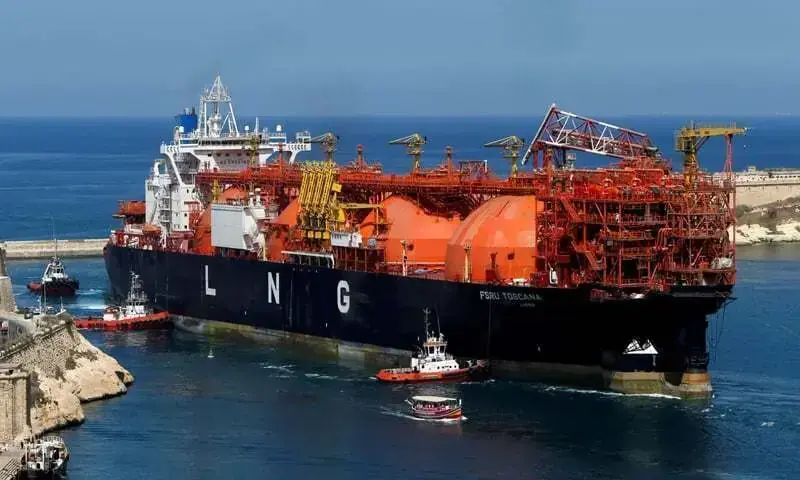
Ogra notifies 15pc increase in Regasified Liquefied Natural Gas price for June
⚡ Quick Summary
ISLAMABAD: The Oil and Gas Regulatory Authority (Ogra) has notified an around 15pc increase in the price of Regasified Liquefied Natural Gas (RLNG) for sales at the distribution stage by the two Sui gas companies for the current month, mainly because of purchases from the international spot market at short notice amid supply disruptions caused by the US-Iran war.
ISLAMABAD: The Oil and Gas Regulatory Authority (Ogra) has notified an around 15pc increase in the price of Regasified Liquefied Natural Gas (RLNG) for sales at the distribution stage by the two Sui gas companies for the current month, mainly because of purchases from the international spot market at short notice amid supply disruptions caused by the US-Iran war.
The latest price notification places the RLNG price for June 15pc higher than in May, almost 56pc higher than in March, and 73pc higher than in February. This has mainly resulted in a substantial increase in fuel costs for power generation, which is evident from the fact that the fuel cost for RLNG-based power generation in May worked out to Rs31 per unit, compared with Rs13.72 per unit in April.
Karachi-based Sui Southern Gas Company Limited (SSGCL) serves consumers in Sindh and Balochistan, and its distribution-stage system losses stand at 12.55pc, compared with about 10.6pc a couple of months earlier. On the other hand, Lahore-based Sui Northern Gas Pipelines Limited (SNGPL) supplies gas to consumers in Punjab and Khyber Pakhtunkhwa, and its distribution-stage system losses were also reported at almost 9pc, up from 7.47pc in October.
At the transmission stage, according to the notification, the RLNG sale price for SNGPL increased by 14.85pc to $17.94 per million British thermal units (mmBtu) in June from $15.62 per mmBtu in May. The company’s transmission-stage price had stood at $10.45 per mmBtu in February.
Inherently expensive cost additions in supply chain, unfavourable spot purchases continue to make RLNG even more expensive for end-users
At the distribution stage, the sale price for SNGPL was, therefore, increased by 14.94pc to $19.5228 per mmBtu in June from $16.9847 per mmBtu in May.
Similarly, the RLNG sale price for SSGCL at the transmission stage increased by 16pc to $16.368 per mmBtu in June from $14.093 per mmBtu in May. It had stood at $9.47 per mmBtu in December 2025. The sale price at the distribution stage for SSGCL also increased by 16.17pc to $18.64 per mmBtu in June from $16.042 per mmBtu in May. It had stood at $10.77 per mmBtu in December.
Besides the unfavourable spot purchases, the inherently expensive cost additions in the supply chain continue to make the end-user RLNG price even more expensive. This is evident from the fact that the RLNG distribution prices of $18.64 for SSGCL and $19.5228 for SNGPL are almost $3.3 and $4.2, respectively, higher than the average delivered ex-ship price, because both LNG importers — Pakistan State Oil and Pakistan LNG Limited — as well as the port authorities charge profit margins on account of retainage and other margins at the rate of 3.77pc of the DES price, in addition to distribution losses of 8.97pc for SNGPL and 12.55pc for SSGCL.
The basket RLNG price was based on a total of four cargoes each in June, May and April. Three of these cargoes were imported under two LNG contracts between PSO and QatarGas at an average price of about $13.144 per mmBtu in June, compared with $9.2 per mmBtu in May. In both June and May, the state-run PLL imported one cargo each at $19.134 per mmBtu and $18.4 per mmBtu, respectively.
PSO has a long-term contract for up to 11 cargoes per month, but part of these supplies is usually diverted to the spot market owing to the country’s economic constraints, resulting in lower domestic energy consumption. However, even the usual seven to eight monthly cargoes could not be supplied because of Qatar’s inability to transport cargoes due to the closure of the Strait of Hormuz and the suspension of gas operations at the field.
As a result, PLL, a special-purpose company created for LNG imports that had remained dormant for almost two and a half years, was reactivated by the government to procure LNG from the spot market as electricity shortages re-emerged. It has been importing, on average, one LNG cargo per month on short notice of 48 to 72 hours.
Ogra said that of PLL’s cargo of 3.2 million mmBtu, two-thirds (2.4m mmBtu) would be supplied to K-Electric, while the remaining one-third (0.8m mmBtu) would be supplied to SNGPL.
Published in Dawn, July 6th, 2026
📰 Related Articles

Have support from India: Netanyahu counters Vance
The HinduIs the US really preparing to drop Israel?
Al JazeeraBARD Aquaculture and Desert Farming Program (United States & Israel)
fundsforNGOs
England's Henderson injures wrist in World Cup celebrations
BBC Sport
Netanyahu claims Christians in Lebanon sought Israeli annexation
Dawn Pakistan