


New 2nd phase of Fuvest: understand why the test will change and what will be charged to students
⚡ Quick Summary
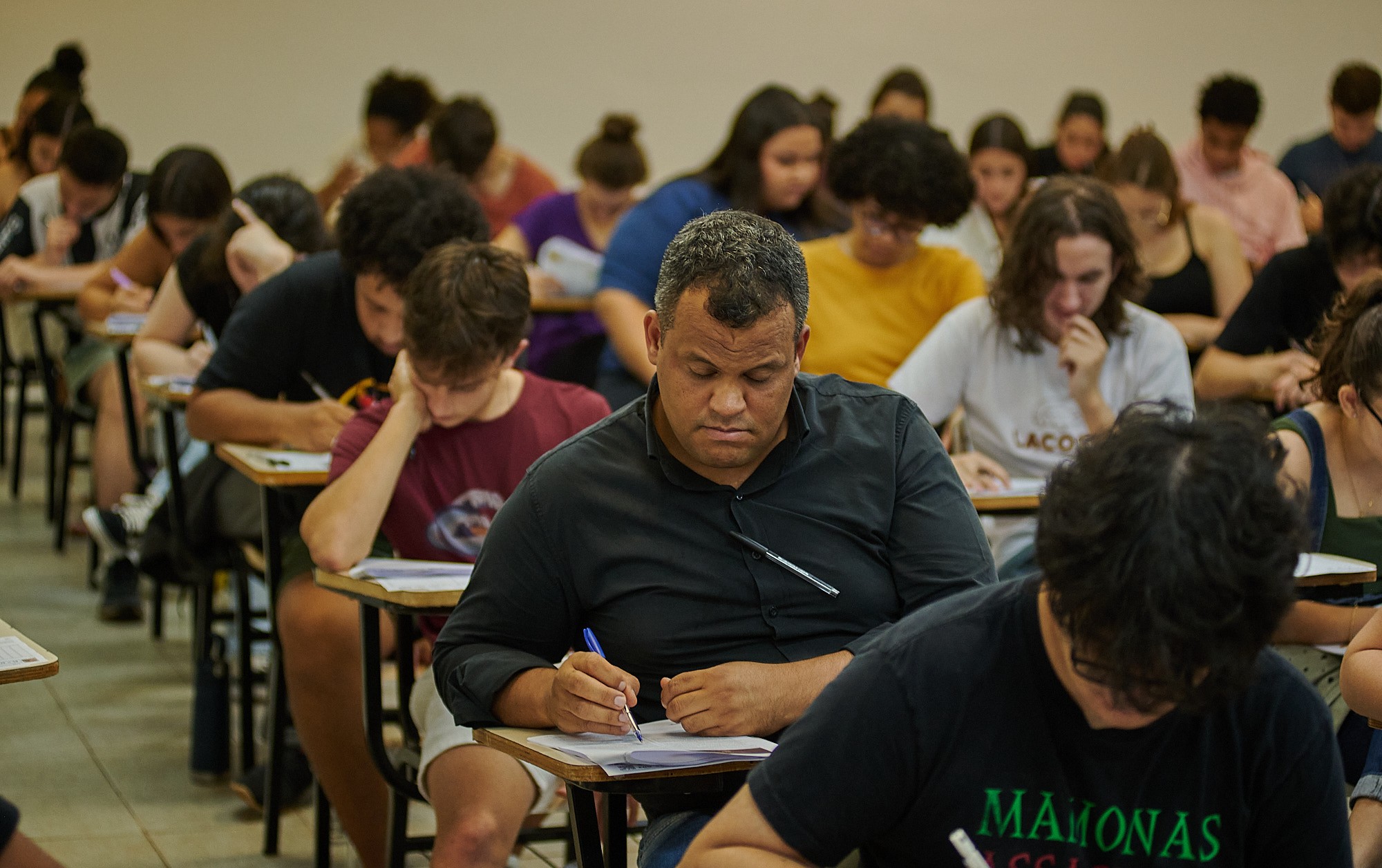
Candidates of different ages took part in Fuvest 2026 in Ribeirão Preto (SP).
Candidates of different ages took part in Fuvest 2026 in Ribeirão Preto (SP).
Eric Andrade/g1
Students who take Fuvest from 2027 onwards, to enter the University of São Paulo (USP) the following year, will have changes in the second phase of the entrance exam. And the reformulation, according to the test administrator herself, has two main objectives: to value interdisciplinarity and adapt the test to the National Common Curricular Base (BNCC).
➡️The changes planned for Fuvest 2028 were detailed this Tuesday (16) and include a reduction in the number of questions and the inclusion of a more interdisciplinary type of test. (see more details below)
"It's a movement that aimed to adapt the entrance exam to the BNCC, the São Paulo curriculum and what is practiced in high school", comments Gustavo Monaco, executive director of Fuvest.
👉The New High School no longer has that old division of subjects into "separate drawers". The curriculum promotes greater dialogue between different subjects. It is divided into two parts:
Basic General Training, which is guided by BNCC guidelines (a document that stipulates which skills must be developed by young people);
and the In-depth Training Itineraries (an integration of two or more areas of knowledge, such as Languages + Human Sciences or Mathematics + Natural Sciences, etc.), which are chosen by each student, depending on their interests.
SEE ALSO:
Student gets a zero in the Fuvest newsroom for using 'difficult words'
The new second phase of Fuvest fits this model.
"On the first day, the test will include Languages and their Technologies (Portuguese Language and Literature, English Language, Art and Physical Education), which will allow the adoption of an interdisciplinary approach also at this stage of the entrance exam", describes Fuvest.
On the second day of the second phase, the competition will feature six modalities:
Mathematics and its Technologies;
Natural Sciences and their Technologies;
Applied Humanities and Social Sciences;
Mathematics and its Technologies and Natural Sciences and its Technologies;
Mathematics and its Technologies and Applied Human and Social Sciences;
Natural Sciences and its Technologies and Applied Human and Social Sciences.
Each course will be linked to one of these test models, which, according to Fuvest, allows candidates to direct their preparation towards the content required in their career of interest.
More interdisciplinary test
In addition to adapting to the BNCC, the new style of the second phase of Fuvest aims to value interdisciplinarity, in a similar way to what is already done in the National High School Exam (Enem).
Viktor Lemos, general director of the Anglo Course, explains that the test is now much less concerned with understanding the content purely through memorization and more with interpretation, with assessing whether the student is capable of using this information to solve concrete everyday problems.
"This change values training that cares much more about the capacity for critical analysis and critical application of these concepts covered throughout high school", he points out.
Monaco explains that the current version of the second phase was structured based on curricular components, with questions that tended to provide a partial view of the situation in question.
From Fuvest 2028 onwards, exam boards will be free to think about questions based on the broad areas established for the second stage of the exam.
"The test became more contextualized, more laborious in terms of reasoning, but it still has deep links with the content", explains the executive director of Fuvest.
It is also in this sense that the test preparation committee reduced the number of questions, to give the candidate more time to reflect on each answer. What changes in student assessment?
According to Fuvest, the changes are not intended to select students with a different profile than the current one, but seek to update the way content is evaluated and charged.
"The publication of the types of test per course aims to guarantee perspective for those who have already started preparing for the 2028 entrance exam, which will be applied at the end of 2027, basically students in the 1st and 2nd year of high school", says Gustavo Monaco.
For Viktor Lemos, the test will continue with the careful standard of content that it has always had, with the difference that it will require greater analysis on the part of the candidates. In other words, it is not enough to memorize the information, you need to know how to interpret it.
Furthermore, with the reduction in the number of questions, the tendency is for the student to be able to solve the questions more calmly, and the assessment will demand this.
"The candidate will be evaluated in a deeper, more sophisticated way than just in a test in which time and rush end up acting as a factor in student selection", he compares.
Changes for Fuvest 2028
The changes planned for the second phase of Fuvest 2028 will take place on both the first and second day of the competition.
Check out what the exam looks like and should look like with the reformulation below:
First day
📝HOW IT IS TODAY: Test consisting of 10 discursive questions in Portuguese, with text interpretation, grammar and literature, considering the mandatory list of books, and an essay.
📆HOW IT LOOKS FROM FUVEST 2028: The test now includes eight questions on Languages and their Technologies (Portuguese Language and Literature, English Language, Art and Physical Education) and an essay.
Second day
📝HOW IT IS TODAY: The test has 12 discursive questions from two to four specific subjects (Biology, Physics, Chemistry, Geography, History, Mathematics) related to the chosen career. The Performing Arts, Visual Arts and Music careers (São Paulo and Ribeirão Preto) have an additional test of specific skills in the second phase.
📆HOW IT LOOKS FROM FUVEST 2028: The test will consist of 10 questions from only six types of test:
Type 1: Mathematics and its Technologies (10 questions in pure and/or applied approach);
Type 2: Natural Sciences and their Technologies (10 questions from Biology, Physics and Chemistry, in an interdisciplinary or isolated approach);
Type 3: Applied Human and Social Sciences (10 questions from Philosophy, Geography, History and Sociology, in an interdisciplinary or isolated approach);
Type 4: Mathematics and its Technologies (5 questions in an applied approach) and Natural Sciences and its Technologies (5 questions in an interdisciplinary or isolated approach);
Type 5: Mathematics and its Technologies (5 questions in an applied approach) and Applied Human and Social Sciences (5 questions in an interdisciplinary or isolated approach);
Type 6: Natural Sciences and their Technologies (5 questions in an interdisciplinary or isolated approach) and Applied Human and Social Sciences (5 questions in an interdisciplinary or isolated approach).
🗞️ 4 sources covered this story

Serena Williams loses in WTA Berlin doubles debut
CNN BrasilSánchez's party says it will not respect the result of the election in Peru
Poder360
First-time athletes: see what tests to take before starting to exercise
CartaCapital
US wants mines removed from Hormuz; operation will be a challenge for Iran
CNN Brasil📰 Related Articles

Images show that Tehran has resumed crude oil exports
Observador
11-year-old girl is intubated in ICU in DF after being stung by a scorpion in her sneakers
G1 Globo
BTS has the album with the most weeks at the top of Spotify Brazil in 2026
CNN Brasil
Peace agreement between the US and Iran reinforces expectations of a new interest rate cut by the Central Bank this Wednesday
G1 Globo
Problems with visas, staying outside the USA and cutting tickets for fans: the difficulties facing the Iran team in the World Cup
G1 Globo