


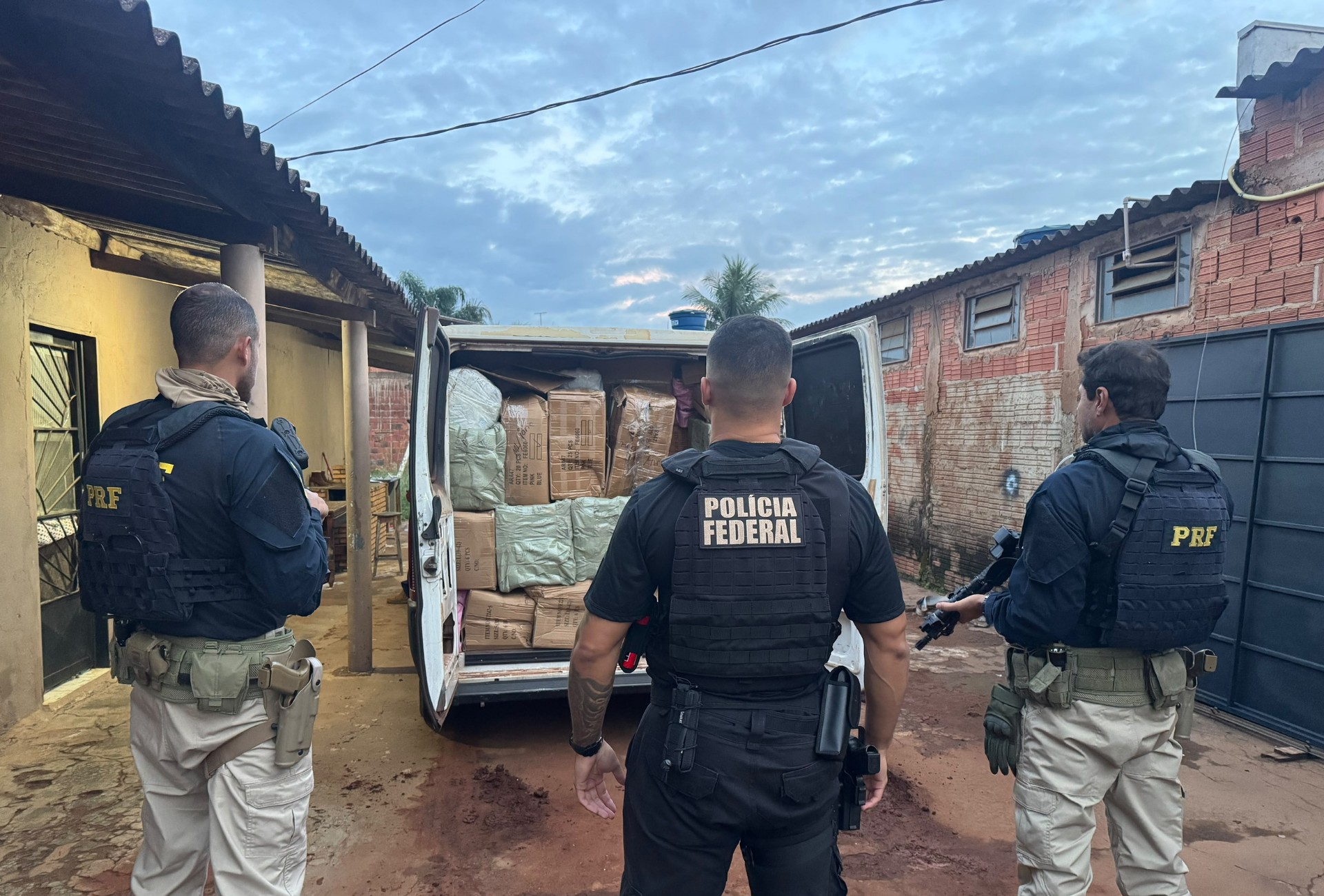
PF arrests leaders of gang suspected of moving almost R$500 million in cigarette smuggling in MS
⚡ Quick Summary
Smuggling network used warehouses in Campo Grande Federal Police The Operation Rota Clandestina investigation revealed a structure considered sophisticated by the authorities to bring cigarettes from Paraguay, store them in Campo Grande and distribute them to different Brazilian states.
Smuggling network used warehouses in Campo Grande
Federal Police
The Operation Rota Clandestina investigation revealed a structure considered sophisticated by the authorities to bring cigarettes from Paraguay, store them in Campo Grande and distribute them to different Brazilian states.
Between 2019 and 2024, those investigated moved R$425.7 million, according to bank and tax data analyzed during the investigation.
✅ Click here to follow the g1 MS channel on WhatsApp
Now on g1
During the investigation, the Federal Police identified an organization with a division of tasks, a defined chain of command, companies used for financial transactions and logistics that involved warehouses, trucks, smaller vehicles and even escorts to accompany the cargo.
Five people were arrested in the operation:
Alexandre Leite do Nascimento: Appointed as the "treasurer" and right-hand man of the boss, responsible for financial control;
Emerson Inácio Caviglioni: Responsible for storage logistics and cargo movement in Campo Grande;
Emerson Renner de Sousa Caviglioni: Son of Emerson Inácio, worked in logistical assistance and storage;
Matheus da Silva Guerra: Responsible for storing and transporting cigarettes in smaller vehicles to transshipment points;
José Luiz Machado: Owner of a transport fleet used for the interstate distribution of illicit goods.
g1 did not find the defenses of the arrested suspects.
The head and treasurer of the scheme
According to the Federal Police, Willyan Paredes Gonçalves was mainly responsible for the criminal organization. Investigations show that he coordinated the purchase of cigarettes in Paraguay, monitored shipments and maintained contact with members responsible for the different stages of the operation.
Alongside him was Alexandre Leite do Nascimento, appointed as the group's financial operator. He was responsible for managing payments, controlling bank transfers and operating clandestine money remittances to Paraguayan suppliers.
Alexandre alone would have moved more than R$62.7 million in bank accounts analyzed by investigators. Willyan recorded a turnover of more than R$26.4 million between 2019 and 2024.
Campo Grande as a distribution center
Investigations show that Campo Grande played a strategic role in the scheme.
After crossing the border between Brazil and Paraguay via clandestine routes, the cigarettes were taken to warehouses in Campo Grande. The city functioned as a large logistical warehouse, where cargo was stored before heading to other states.
Among the locations identified by researchers are properties in Bairro Santa Emília, used to store goods and organize distribution.
From these deposits, cigarettes were redistributed mainly to Goiás and Mato Grosso.
The core responsible for logistics
According to the investigation, Emerson Inácio Caviglioni was responsible for coordinating the organization's logistics in Campo Grande.
Alongside his son, Emerson Renner de Sousa Caviglioni, he organized the storage of goods, contact with drivers and shipping of cargo to other states.
Matheus da Silva Guerra helped move cigarettes between warehouses and loading points. According to the Federal Police, he used smaller vehicles to transport the goods to places where the trucks received the final load.
Due to their importance in the group's logistical structure, the three had preventive detention ordered by the Federal Court.
How the cigarette route worked
Group moved millions and supplied states with illegal cigarettes
Federal Police
The scheme began in the Paraguayan city of Pedro Juan Caballero, where cigarettes were purchased from local suppliers. After purchase, the products were brought to Brazil via alternative routes used to avoid inspections. To reduce the risk of seizures, the organization divided the loads into several smaller vehicles. After arriving in Campo Grande, the merchandise was stored until it was prepared for longer trips.
Investigators identified that part of the shipments used adapted vehicles and trucks to supply buyers in other states.
Fake invoices gave the appearance of legality
To make inspection activities more difficult, the organization used ideologically false tax documents. According to the investigation, the invoices were used to give the appearance of legality for the transportation of smuggled cigarettes during interstate trips.
With irregular documentation, the charges attempted to simulate legitimate commercial operations and reduce suspicion during approaches on highways.
The role of transportation in national distribution
The final stage of the scheme was interstate distribution. The investigation shows that José Luiz Machado was responsible for the fleet used to transport cigarettes to different regions of the country.
Trucks linked to the group were identified in several seizures carried out by security forces between 2023 and 2025.
Due to his participation in transporting the cargo, he was also placed under preventive detention by the courts.
More than 1 million packs seized
During the investigation, at least 12 major seizures associated with the criminal organization were identified. Combined, the loads exceed 1 million packs of cigarettes.
The seizures occurred in cities in Mato Grosso do Sul and Goiás and helped to reveal the continuity of the group's operations, which kept the scheme active for several years.
In addition to smuggling, the Federal Police identified signs of money laundering. The investigators point out that companies and people linked to the group were used to move resources that were incompatible with the declared income.
One of the companies analyzed handled more than R$243 million during the period investigated. Another small company recorded a turnover of more than R$29 million, despite having much lower declared revenue.
According to the Federal Police, the objective was to hide the origin of funds from smuggling and make it difficult to track the values.
Illegal remittances to Paraguay
Part of the money raised from the sale of cigarettes was returned to Paraguayan suppliers through the so-called "cape dollar".
The system works in parallel to the official financial market and allows international transfers without formal registration with control bodies.
According to the investigation, this mechanism was used to pay foreign suppliers and hide the circulation of resources obtained from criminal activity.
Justice blocked assets and values
In light of the financial transactions identified, the Federal Court authorized the freezing of the assets and values of those being investigated. The asset seizure was set at up to R$17.8 million, an amount calculated based on the tax loss caused by smuggling, illegal remittances abroad and the fines that may be applied at the end of the process.
For investigators, the measure seeks to prevent assets accumulated during the organization's activities from being hidden or transferred while investigations continue.
Watch videos from Mato Grosso do Sul:
📰 Related Articles

Senate approves symbolic transfer of federal government headquarters to Salvador on July 2
G1 Globo
US military again bombs vessel in the Pacific accused of drug trafficking; two crew survive
G1 Globo
First-time athletes: see what tests to take before starting to exercise
CartaCapital
Eduardo Bolsonaro is sentenced to 4 years and 2 months in prison for trying to disrupt his father's trial for a coup d'état
G1 Globo
Lucky Day today: contest 1226 results and numbers drawn
G1 Globo