Pedro Miranda e Forró da Gávea seguem o baile nordestino em álbum feito como se o baião ainda fosse a dança da moda
⚡ Quick Summary
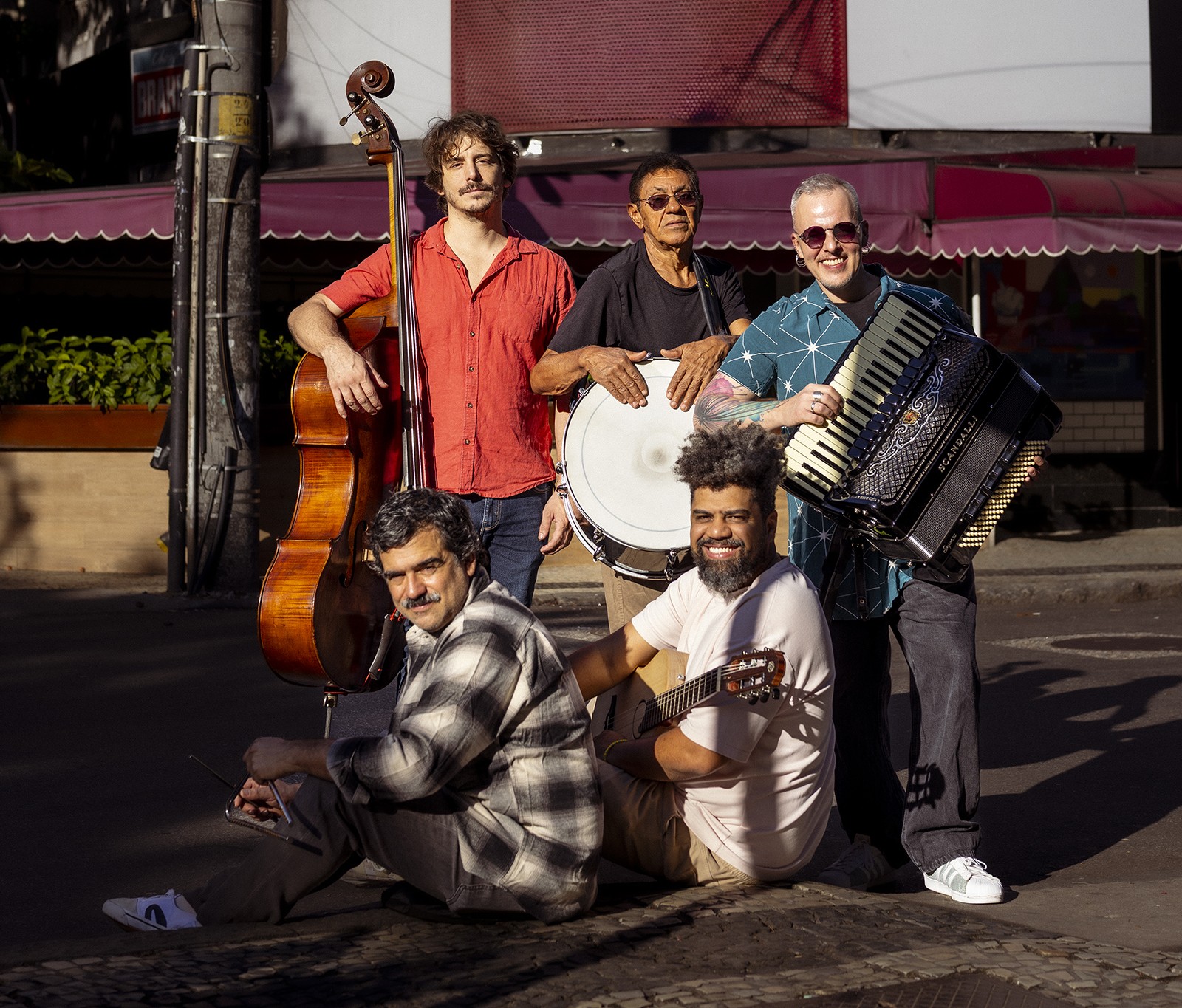
The group Forró da Gávea, created by Pedro Miranda (in a checkered shirt), releases their first album, 'Amor Verdade' Jorge Bispo / Disclosure ♫ ALBUM REVIEW Title: True love Artist: Pedro Miranda and Forró da Gávea Quote: ★ ★ ★ ★ 1/2 ♬ In 2026, baião is no longer the fashionable dance in a market dominated by piseiro and brega-funk, among other imposing subgenres in the profitable northeastern circuit bustling with electronic forró bands and artists.
The group Forró da Gávea, created by Pedro Miranda (in a checkered shirt), releases their first album, 'Amor Verdade'
Jorge Bispo / Disclosure
♫ ALBUM REVIEW
Title: True love
Artist: Pedro Miranda and Forró da Gávea
Quote: ★ ★ ★ ★ 1/2
♬ In 2026, baião is no longer the fashionable dance in a market dominated by piseiro and brega-funk, among other imposing subgenres in the profitable northeastern circuit bustling with electronic forró bands and artists.
However, in 1950, everyone wanted to learn from Luiz Gonzaga (1912 – 1989) how to dance and play the baião – to the point that Gonzaga released a single that year with a baião entitled “A dance da moda” and composed with his partner Zé Dantas (1921 – 1962) with lyrics that dealt with the strong presence of the genre in playlists and dances in the 1940s and 1950s.
This rare gem from 1950 opens the first album by the group Forró da Gávea, “Amor Verdade”, in a recording that combines the voices of Pedro Miranda and Giuliano Eriston. Eriston's presence is justified because it was this young and talented singer from Ceará who brought “A dance da moda” to the repertoire of Forró da Gávea, a Rio collective created by Pedro Miranda in June 2018.
The collective emerged to play xotes, cocos and baião in shows with a ballroom atmosphere, harmonizing the attachment to the traditions of forró – strictly speaking, a generic label that encompasses several musical genres of northeastern origin – and the freedom to go beyond the canons of this northeastern musical universe.
It is this atmosphere of a dance with drag that Forró da Gávea intended to bring to the album published by the record label Biscoito Fino this Friday, June 12th, with a cover that shows the group in a photo by Jorge Bispo and the name of Pedro Miranda highlighted, preceding the name of Forró da Gávea.
Pedro's sagacious singing spans the album between two instrumental tracks that celebrate the playing and legacy of accordion players Oswaldo de Almeida Silva – named after the musician from Rio de Janeiro known as Oswaldinho do Acordeon, currently 72 years old – and José Domingos de Morais (1941 – 2013), Dominguinhos.
The first is revered with the re-recording of “Lamento nordestino” (Oswaldinho do Acordeon and Roberto Stanganelli, 1982), a theme released by Pernambuco singer Sebastião do Rojão (1935 – 2011) and rewound by Forró da Gávea with the touch of accordionist Nandinho Barros. Dominguinhos is greeted with an approach to the original theme “O xote do coice” (1999), recorded by the collective with accordion player Cosme Vieira and saxophonist and flutist Edu Neves.
Between one track and another, Forró da Gávea revisits more or less known songs on the album, making forró popular, but never popular. The vast team of guests values the album recorded with arrangements and musical direction by Rafael dos Anjos, guitarist in the group formed by Durval Pereira (bass drums and percussions), Pedro Aune (acoustic and electric double basses) and Rodrigo Ramalho (accordion).
A Bahian singer active on the Rio alternative circuit, Tâmara Terra forms a duo with Pedro Miranda in “Roendo unha” (1976), a partnership between Luiz Gonzaga and Luiz Ramalho (1931 – 1981) released 50 years ago by Gonzaga and re-recorded in 1983 by Elba Ramalho, information that makes sense on the album due to the fact that Tâmara's vivacious singing evokes Elba's singing.
The most predictable song in forró setlists, the xote “Sabiá” (Luiz Gonzaga and Zé Dantas, 1951) has the softness added by Roberta Sá’s voice. The memory of “Cajuína” (1979) has a special flavor for those who know that the author of the composition, Caetano Veloso, has always been a confessed admirer of Pedro Miranda, a singer skilled in divisions.
Pedro Aune's bass solo on the track signals that, at least on the album, Forró da Gávea escaped the forrozeiro karaoke line, as reiterated by the instrumental passage in the middle of the recording of “Kalu” (1952), a bashful baião composed by Humberto Teixeira (1915 – 1979) and amplified in the voice of star Dalva de Oliveira (1917 – 1972). A rare pearl caught by Forró da Gávea, the title song “Amor Verdade” (Luiz Bandeira and Severino Dias de Oliveira, 1956) is a baião song released 70 years ago by Trio Marayá. With the lapidary singing of Mônica Salmaso, skillful in conveying all the melancholy of the theme, the track “Amor Verdade” shows that the northeastern forrozeiro suffers without losing the rhythm of the dance.
An unusual moment on the album, the environmentalist song “Passaredo” (Francis Hime and Chico Buarque, 1975) gains northeastern harmony, the additional voice of Francis Hime and random instrumental quotes from two bossa nova standards, “O barquinho” (Roberto Menescal and Ronaldo Bôscoli, 1961) and “Garota de Ipanema” (Antonio Carlos Jobim and Vincius de Moraes, 1962).
The album “Amor Verdade” takes up the original route by following the beautiful “Estrada de Canindé” (Luiz Gonzaga and Humberto Teixeira, 1950) at a cadence close to xote. Next, Forró da Gávea brings Teresa Cristina to the dance to revisit “Como é grande e beautiful a Natureza” (Sivuca and Glória Gadelha, 1981) – a song released in the luminous voice of Clara Nunes (1942 – 1983) – and joins Juliana Linhares to revive the xote “Bate Coração” (Cecéu, 1980).
Juliana's presence sounds special because, although the xote was released by the singer Marinês (1935 – 2007) on the northeastern circuit, “Bate Coração” is a song popularized throughout Brazil in the voice of Elba Ramalho, a singer of whom Juliana is a modern follower.
Another song by Cecéu originally recorded by Marinês, “Por Suas Panas” (1978) – a naughty approach to social hypocrisy in lyrics amplified on a national scale in the voice of Ney Matogrosso in 1982 – has the picardy revamped by Pedro Miranda in a recording with singer Marcelo Mimoso and the breath of Carlos Malta.
The album also features the memory of the coconut “Tum tum tum” (Ary Monteiro and Christovão de Alencar, 1958), a hit by Jackson do Pandeiro (1919 – 1982) gracefully covered by the group with Dadi Carvalho and Moreno Veloso, who already used to include “Tum tum tum” in the singer’s show itineraries.
The only new song in the repertoire, “Cada um, cada um” proposes national rhythmic integration in a recording that features singer Moyseis Marques, Pedro Miranda’s partner in the composition. It's a breath of newness in an album in which Forró da Gávea feeds on the memory of the rich and vast northeastern songbook encompassed under the label of forró.
The freshness of Pedro Miranda's singing and the playing of the group's musicians brings together music from different eras and styles, with a true love for forró, as if baião were still the fashionable dance...
Cover of the album 'Amor Verdade', by Pedro Miranda and Forró da Gávea
Jorge Bispo / Disclosure
📰 Related Articles
Flávio asks fans to wear 'Bolsonaro's shirt' at the World Cup, and Lula wants leftists in green and yellow
G1 Globo
Agreement between US and Iran has never been so close, says Iranian foreign minister
CartaCapital
Sharks undergo ultrasound in new research area in Fernando de Noronha; VIDEO
G1 Globo
G7 meets in France to discuss Ukraine and the Middle East
Observador
"Trump seeks victory in Iran to recover politically"
Observador