


World Cup puts authorities on alert for disease outbreaks; measles leads concerns
⚡ Quick Summary
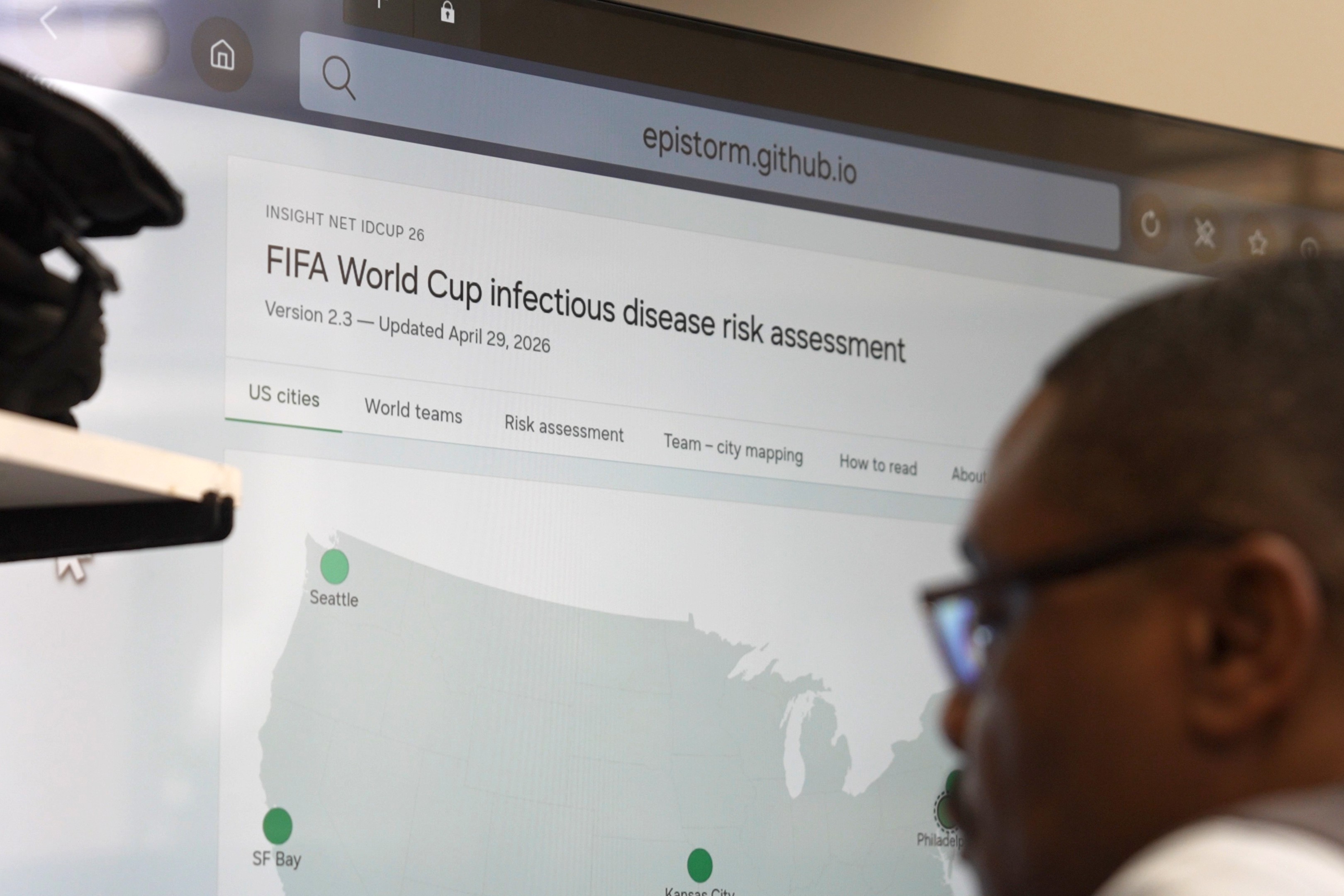
A screen displays infectious disease risk assessments for the World Cup at the Health Security Operations Center at Georgetown University in Washington on June 3, 2026.
A screen displays infectious disease risk assessments for the World Cup at the Health Security Operations Center at Georgetown University in Washington on June 3, 2026.
AP/Shelby Lum
As millions of fans watch the first World Cup games in the United States, Canada and Mexico, a less visible dispute has already begun behind the scenes: the race by health authorities to prevent the tournament from becoming a catalyst for infectious disease outbreaks.
The concern goes far beyond the heat waves predicted for several host cities. Epidemiological surveillance teams are monitoring hospitals, social networks and even city sewage to identify early signs of possible outbreaks amid the movement of millions of people over the next six weeks.
At the top of the list of concerns is measles, one of the most contagious diseases known. The alert gained strength this week after the Pan American Health Organization (PAHO) issued a statement calling for special attention to the risk of transmission during the event.
The concern is not theoretical. The United States has already recorded more than 2,000 cases of measles in 2026, almost the same total recorded throughout last year. At the same time, Canada is facing outbreaks of the disease and Mexico has surpassed the 11,000 case mark.
Now on g1
"Measles is particularly concerning because people can transmit it before they even realize they are sick," explains Rebecca Katz, a global health expert at Georgetown University.
According to PAHO, a single infected person can transmit the virus to up to 18 unimmunized individuals.
In addition to measles, authorities are monitoring a long list of potential threats. These include norovirus — responsible for outbreaks of gastroenteritis and diarrhea —, hepatitis A, rotavirus and diseases transmitted by mosquitoes, such as dengue and chikungunya.
“This is really a marathon,” summarizes Palak Raval-Nelson, health commissioner of Philadelphia, one of the cities that will host matches in the tournament.
Rebecca Katz of Georgetown University points to wastewater data analyzing infectious diseases at the Georgetown Health Security Operations Center in Washington on June 3, 2026.
AP/Shelby Lum
Sewer surveillance to detect outbreaks
One of the authorities' main concerns is the so-called wastewater surveillance.
The strategy consists of analyzing sewage samples in search of genetic material released by viruses and bacteria. In some cases, signs appear days before patients first seek medical attention.
Recent monitoring reports have already identified the circulation of rotavirus, hepatitis A and norovirus in some regions of the United States, which led experts to reinforce attention with the arrival of fans.
In Dallas, for example, monitoring was expanded to include airports and other points of mass movement of people. In addition, local authorities began testing mosquitoes not only for the West Nile virus, common in the region, but also for dengue fever and chikungunya.
What about Ebola?
Although the Ebola outbreak in Central Africa has sparked international concern in recent weeks, experts consider the risk of transmission during the World Cup to be very low.
"Ebola is not the number one, two or even three threat to me," says Craig Spencer, a Brown University doctor who survived the disease after serving during the massive West African outbreak more than a decade ago.
According to him, other infections have a much greater potential to circulate during the tournament.
Jennifer Nuzzo, director of the Pandemic Center at Brown University, highlights that Ebola has characteristics that make it difficult to spread at large events. Unlike measles or other respiratory viruses, transmission occurs through contact with bodily fluids from people who are already symptomatic. “One of the advantages of this virus is that people are more contagious when they are really sick,” he explains.
Pressure on healthcare systems
The challenge comes at a delicate time for American public health.
The Centers for Disease Control and Prevention (CDC) faces budget constraints and staff cuts while simultaneously dealing with different health emergencies.
To reinforce surveillance, Georgetown University and the MedStar hospital network created an operations center that produces daily reports on disease trends in host cities and national team training sites.
Information is shared with hospitals, health departments, emergency responders and federal authorities.
"It's important not to be alarmists," says Shane Kappler, emergency medicine specialist at MedStar. "We're trying to be an extra layer of security."
For experts, the main message to fans is the same as that recommended at any major international event: keep your vaccinations up to date, especially against measles, take care of your hydration during periods of intense heat and adopt basic hygiene measures, such as washing your hands frequently.
The expectation is that the World Cup will bring together tens of millions of people between games, parties, bars and tourist attractions. And, for public health, the tournament will also be a major test of the ability to detect and contain diseases before they gain scale.
📰 Related Articles

Defense Minister resigns after disagreements over spending
ObservadorAccident between two cars leaves two people injured on Via Dutra, in Resende
G1 Globo
Strike in Taubaté: Meeting between city hall and union ends with proposal that will be voted on in assembly this Thursday (11)
G1 Globo
Executive secretary takes over Saúde de Palmas after arrest of Dhieine Caminski
G1 Globo
'Very moving': Fernanda Torres comments on Jennifer Lopez's praise for the film 'I'm Still Here'
G1 Globo