


Companies admit using AI as a pretext for layoffs and explain reasons
⚡ Quick Summary
Why doesn't anyone respond to your resume? 🤖 Is artificial intelligence (AI) really replacing workers or has it become the perfect excuse to justify staff cuts?
Why doesn't anyone respond to your resume?
🤖 Is artificial intelligence (AI) really replacing workers or has it become the perfect excuse to justify staff cuts? New research carried out in the United States indicates that the second hypothesis may be more common than it seems.
According to a survey by Resume Templates of 1,000 hiring managers, 59% of companies admit to highlighting artificial intelligence when justifying layoffs or job freezes because this explanation tends to be better received than reasons linked to financial difficulties.
Although AI appears as the main reason cited for layoffs, the survey data itself indicates that the technology has not yet replaced workers on a large scale in most companies.
Only 9% of managers say that certain functions have been completely replaced by AI. Already 45% report that technology has partially reduced the need for new hires, while another 45% say it has had little or no effect on team sizes.
The numbers suggest that the main influence of AI has been to increase productivity and slow down future admissions, rather than causing a mass elimination of jobs.
This makes another research result even more relevant: the difference between the effective impact of technology and the way it has been used in corporate communication.
Among the managers interviewed, 17% say that their companies directly use artificial intelligence as a justification for freezing vacancies or promoting layoffs. Another 42% say they do this partially.
In practice, almost six in ten companies recognize that they highlight the role of AI because this narrative tends to be better received by employees, investors and the market in general.
For Kara Dennison, chief career consultant at Resume Templates, there's a simple reason for this.
“AI suggests progress rather than problems,” he says.
According to the expert, mentioning technological innovation conveys an image of modernization and strategic planning. Attributing cuts to financial difficulties can raise concerns about the company's health.
The consultant warns, however, that this strategy may have side effects.
If employees do not perceive concrete changes brought about by technology in their activities, the justification may compromise trust in leadership. Instead of reducing tensions, the speech may end up fueling doubts about the real reasons behind the decisions.
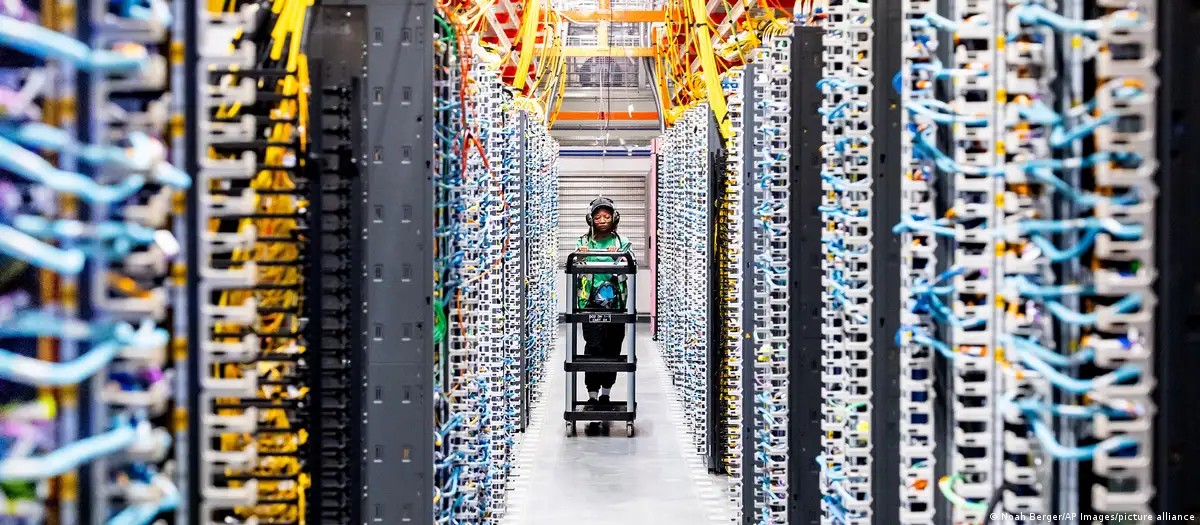
Threat of artificial intelligence to replace human work creates insecurity
Noah Berger/AP Images/picture alliance
Companies continue hiring
Despite concerns about the advancement of automation, research indicates that the job market is unlikely to decline.
Although 55% of companies plan to make layoffs in 2026, 92% say they intend to hire new employees.
The scenario reveals a market in constant movement and a corporate discourse in which artificial intelligence does not always appear only as a cause of changes, but also as a justification.
The result points to a reorganization of teams, in which companies eliminate certain positions while reinforcing others considered more strategic.
The main reasons given for dismissals are:
impact of artificial intelligence, cited by 44%
organizational restructuring, with 42%
budget restrictions, with 39%
According to Kara Dennison, many companies are failing to invest in positions that are less aligned with new business priorities to direct resources to areas linked to efficiency, technology and growth.
“We are seeing a rebalancing of the workforce,” says the expert. According to her, companies are prioritizing "capacity, flexibility and impact" instead of simply maintaining traditional structures. Which professionals continue to be disputed
The survey also helps to identify which profiles remain valued in a market increasingly influenced by artificial intelligence.
The skill most sought after by employers is the ability to solve problems, cited by 54% of managers as one of the three most important skills for new hires.
Then they appear:
ability to quickly learn new tools and technologies, with 44%
communication skills, with 43%
adaptability, with 39%
collaboration and teamwork, with 36%
Interestingly, familiarity with artificial intelligence tools appears behind all these skills, being cited by 31% of respondents.
The result indicates that, although technology is transforming the corporate environment, companies continue to value human skills that are difficult to automate, such as critical thinking, continuous learning and the ability to adapt.
Another fact stands out: only 21% of managers highlighted leadership potential among the priority characteristics for new hires, signaling a greater demand for professionals capable of generating immediate results.
How the research was done
The survey was carried out by Resume Templates in December 2025, with 1,000 hiring managers in the United States.
All participants held positions with direct influence or responsibility for recruitment decisions in their organizations.
Data collection was carried out through the Pollfish platform, using the Random Device Engagement methodology, which recruits participants via mobile devices to increase the diversity of the sample and reduce common biases in online surveys.
According to the company, the responses were anonymous and went through quality control mechanisms before the results were released.
📰 Related Articles

PSU will force disabled young people into social work
Observador
The team leaves Leiria with a 100% winning record
ObservadorCommunication Agency - ABF Expo 2026: Yungas highlights the role of AI as a pillar of franchising expansion
Estadão Blue Studio
The Cavalhadas of Vildemoinhos, the virtuosity of a legend
Observador
Going on vacation? Medications you can't forget
Observador