Tren de Aragua: how Venezuelan faction in Trump's sights acts in Northern Brazil
⚡ Quick Summary
Tren de Aragua: the American siege on Venezuelan drug traffickers generates tension in the region At the beginning of 2025, the Roraima police located a clandestine cemetery in a forested region of Boa Vista.
Tren de Aragua: the American siege on Venezuelan drug traffickers generates tension in the region
At the beginning of 2025, the Roraima police located a clandestine cemetery in a forested region of Boa Vista. There, at least nine bodies were found, most of them Venezuelan victims.
According to investigations, the bodies were buried after homicides committed by different criminals. The witness responsible for taking the police to the location acted as a scout for the Tren de Aragua criminal group and stated in his statement that he was being persecuted by the faction, which also kidnapped his family.
This is just one of the cases registered by Roraima authorities involving the Venezuelan group, which is now present in at least four municipalities in the state.
Originally founded in a prison in north-central Venezuela, around 60 km from the capital Caracas, the criminal organization also operates in several other South American countries, such as Colombia, Bolivia, Peru and Chile.
Last year, the group came into the crosshairs of American President Donald Trump, when it was classified as a foreign terrorist organization by the United States Department of State, the same designation given to the Brazilian factions Primeiro Comando da Capital (PCC) and Comando Vermelho (CV) more recently.
According to the American government, Tren de Aragua, also known in Brazil by the acronym TDA, is a "brutal" group involved in kidnappings, extortion, human trafficking for sexual exploitation, smuggling of goods and migrants, illegal mining, drug trafficking and robbery.
The United States also accuses the organization of having maintained links with the government of Nicolás Maduro, who is currently awaiting trial in the American courts for narco-terrorism, drug trafficking and illegal possession of weapons.
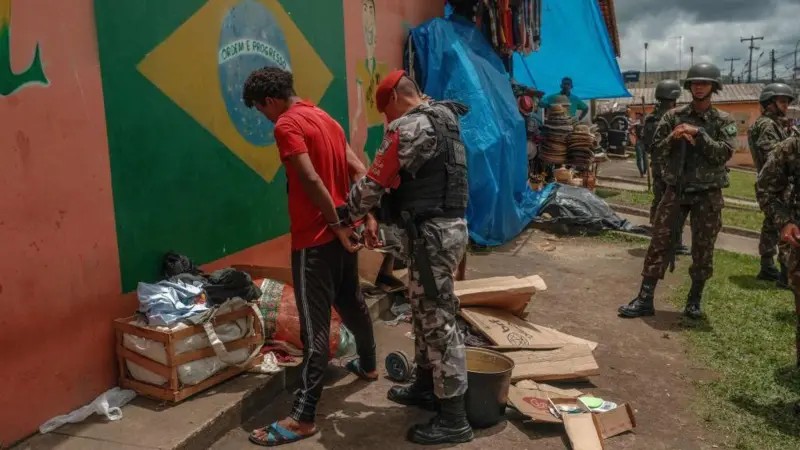
Tactical Force police officers arrest a man for allegedly selling drugs on the border with Venezuela, in 2019
AFP via Getty Images
From Tocorón to Roraima
Even before entering Trump's sights, the TDA suffered a major blow to its structure when, in September 2023, the Venezuelan government regained control of the Aragua Penitentiary Center.
The prison, which became popularly known as Tocorón, the same name as the city where it is located, is considered the birthplace of the faction and was in the hands of the so-called pranes (criminal leaders) since the beginning of the 2010s.
Just under three years ago, an operation led by the Ministries of Justice and Interior of the government of then President Nicolás Maduro invaded the site and took control.
The seizure of the prison was seen by experts and researchers on the subject as significant for the future of the criminal organization. The group was significantly weakened and lost much of its political coverage and allies in the state.
Local press reports, however, indicate that the criminal leaders were warned about the intervention in advance and managed to leave the area with weapons and money.
Currently, one of the gang's main strongholds is controlled by Yohan José Romero, also known as Johan Petrica, in Las Claritas, one of the last Venezuelan cities before a large forested area that borders Brazil.
It is from there that orders for criminals operating in Brazilian territory are believed to come from.
There are reports of Tren de Aragua's presence in at least six states in the country, but the group has consolidated itself mainly in the North region, closest to Venezuela.
In Roraima, where the police believe the largest cells are located, the organization grew stronger through drug and weapons trafficking, control of prostitution rings, transport of migrants, loans and extortion.
Ronna Rísquez, journalist and author of the book O Trem de Aragua: The Group that Revolutionized Organized Crime in Latin America, states that the first signs of infiltration by one of the faction's arms in Brazilian territory date back to 2016. In Roraima, criminals would have found friendlier living conditions than in Venezuela, where they were already known and sought after, as well as ways to expand their businesses and launder their illicit money.
"Venezuela was in a complex humanitarian emergency situation [at the time] and the Brazilian side was safer, had better conditions", says the researcher. “Little by little they started buying properties and settling down.”
Named as one of the "fathers" of the TDA, drug trafficker Johan Petrica would have traveled freely across the border with Roraima for years and even had a son in Brazil, according to Rísquez.
Johan Petrica and three other members of the faction were indicted for terrorism and international drug distribution by the United States Attorney's Office in December last year. His whereabouts are currently unknown to authorities.
Presence of the Aragua Train in Roraima
Graphics by Caroline Souza, from the BBC News Brasil visual journalism team
Drug mining across the border
The border city of Pacaraima serves as an entry and exit point for the movement of criminals between the two countries.
"The border is made up of low vegetation that does not represent an obstacle to crossing. This is very conducive to illegal activity, for transporting drugs, weapons or people walking past", says delegate Wesley Costa, from the Civil Police.
The clandestine routes and irregular trails that cross the border area, known as trochas, mark the surrounding landscape and have become a symbol of the penetration of crime in the city.
Through trochas, weapons diverted from Venezuelan authorities are frequently transported, according to the police. The vast majority of them end up in the hands of miners.
Today, illegal mining is responsible for an important part of the profits of Tren da Aragua in Brazil, according to Rodrigo Chagas, senior researcher at the Brazilian Public Security Forum (FBSP) and one of the authors of the 2025 Cartographies of Violence in the Amazon report.
Drug dealers at a drug sales point on the outskirts of Boa Vista, Roraima, Brazil
Getty Images
In addition to selling weapons, criminals are also involved in the trafficking of fuel, food and machinery that supplies mining areas, says Chagas.
"Pacaraima is a logistical and strategic hub for the Brazil-Venezuela relationship, while Boa Vista is where things happen", points out the sociologist, referring to the highest crime and violence rates recorded in the state capital.
Venezuelan criminals were also known for recruiting Venezuelan women to act as sex workers in mining areas, according to experts.
The faction's connection with mining, however, dates back long before the infiltration in Brazil. The group controls gold extraction in Las Claritas, whose deposits are among the largest and most productive in the country, since at least 2010.
It was through these businesses that one of the faction's arms established itself and grew in the border region.
This also gave rise to Tren da Aragua's partnership with Brazilian criminal organizations, especially the PCC and the CV.
The increased presence of Venezuelan gang members, including the TDA, in Brazilian prisons would also have contributed to this union, says Rísquez.
Venezuelan immigrants accused by the US of belonging to the Tren de Aragua criminal gang in El Salvador
Anadolu via Getty Images
The level of collaboration between criminals is not yet fully known. But it is known that the part of the weapons diverted from Venezuelan security forces that does not go to mining ends up in the hands of Brazilian factions in the Southeast of Brazil, according to delegate Wesley Costa, from the Civil Police.
The city of Rorainópolis, the second most populous municipality in the State, serves as a base for this flow towards the Amazon, explains the researcher. And high-caliber weapons, which are more useful outside Roraima, are sold there and in Rio de Janeiro.
The business also extends to drug trafficking, with evidence of some level of collaboration in the transport and distribution of cocaine shipments coming from Colombia.
"This symbiosis was born from this local situation in which we have the Brazilian consumer market, the Colombian supplier market and a corridor controlled by this criminal faction", details Costa.
"The drugs have flowed through this corridor, whether by land, air or even river, flowing through the State of Roraima to other distribution points in Brazil and even to other countries, in a partnership arrangement with Brazilian factions, specifically with the PCC and part of the CV."
Within Roraima, more specifically in Boa Vista, the Tren da Aragua supplies a micro-trafficking scheme aimed especially at Venezuelans, according to experts, focused mainly on skunk, a stronger type of marijuana.
Violence and intimidation
It is, in fact, the Venezuelan community that currently lives in the North of Brazil that suffers the greatest impact from the violent actions of criminals.
Immigrants are constant targets of recruitment and extortion attempts, according to sources in Boa Vista and Pacaraima interviewed by BBC News Brasil.
At the height of the migration flow to Brazil, starting in 2018, the shelters set up by Operação Acolhida became a center of crime, with several recorded cases of sexual violence and assaults motivated by contracting debts with members of the faction.
It is estimated that more than 1.4 million Venezuelans migrated to Brazil between 2018 and the end of 2025, with more than 700,000 remaining in the territory.
Many Venezuelan gang members have infiltrated these numbers, says the Civil Police.
Tren da Aragua is not the only group operating in Roraima and, often, it is difficult to pinpoint which organization the criminals swore allegiance to, also points out Rodrigo Chagas, from the FBSP.
"But everything indicates that the relationship [of the TDA] takes place by acting on Venezuelan immigrants, taking advantage of their vulnerability", says the sociologist and professor at the Federal University of Roraima (UFRR).
Part of the problem pointed out by experts is when entering Brazil, where human smuggling networks and coyotes linked to factions charge for clandestine transportation and security.
In Brazilian territory, in shelters intended to welcome refugees, the infiltration of factions has decreased considerably since the height of the migration crisis, according to different sources heard by BBC News Brasil.
But the fear caused by Venezuelan gangs was — and still is in some cases — a constant theme for many families who sought a life in Brazil far away from the humanitarian crisis that hit the neighboring country.
A person involved in humanitarian efforts aimed at Venezuelan refugees in Boa Vista, who preferred not to be identified, reported several cases in which, taking advantage of the extreme vulnerability and need of immigrants, criminals recruit them as cheap and easy labor for transporting illegal goods and products between cities and various mining jobs.
Women are also hired under the false pretext of working as cooks, but end up being destined for prostitution.
Upon arriving at the mining areas, these people end up finding themselves in a situation of forced labor, needing to gather grams of gold to pay what they supposedly owe for their transportation and accommodation, says the source interviewed by BBC News Brasil.
According to her, immigrants who defied the imposed rules or tried to escape the group suffered heavy attacks or were victims of cruel murders.
Reception shelters also faced many problems with criminals charging immigrants fees to access areas within the complexes or to receive food that should be free. "I received a report from a girl who had stones thrown at her tent at the shelter every night and had to get up to have sex with the criminals, as they threatened revenge against her and her mother," says the source.
The allegations of abuse and extortion were revealed for the first time in a series of reports by Agência Pública published in 2024.
At the time, in response to the complaints, the Ministry of Development and Social Assistance, Family and Fight Against Hunger (MDS) said that the Humanitarian Logistics Task Force operates by monitoring and monitoring the environments and structures of Operation Acolhida to dissuade and identify possible threats, activating public security authorities when necessary.
The ministry also highlighted that "military personnel are employed, in addition to hiring companies that provide surveillance services, which, day in and day out, guard the shelters and patrols inside the perimeter."
BBC News Brasil contacted the MDS for further clarification on the measures taken to ensure the safety of shelters, but did not receive a response until the publication of this report.
Brutality on the streets
Cases of violence linked to the Tren de Aragua are not restricted to shelter areas. In addition to the cemetery discovered last January in Boa Vista, other areas where bodies left by the faction were deposited in the city are also being investigated by the police.
There are still many records of barbarities committed by TDA members against rivals from other Venezuelan organizations and even against members of the faction itself as a form of punishment, says Rodrigo Chagas.
According to the sociologist, brutality has already become one of the hallmarks of the Venezuelan faction.
"The Tren de Aragua gained fame for being the group that commits the most acute violence. It is not simply the fact of killing, but killing with very cruelty and aggressiveness."
In recent years, authorities have found decapitated or mutilated bodies, wrapped in mattresses and bags, in forested areas or vacant lots in Boa Vista on several occasions. According to Civil Police investigations, the victims were Venezuelans and were murdered at the behest of criminals from the group.
In the case of the collective cemetery found in Pricumã, in the West Zone of Boa Vista, the police hypothesis is that the dead were targets of the Venezuelan "crime court".
"In Venezuela, the conflict between criminal factions is very fierce", which has led Tren de Aragua to specialize in causing terror as a form of deterrence so that its territorial domains are maintained, says delegate Wesley Costa.
"They brought this same way of acting that they had in Venezuela to Brazil", he says.
Police officers found a collective cemetery in Pricumã, west of Boa Vista, in early 2025
Disclosure/PCRR
In absolute numbers, Roraima recorded 174 homicides in 2024, according to the 2026 Violence Atlas, released by the Institute of Applied Economic Research (Ipea) and the FBSP.
Despite gang violence, the State has shown a reduction in rates, with a 53.8% drop in intentional homicides between 2021 and 2024.
In an interview with BBC News Brasil in January, the state governor, Antonio Denarium (Progressistas), demanded greater inspection of the Venezuelan border with Roraima and stricter legislation for the entry of foreigners into the country.
"We have to have restrictions on the entry of Venezuelans. They have to present a criminal record certificate. Today, they [criminals] are entering as refugees," said the governor.
Denarium also criticized the costs in the State to serve Venezuelans who arrive daily and said he wants to build an exclusive pavilion for foreign prisoners in the State penitentiary, with resources that will be received from the federal government.
"When Venezuela's criminal factions are cornered, they leave and enter Brazil through Roraima. They work with the trafficking of drugs, weapons, people, embezzlement, bringing illegal goods to Brazil and selling them," he said.
"Roraima has the second largest border in Brazil. There are more than 2 thousand km of border. For those in Pacaraima, to enter Venezuela, just take one step and you're already on the other side."
When contacted by BBC News Brasil, the Federal Police did not comment on the governor's statements.
🗞️ 1 sources covered this story
📰 Related Articles

Mourinho says goodbye and thanks for the “honor” of coaching Benfica
Observador
CR7's last dance is the highlight of Group K of the World Cup
Agência Brasil
Brazil, Messi, Klose and more: the teams and players who hold World Cup records
BBC Brasil
Mussolini's reconquest of the World Cup before the Great War
Observador
Web Summit: experts argue that Brazil should create its own model to regulate AI and criticize text under discussion in Congress
G1 Globo