


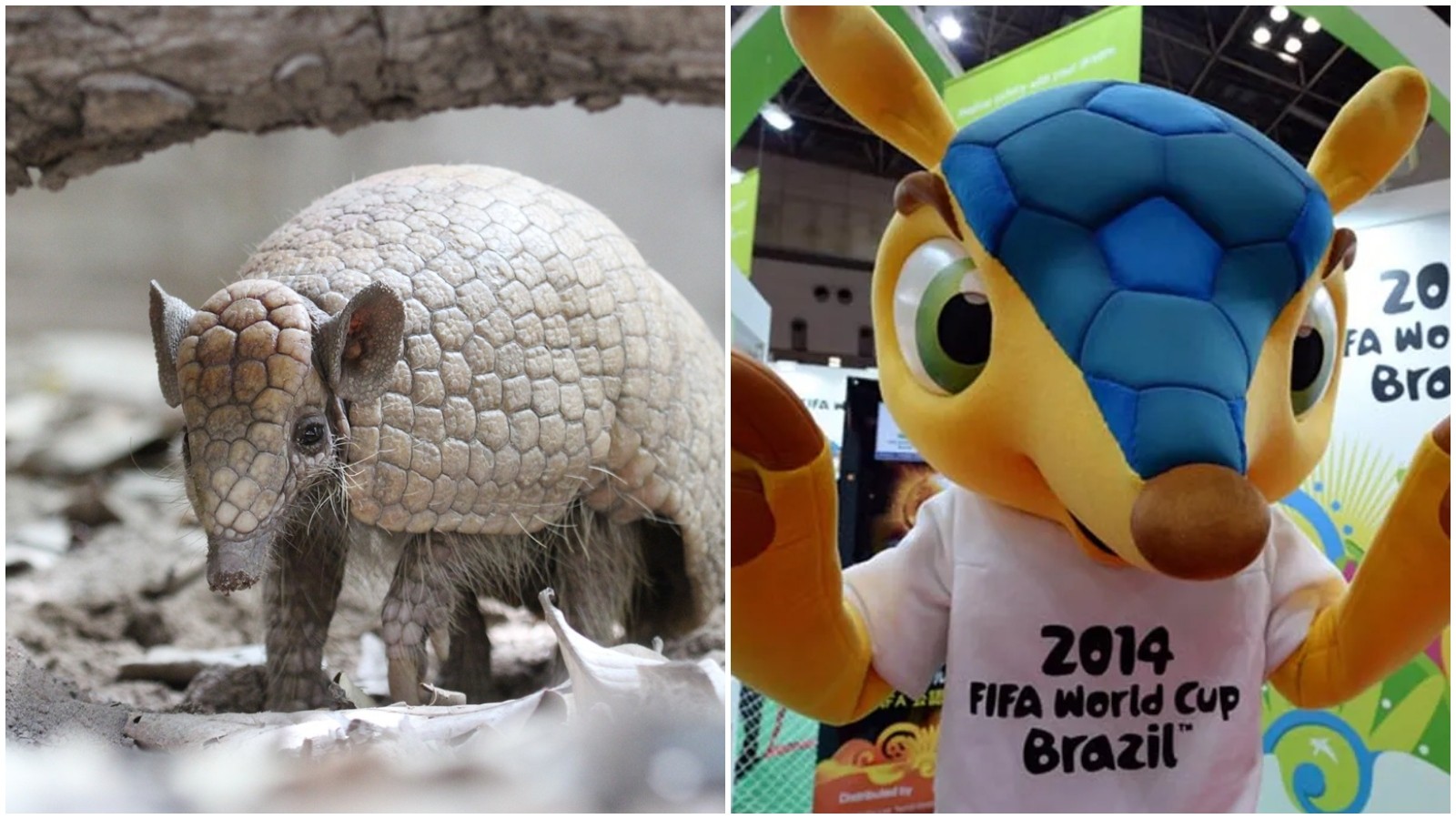
The three-banded armadillo remains threatened with extinction 12 years after inspiring the 'Fuleco' mascot for the World Cup in Brazil
⚡ Quick Summary
Armadillo remains threatened with extinction 12 years after inspiring mascot 'Fuleco' Smaller than a football and an exclusive species of Brazilian fauna, the nine-banded armadillo marked the 2014 World Cup hosted in Brazil by inspiring the championship's official mascot, Fuleco.
Armadillo remains threatened with extinction 12 years after inspiring mascot 'Fuleco'
Smaller than a football and an exclusive species of Brazilian fauna, the nine-banded armadillo marked the 2014 World Cup hosted in Brazil by inspiring the championship's official mascot, Fuleco. Already at that time, the animal was threatened with extinction. ➡️ More than ten years later and close to the 2026 World Cup, the situation is the same.
According to the Caatinga Association, a civil society organization that works to conserve the Caatinga biome, the nine-banded armadillo has lost around 50% of its natural range in the last 27 years and continues to suffer from deforestation and hunting. When chosen as the mascot for the 2014 World Cup, the aim was to debate its preservation. There has been progress, but the scenario is still worrying.
READ ALSO:
IJF patient with spinal cord injury receives polylaminin procedure
Longevity cannot be summarized as life expectancy
To try to alleviate the problem and think of new preservation strategies, the Chico Mendes Institute for Biodiversity Conservation (ICMBio) will begin a new cycle of the PAN Tatá — National Action Plan for the Conservation of the Giant Anteater, Giant Armadillo and Giant Armadillo.
A species that is a symbol of Brazilian biodiversity, it has lost around 50% of its natural range and continues to suffer from deforestation and environmental degradation in the Caatinga and Cerrado.
Samuel Portela/Caatinga Association
Samuel Portela, Biodiversity Conservation coordinator at the Caatinga Association, explains that PAN Tatá brings together experts from across the country and outlines general and specific objectives for each species. For the coordinator, this new edition of the World Cup could be an important moment to remember and reflect on the preservation of 'Fuleco'.
"PAN Tatá has several actions related to reducing habitat loss, such as creating new conservation units, expanding existing conservation units, restoring degraded areas, etc. It has actions to combat forest fires, actions to reduce roadkill of these species and more. Based on the threats that are identified, a list of objectives and actions is drawn up."
Armadillo is classified as vulnerable to extinction
The animal has the ability to completely curve its carapace over its body to protect itself.
Samuel Portela/Caatinga Association
Currently, the nine-banded armadillo is classified as vulnerable to extinction. This means it faces a high risk of disappearing from the wild. In the same situation are other animals such as the Tapir, the Maned Wolf and the Jaguar, according to ICMBio.
An updated institute report on fauna in Brazil brings a worrying warning: 1,264 species are threatened with extinction in the country. The document points out that the main threat factors are linked to human activities, such as agricultural and livestock expansion, urbanization and pollution, and mining.
Ceará has a worrying scenario
Exclusive to Brazilian fauna, the nine-banded armadillo occurs in two biomes: the Caatinga and the Cerrado.
Samuel Portela/Caatinga Association
If the situation is delicate nationally, Ceará has an even more alarming scenario. According to Samuel Portela, the nine-banded armadillo appears in the state as critically endangered, one of the most extreme statuses.
"In Ceará, there are very few records of this species. We had an occurrence in 2023 in Crateús and another in the Cariri region. It is a species that within the state can almost be said to be extinct. There is a larger occurrence towards Piauí, Bahia... The list of fauna threatened with extinction in the state of Ceará is quite large", comments Samuel.
The reasons that led to the almost complete extinction of the nine-banded armadillo are hunting and the loss of its natural habitat. With the reduction of forests, expansion of cultivation areas and fires, the environments of this species are harmed and, gradually, the animal disappears.
More than 1,200 Brazilian fauna are threatened, says ICMBio. Marcelo Cabral / Agência Brasil
In addition to inspiring a charismatic mascot, the nine-banded armadillo functions as a "nature thermometer" and plays an essential role in maintaining the ecosystem. The absence of this species in a region may mean that the location has undergone a negative transformation and is no longer a stable environment for the animals.
"It is a symbol of conservation. It is an animal that likes open areas, that type of more spaced-out caatinga. We have the nine-banded armadillo as a flag or umbrella species. The environment in which it lives is, in most cases, more conserved, naturally stable. If it is there, it is because the environment is good."
The Tolypeutes tricinctus does not receive the popular name of armadillo for nothing. Small, it can weigh around two kilos when adult, but has the ability to completely curve its carapace over its body to protect itself. This way, it stays in the shape of a ball and prevents predators from approaching, which are unable to penetrate the carcass.
Despite the strategy, it becomes easy prey when carrying out this movement, as hunters can easily pick it up from the ground. The creature is generally nocturnal and digs shallow burrows. The nine-banded armadillo feeds on termites and other insects, as well as small fruits during the rainy season.
For shelter, they can also use depressions in the ground or cover themselves with leaves. During the mating season, more than one male can be seen accompanying the same female, which makes it easier to capture several specimens at a time.
If you find this animal in its habitat, simply leave it there. But if it is outside its natural environment, such as in someone's home, you should contact ICMBio or Ibama. These bodies will collect the species, assess whether it is capable of returning to the wild and provide the appropriate destination. If the animal cannot be returned to the environment, it will likely be sent to a zoo to assist with conservation and reproduction efforts.
In more than ten years, what has changed?
Expert warns of degradation of the Caatinga and possible extinction of the armadillo
Researcher Samuel Portela was one of the experts who fought for the nine-banded armadillo to be elected mascot for the World Cup in Brazil in 2014. The Caatinga Association launched the campaign, which had the city of Crateús as its main base, with the aim of expanding the debate on environmental preservation.
After being elected, the animal became a symbol of the city and even received a sculpture made of gears in the city's central square.
Armadillo was given a sculpture made of gears in the central square of Crateús.
André Teixeira/g1
"It was chosen after a heavy campaign that we carried out so that the biggest sporting event in the world would also leave an environmental legacy for the host country. We managed to initiate some actions related to its conservation, identifying new areas of occurrence, mainly in Buriti dos Montes, in Piauí, and proposing the creation of new conservation units in these areas", explains Portela.
The biggest advance, according to the coordinator, was the creation of protected areas totaling 24 thousand hectares in places where the species occurs. This resulted in the creation of two state parks:
Rio Poti Canyon State Park (on the edge of Ceará, but belonging to Piauí);
Later, the Cânion Cearense do Rio Poti State Park.
➡️ With the new PAN Tatá cycle, the species should gain new preservation strategies.
"Given what the species needs, we are still in our infancy (in relation to preservation strategies). We still need a lot of support to implement new actions, public policies focused on expanding conservation units to protect these areas where the species occurs", warns Samuel.
Fuleco, the World Cup mascot, at Maracanã.
Alexandre Durão / G1
After the mobilization in 2014, 'Fuleco' became popular with the Brazilian public. He received a uniform with the national team's colors and even a blue shell. The name was chosen in a vote carried out by TV Globo and competed with Zuzeco and Amijubi. Who remembers?!
Exactly 12 years later, Brazil is preparing to compete in another World Cup, which will take place in the United States, Mexico and Canada. There will be three mascots, also animals that represent the countries: bald eagle, jaguar and an elk, respectively.
"The best thing is to bring this issue back, so that the name of the species is on the agenda again, remember that the nine-banded armadillo exists, it is exclusively ours. The message we have is to take care of our habitat, our forests, try to preserve it. We can do our homework", concludes Samuel Portela.
Armadillo inspired the Fuleco mascot at the 2014 World Cup in Brazil.
Samuel Portela/Associação Caatinga and Toshifumi Kitamura/AFP
Watch the most viewed videos from Ceará:
🗞️ 4 sources covered this story
Who gets points and who is threatened in the team after Brazil draws with Morocco
O GloboAfter failure, Apple reformulates Siri with a focus on the AI market
Correio BrazilienseKnicks are lethal in the end, beat Spurs and are NBA champions after 53 years
CNN Brasil
Who was the young woman killed after being thrown from a rope jump without a rope in SP
CNN Brasil📰 Related Articles

The kneeling apology that the Vatican made to people in Peru: 'They did what they wanted with us because we are poor'
G1 Globo
Brazil x Morocco: Renan Santos gets the result right; see predictions for Lula, Flávio Bolsonaro and other presidential candidates
G1 Globo
Pix worth R$0.01 helped former student identify teacher accused of sending sexual messages; understand
G1 Globo
'I don't make any more plans for 2035': man who held a wake in his lifetime creates a list of dreams to live now
G1 Globo
What is known about the family scheme investigated for international drug trafficking in MG
G1 Globo