With an eye on Paulistão 2027, Juventus accelerates renovation of listed stadium in Mooca before it even has a permit
⚡ Quick Summary
Fences and benches are demolished at the iconic Juventus stadium in SP Started in May by Clube Atlético Juventus, the works to renovate the iconic stadium on Rua Javari, in Mooca, East Zone of São Paulo, have not yet been duly authorized by City Hall and Conpresp (municipal council for the defense of the city's heritage).
Fences and benches are demolished at the iconic Juventus stadium in SP
Started in May by Clube Atlético Juventus, the works to renovate the iconic stadium on Rua Javari, in Mooca, East Zone of São Paulo, have not yet been duly authorized by City Hall and Conpresp (municipal council for the defense of the city's heritage). As it is a listed complex due to its architecture and historical value, approval from the body is mandatory before any intervention.
According to residents and traders interviewed by g1 around the stadium, the works began a few days after Juventus beat Ferroviária in the final of the A2 series of the Campeonato Paulista, on May 13, guaranteeing their return to the elite of state football after 19 years.
Since then, the movement of workers and construction noise have become constant. At the end of last month, a neighbor recorded the moment when the fence and concrete benches were demolished by a machine (see below). A side stand and a futsal gym near the Javari Street entrance were also completely demolished.
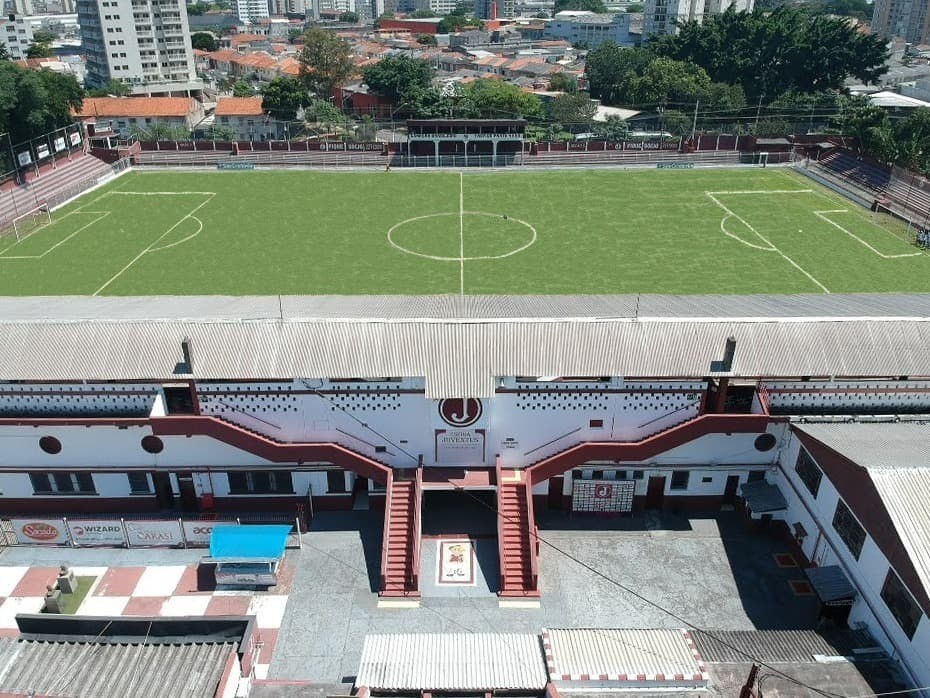
Conde Rodolfo Crespi Stadium, home of Juventus da Mooca, before the renovation began. Gym on the right in the image has already been demolished.
Clube Atlético Juventus/Disclosure
According to the city hall, the request for restoration of listed buildings, demolition of unprotected annexed buildings and new interventions at the Juventus stadium is still under technical analysis by the Department of Historical Heritage (DPH). Only after the evaluation has been completed will Conpresp be able to authorize or not authorize the works. A request for a permit to renovate the property is also being analyzed by the Municipal Department of Urban Planning and Licensing.
"The ongoing evaluation considers whether the project meets the requirements of restoration, conservation and requalification of the listed property, as well as the feasibility of carrying out the interventions in partnership with SAF-Juventus", says a note sent to g1 by the Municipal Department of Culture.
When asked about a possible punishment for the club for starting work before the demonstration on authorization, the municipal management did not respond.
When contacted, the Sociedade Anônima do Futebol (SAF), which runs Juventus, did not want to detail the project or the current size of the works. Last week, however, the team's official store began selling original numbered chairs and pieces of the fence on social media. "Eternalize a piece of Javari", says the advertisement.
One of the main objectives of the renovation is to expand the stands so that the stadium can accommodate up to 15 thousand fans, tripling the current capacity. With this, the team will meet the parameters required by the São Paulo Football Federation to host matches from the A1 series of the Campeonato Paulista at home next year.
SAF was questioned, but did not want to comment on possible irregularities in the early start of works.
SAF-Juventus started selling original chairs and pieces of the Javari Street fence
Reproduction/Instagram
Stadium is São Paulo’s heritage
Opened in 1941, the Conde Rodolfo Crespi Stadium had its architectural characteristics recognized as a heritage of the city of São Paulo in 2016.
Years later, a Conpresp resolution defined that the walls, the main entrance and the ticket offices on Rua Javari must be preserved, as well as the bleachers, the general stands (lowest sector and closest to the fence) and the football field, among other areas. The council also established that buildings built on the land after the original project can undergo changes and even be demolished, but that there must be a "case-by-case assessment".
In March, SAF-Juventus sent a restoration and renovation project for the sports complex to the city hall. A photographic report indicates a series of damages and degradations, such as cracks and infiltrations, which compromise the stadium's structure. The document also highlights the architectural deterioration suffered over the years with the construction of "spurious buildings" that impair the visual reading of the listed property – among them is the gymnasium that was demolished in May.
Project foresees the construction of a new building in place of the demolished gym on Rua Javari
Reproduction
For architect and urban planner Silvio Oksman, a specialist in heritage preservation, the renovation began in May irregularly. "If it's still 'under approval', nothing can happen there," he says.
The restriction, according to the expert, is general until Conpresp's decision: "no matter how much the resolution says what should be preserved, the listing is done on the lot. In principle, everything that happens inside should go through the council", says the partner at the Metrópole Arquitetos office.
On the other hand, he assesses that Conpresp was vague in defining only the procedure for authorizing interventions in non-listed areas of the stadium as a "case-by-case assessment". For him, the document should more clearly define the mandatory approval by the council in these cases.
Juventus Stadium in Mooca is listed and structure must be preserved
Resource for restoration was diverted
The presentation of the restoration project for the Conde Rodolfo Crespi stadium marks a turning point for Juventus, which, last year, was fined by the city hall and had former directors investigated by the police on suspicion of embezzling money that was supposed to pay for conservation and restoration work on the stadium.
In 2022, the club declared that it did not have the financial capacity to carry out the renovation and obtained authorization from São Paulo City Hall to sell the unused "constructive potential" in the property, which has limitations on expanding its built area due to the listing. With the operation, Juventus raised around R$ 2.3 million that should be applied to the conservation of the listed heritage, according to the commitment signed with the municipal management.
🔎The São Paulo Master Plan of 2014 establishes that entrepreneurs need to pay the city hall a fee called "onerous grant" to build taller buildings. The Transfer of the Right to Build (TDC) allows him to buy additional "construction potential" from owners of listed properties, usually for a lower price, instead of paying the fee directly to the public coffers. In theory, the money paid in this transaction should be used to conserve assets.
After almost three years, however, the club had not even presented the project to restore the stadium. In 2025, default generated a contractual fine calculated at R$2.9 million by the city hall, in addition to the full return of the amount collected to the Cultural Heritage Protection Fund (Funcap).
Facade of the Clube Juventus stadium, in Mooca, East Zone of São Paulo. Mythical stadium on Javari Street.
Disclosure/Juventus
During the transition process to the SAF, the new board found evidence of misappropriation of resources, which would have been used to pay off personal loans from former directors. The case became the target of an internal investigation and a police investigation to investigate the crimes of major embezzlement, embezzlement and criminal association involving four former managers of the club.
According to the Public Security Secretariat (SSP), the case is currently investigated as money laundering by the Citizenship Protection Police Department. "The investigation identified companies suspected of paying for transfers and efforts are continuing to clarify the final destination of such resources", says a note sent by the department.
Faced with evidence that the institution was a victim of its own administration, Conpresp decided to suspend the fine against Juventus while it analyzes the project presented in March. A definitive decision on the punishment will only be made after technical analysis has been completed.
📰 Related Articles

Seguro receives selection before departure for the World Cup
Observador
VIDEO: With adapted bar, 3-year-old crossfitter boy imitates training and goes viral on social media
G1 Globo
New road connections boost residential megaproject in Alto Tietê
G1 GloboTurma do Pagode in Fantástico; see the songs
G1 Globo
Santos' priority will be to provide quality to the squad in the window, says president
CNN Brasil