Unpublished map reveals that underground fungi form a network of 110 quadrillion km; understand
⚡ Quick Summary
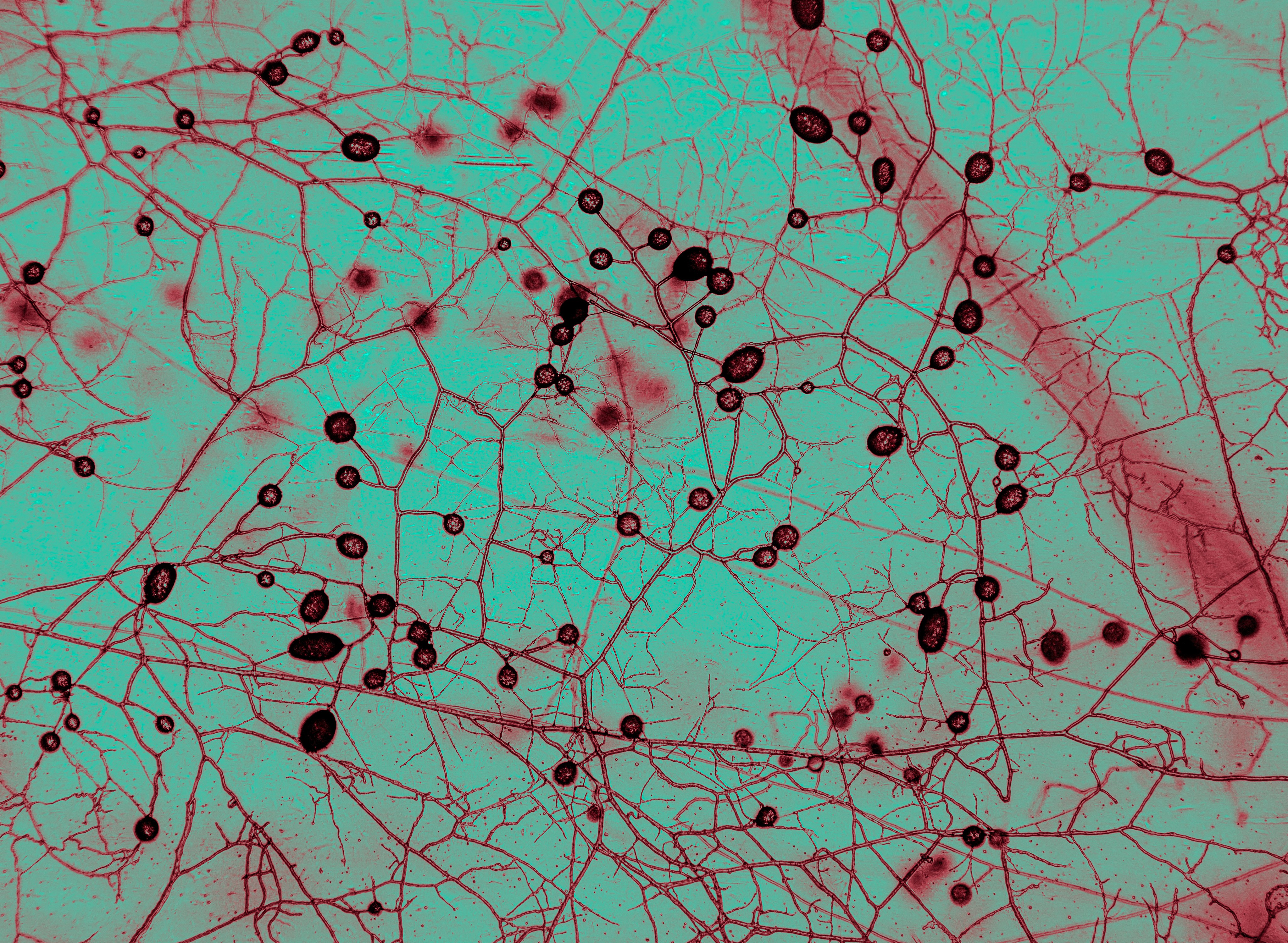
Mycorrhizal fungi seen under a microscope at the AMOLF biophysics institute in Amsterdam. The circular structures are spores; colors have been changed to make viewing easier.
Mycorrhizal fungi seen under a microscope at the AMOLF biophysics institute in Amsterdam. The circular structures are spores; colors have been changed to make viewing easier.
Tomás Munita
It's very likely that beneath your feet, right now, there is one of the largest living structures on the planet: a dense network of microscopic fungi that runs through the soils of the entire world, connects plant roots and, without anyone noticing, helps regulate the Earth's climate.
A study published this Thursday (11) in the journal Science mapped this infrastructure for the first time — and the numbers are impressive.
To see where these networks are most dense and where they are most threatened, researchers have released a free interactive map that allows you to explore any point on the planet. Access here (in English).
The filaments of these fungi, called hyphae, are around 110 quadrillion kilometers long.
☀️🌍 To give you an idea: this extension is equivalent to almost a billion times the distance from Earth to the Sun.
"It's hard to overstate the importance and immensity of these fungi," said Justin Stewart, lead author of the study. "There can be up to 10 meters of fungal network in just one teaspoon of soil."
Trending videos on g1
The way it works is simple to understand: these organisms attach themselves to the roots of plants and make an exchange.
They take water and nutrients — they can provide more than 80% of the phosphorus that plants need — and receive back the carbon produced by photosynthesis.
This is why they are present in partnership with around 70% of all plant species on Earth.
But the climate role is what draws the most attention. By absorbing carbon from plants and transporting it into the soil, these networks remove the equivalent of 4 billion tons of CO₂ per year from the atmosphere — 11% of everything humanity emits. Without them, this carbon would remain loose in the air.
Where are they and why is it a concern?
To build the map, researchers analyzed more than 16,000 soil samples collected around the world and used artificial intelligence to estimate the density of networks in regions never before studied.
A high-resolution robot photographed more than 300,000 laboratory-grown filaments to precisely measure their thickness.
NASA investigates anomaly in Earth's magnetic field, which could cause chaos in communications
The result shows that prairies and natural fields concentrate around 40% of all this fungal biomass.
Global map of the density of hyphae of arbuscular mycorrhizal fungi, which live associated with plant roots.
Truth & Beauty/Moritz Stefaner/Justin Stewart/SPUN
Places like the Florida Everglades, the Tibetan Plateau and the swamps of South Sudan have the highest densities in the world.
The problem is that agricultural crops have densities around 50% lower than these natural environments.
And prairies are being converted to farmland four times faster than forests — with almost no legal protections.
"Fungi have been ignored in climate and conservation policy for too long," said Toby Kiers, executive director of the organization that led the study. “Now is the time to change that trajectory.”
VIDEO: Does pollution really make the sky more beautiful?
Does pollution really make the sky more beautiful?
🗞️ 1 sources covered this story

📰 Related Articles

"Trump is a manipulator of perceptions and we are wrong"
Observador
The population can choose proposals from the Participatory Budget starting this Friday (12); more than 800 proposals in 5 cities in PI
G1 Globo
Ford presents car made in Spain with hands-free driving
Observador
Lisbon celebrates Saint Anthony with Marches and weddings
Observador
Marisa Monte debuts at Parque do Povo and is a Valentine's Day attraction at São João de Campina Grande this Friday (12)
G1 Globo