United States agency confirms start of El Niño phenomenon
⚡ Quick Summary
The United States government's National Oceanic and Atmospheric Agency (NOAA) declared that it had observed conditions consistent with the El Niño phenomenon throughout the first week of June.
The United States government's National Oceanic and Atmospheric Agency (NOAA) declared that it had observed conditions consistent with the El Niño phenomenon throughout the first week of June. According to the agency, the phenomenon is expected to continue until the end of winter in the northern hemisphere, in February 2027.
The agency stated that the beginning of the warming period is perceived in measurements along the entire tropical strip of the Pacific Ocean.
Related news:
The South, Southeast and Midwest may have a weekend of intense rain.
Inmet warns of favorable conditions for a new episode of El Niño.
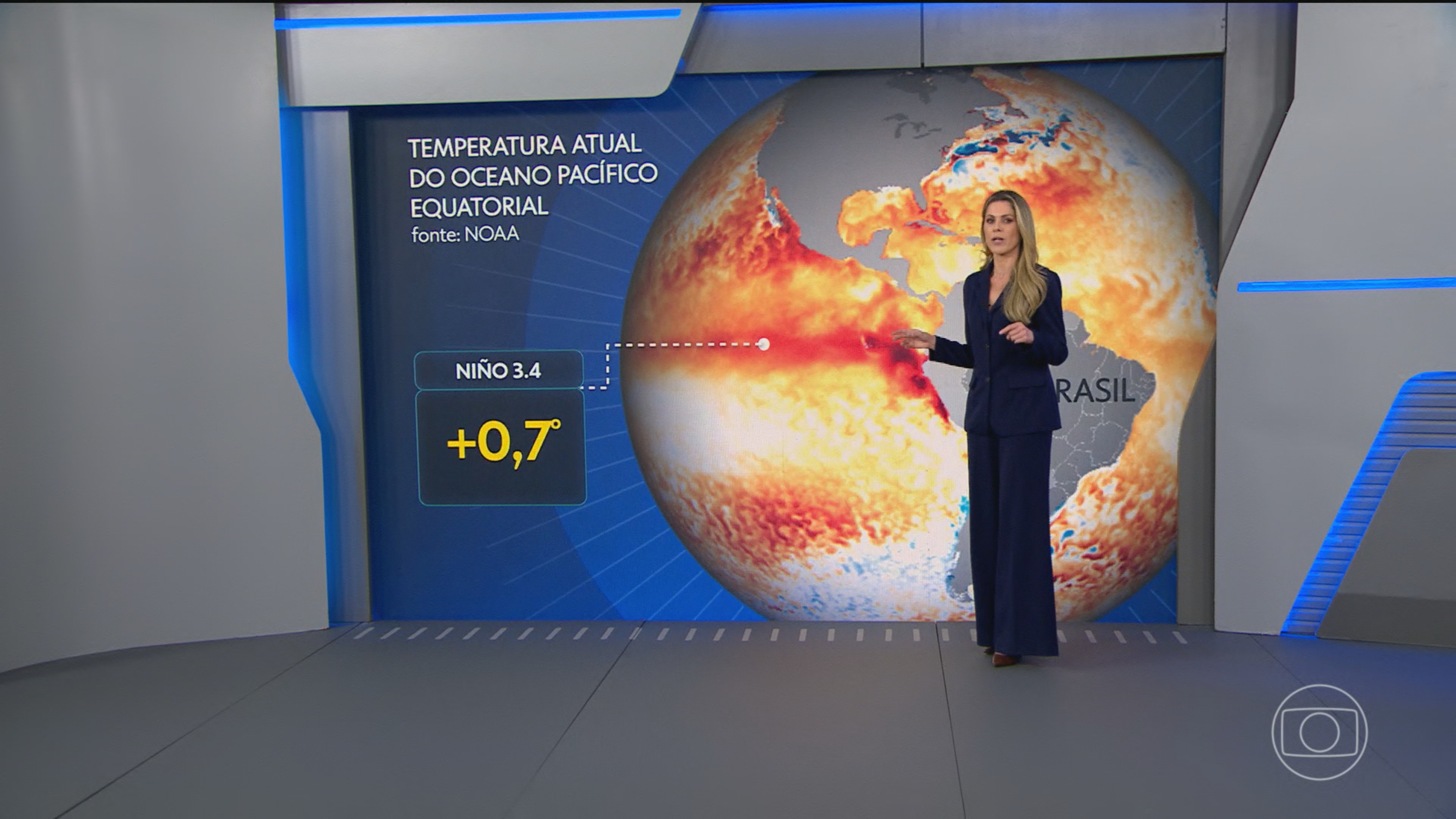
In general, the period is classified as El Niño when the average temperature measured along the equatorial strip of the ocean, between Indonesia and Central America, is 0.5 degrees Celsius above the historical average. In the first week of July, measurements showed 0.7 degrees above.
The analysis by NOAA scientists also pointed out that the probability of warming more than two degrees Celsius above average is 63%. This sets up a very intense El Niño, concentrated between November 2026 and February 2027.
In Brazil, this determines a shorter and less intense period of rain in the North and Northeast regions, increasing the possibility of droughts, in addition to a considerable concentration of rain in the South region, mainly affecting Santa Catarina and Rio Grande do Sul. The two conditions were observed in 2024, the last incidence of the phenomenon, when Rio Grande do Sul faced historic floods.
Warming of the oceans
Professor Ricardo de Camargo, from the Institute of Astronomy, Geophysics and Atmospheric Sciences at USP, explained that it is difficult to make statements about the increase in frequency or reduction in the interval between phenomena related to ocean warming, as well as establishing a direct relationship that these events are more intense.
"It is important to consider that the monitored region is quite large and it becomes warmer than normal and it is expected that global temperature averages will increase, which has happened in recent years. We also need to consider that the oceans are accumulating much of this heat. We need to be careful not to confuse climate change with climate variability. Phenomena such as El Niño are part of the planet's natural variability", he explains.
For the professor, NOAA's assessment criteria are consolidated and reflect current academic research and data from a wide collection network, with data collected in the atmosphere, on the surface and through a network of deep-sea buoys.
"However, we know that researchers from these American federal bodies are facing restrictions on the use of certain terms, which were sort of banned by the Federal administration in the United States, which is denying the importance of climate change", ponders the researcher, who highlights the existence of other important centers, such as the European, Japanese and Australian ones.
According to Camargo, the telemetry and models adopted by these centers are reliable, however the network of deep-sea buoys is basically maintained by the United States, and their loss can considerably affect the quality of the data.
The Trump administration has already signaled its interest in shutting down both the Pacific buoy network and its equivalent in the Atlantic.
NOAA's next El Niño assessment is expected to be published on July 9.
🗞️ 4 sources covered this story
American climate agency warns of serious effects of El Niño
G1 Globo
Pochettino sees cultural challenge for the evolution of football in the United States
CNN Brasil
United States sanctions Cuban state oil company for role in government repression
Euronews PTWEATHER NOTE SDC/SC 11/06 – NOAA confirms the beginning of the El Niño phenomenon
Secretaria de Estado da Proteção e Defesa Civil📰 Related Articles
American climate agency warns of serious effects of El Niño
G1 Globo
“Dai Dai” was chosen as the best song of the World Cups, says Billboard
CNN Brasil
PT goes to court against SP City Hall to expropriate idle properties
CNN Brasil
Luan Santana does a strange feat with Ricky Martin in a version of the 1995 hit
G1 Globo
Radioagência takes 3rd place in the Dom Phillips and Bruno Pereira award
Agência Brasil