


Patient celebrates total cancer remission after CAR-T Cell: 'The culmination of a 13-year fight'
⚡ Quick Summary
Patient celebrates total cancer remission after CAR-T Cell: 'The culmination of a 13-year fight' One of the first patients treated with CAR-T Cell therapy, developed by USP in partnership with the Hemocentro de Ribeirão Preto (SP) and the Butantan Institute, publicist Paulo Peregrino, aged 64, still gets emotional when looking at the images of the exam that compares the before and after treatment.
Patient celebrates total cancer remission after CAR-T Cell: 'The culmination of a 13-year fight'
One of the first patients treated with CAR-T Cell therapy, developed by USP in partnership with the Hemocentro de Ribeirão Preto (SP) and the Butantan Institute, publicist Paulo Peregrino, aged 64, still gets emotional when looking at the images of the exam that compares the before and after treatment.
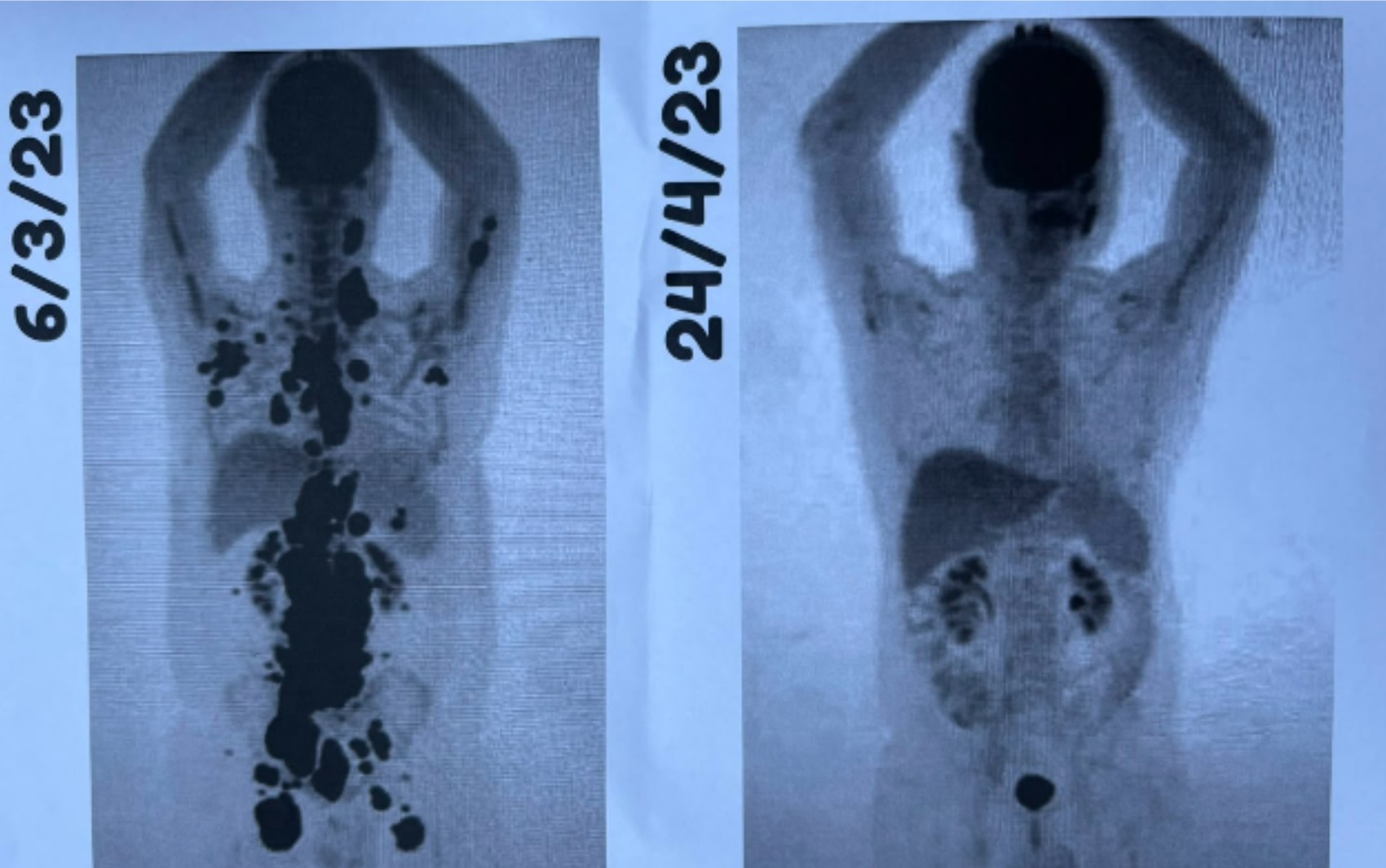
Paulo was diagnosed with non-Hodgkin's lymphoma in 2018. In March 2023, he tested cell therapy for the first time and, within 48 days, the lymphomas, which were spread throughout the publicist's body, disappeared.
"A scan was done as soon as I entered the HC in São Paulo to do the last phase, on March 6th. My entire body was taken over by lymphoma, so the entire lymphatic system from head to leg, everything was taken over. A month later, in April, the petscan showed my entire body clean. The remission was total, as if a rubber had been applied."
✅Click here to follow the g1 Ribeirão e Franca channel on WhatsApp
New results of the study, released this Wednesday, indicate that approximately 9 in 10 patients had a significant reduction or disappearance of the tumor after treatment.
Image shows reduction of tumors in a patient who underwent CART-Cell treatment at the Hemocentro de Ribeirão Preto, SP
Personal file
This year, Paulo completes two years of total remission of the disease. But much earlier, in 2010, he had already faced another cancer in 2010. Today, the publicist is cured.
"For me, [2023] was the culmination of a 13-year fight against cancer. I always say, when the nurse arrived in the room carrying a thermal box and took out a bag of blood, I looked and said 'is that the CAR-T Cell?' She said 'yes'. And then I said 'how long will it take?' She said 'about 45 minutes'. I even get a little emotional, because in one hour, theoretically, you can solve a 13-year-old problem. So that's the secret of science."
Paulo Peregrino, patient who recovered from cancer after treatment with CART-Cell in Ribeirão Preto, SP
Valdinei Malaguti/EPTV
CAR-T Cell involves the removal of white blood cells, which are the patient's body's defense cells, by collecting blood through a vein.
Known as lymphocytes, they are genetically reprogrammed in the laboratory to recognize and fight cancer cells, in this case B-cell acute lymphoblastic leukemia and B-cell non-Hodgkin lymphoma.
The cells are manipulated and expanded in the laboratory and returned to the patient's bloodstream.
READ ALSO:
Patient who had cancer remission with cellular therapy walks home after leaving the city of mobile ICU
Patient who treated cancer with cell therapy completes one year of disease remission: 'I had a little wine to celebrate'
Patient with cancer for 13 years has complete remission in SP in one month after cell therapy in study in the public network
To date, 75 participants have already been included in the clinical study, of which 25 received the infusion of the product with CAR-T cells, that is, they are already being treated, according to USP.
The research also foresees the recruitment of at least 100 patients, with the production of CAR-T cells for 81 participants and completion of the phase I/II clinical study.
Data from the National Cancer Institute (Inca) indicate that the estimated number of cases of non-Hodgkin's lymphoma in Brazil, for each year from 2026 to 2028, is 12,560 new records. Of this total, an estimated 6,580 new cases are in men and 5,980 in women.
Patient says he was disappointed
Paulo said that he was practically disillusioned when the opportunity arose to undergo treatment with CAR-T Cell, a therapy considered revolutionary. From 2018 to 2021, when the third lymphoma was diagnosed, he had already undergone 50 chemotherapy sessions.
During this period, he also underwent a bone marrow transplant, but nothing seemed effective in combating the disease.
"I no longer had a choice. The option that emerged in 2022, when the disease was really out of control, was CAR-T Cell.”
According to him, during the first consultations, the doctors saw that Paulo met all the main criteria to take part in clinical research into cell therapy.
"I had blood cancer, which was treatable by CAR-T Cell, which was non-Hodgkin's lymphoma, and I had no other chance, the condition was extremely serious, hopeless, and I had already tried everything that medicine had at that time. So I was selected."
The advertiser reveals that he didn't think twice about participating in the study, so he could help other people and prevent them from going through what he went through.
"I understand that participating in clinical research is essential so that people, in the future, can use the benefits of that experience. I did this with all my availability, I'm even proud to be part of it. When I share my story, I know I'm giving people a little bit of hope. Believe in science and God."
CAR-T Cell Therapy
CAR-T Cell therapy represents one of the greatest innovations in global oncology and works with immune system engineering in which the body's defense cells are removed from the patient's blood and are modified in the laboratory to gain "sensors" capable of identifying and attacking specific tumors.
🔎 CAR-T Cell stands for Chimeric Antigen Receptor T-cell, that is, chimeric antigen receptor T cell.
After this reprogramming, the cells are reintroduced into the body, where they begin to act against cancer. The technique offers high response rates in aggressive blood cancer cases, when other therapeutic options have been exhausted, and is indicated for the treatment of acute lymphoblastic leukemia, non-Hodgkin's lymphoma and multiple myeloma.
In addition to the clinical impact, Brazilian studies indicate that the early use of CAR-T therapy can save hospital resources by avoiding hospitalizations and treatments for disease relapses.
In 2019, Brazil had its first treatment at the USP of Ribeirão Preto at the Hospital das Clínicas of the Faculty of Medicine of Ribeirão Preto, applied to a 64-year-old retiree, who became symptom-free after being hospitalized with lymphoma in a serious condition and unresponsive to conventional treatments.
Between 2022 and 2024, the National Health Surveillance Agency (Anvisa) approved commercial therapies from foreign pharmaceutical companies, making Brazil the main reference in Latin America. Even so, this remained restricted due to the high cost, of up to R$4 million per dose, and logistical issues, with the requirement to send cells for manufacturing in the United States or Europe, putting critically ill patients at risk.
To nationalize the technology and reduce costs, institutions such as the Ribeirão Preto Blood Center, University of São Paulo and Butantan Institute joined forces in national research.
With the consolidation of clinical tests in these studies, researchers were able to reach efficacy rates of up to 87.5% in patients with acute lymphocytic leukemia B and non-Hodgkin's lymphoma B. The next step will be the request for definitive registration of these national therapies with Anvisa, paving the way for offering the technology through the SUS.
See more news from the region on g1 Ribeirão Preto e Franca
VIDEOS: Everything about Ribeirão Preto, Franca and the region
🗞️ 1 sources covered this story

📰 Related Articles

'I love inflation,' says Trump, as US prices rise at fastest pace in 3 years
BBC Brasil
US strikes make ceasefire 'practically meaningless', Iran says
CartaCapital
US hits ship carrying goods from Oman to Iran, says Iranian media
CNN Brasil
Oil price drops slightly to 92 dollars
Observador/https://i.s3.glbimg.com/v1/AUTH_59edd422c0c84a879bd37670ae4f538a/internal_photos/bs/2026/j/x/JtLilYT0ykDmRdfmG5kw/2026-06-11t075317z-1934326070-rc2jrla61lzg-rtrmadp-3-iran-crisis-bahrain.jpg)
Iranian Foreign Ministry says US strikes make ceasefire 'practically meaningless'
G1 Globo