


10 points from Quaest, which shows Lula increasing his advantage over Flávio Bolsonaro after the Master case
⚡ Quick Summary
What the June Quaest survey shows The June Quaest survey, released this Wednesday (10), shows that President Lula, a pre-candidate for re-election, opened a six-point lead over Senator Flávio Bolsonaro (PL) in a simulated second round.
What the June Quaest survey shows
The June Quaest survey, released this Wednesday (10), shows that President Lula, a pre-candidate for re-election, opened a six-point lead over Senator Flávio Bolsonaro (PL) in a simulated second round. It is the consultancy's first survey since the revelation of conversations between the son of former president Jair Bolsonaro and Daniel Vorcaro, owner of Banco Master.
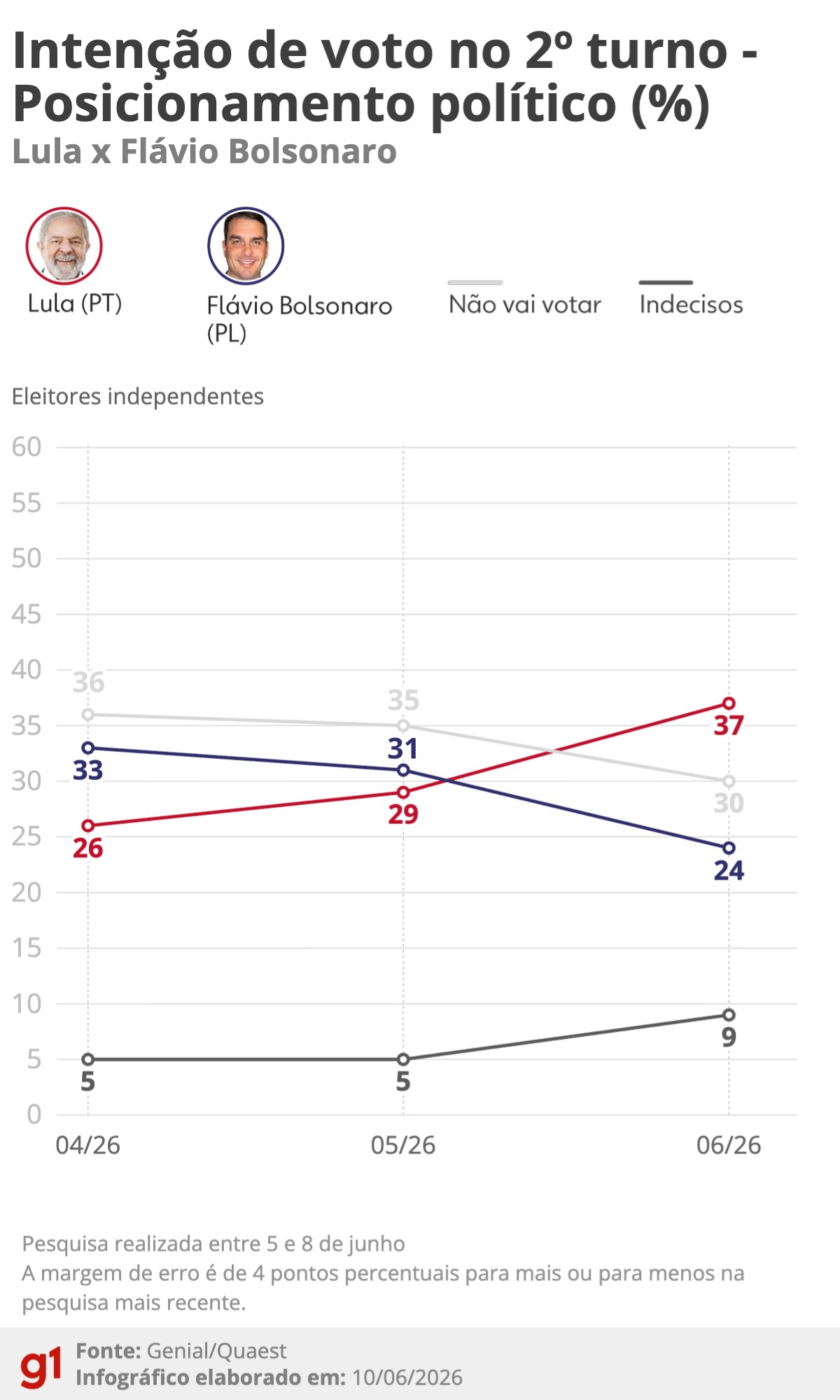
In the second round scenario, Lula appears with 44% of voting intentions, against 38% for Flávio Bolsonaro. In May, the two were technically tied, with 42% and 41%, respectively. Among independent voters, who represent around a third of the electorate, the president went from 29% to 37%, while the senator fell from 31% to 24%.
The survey also shows that the episode involving the request for financing for the film "Dark Horse" helped to erode Flávio Bolsonaro's image among the electorate, while government economic measures contributed to a recovery in Lula's approval.
Below, see the main highlights of the research.
Lula opens up advantage in the 2nd round
The scenario of a technical tie between the two main candidates is over. If the election were held today, Lula would be re-elected with 44% of the votes, while senator Flávio Bolsonaro appears with 38% in the second round simulation. In the previous survey, the distance was just one percentage point: 42% for Lula to 41% for the senator. The margin of error is plus or minus 2 percentage points.
Quaest survey of voting intentions in the 2nd round between Lula and Flávio Bolsonaro considering only voters who say they are independent.
Art/g1
The weight of the Master Case
The research indicates that the release of audios between Flávio Bolsonaro and banker Daniel Vorcaro about the financing of the film "Dark Horse", a biography about former president Jair Bolsonaro, had a negative impact on the senator: 65% of Brazilians believe that Flávio made a mistake in asking the banker for resources, and 58% believe that the episode suggests some illegal involvement in the case.
Quaest: Assessment of Flávio Bolsonaro's decision on the financing request to Daniel Vorcaro (June/2026)
Art/g1
Flávio Bolsonaro with Trump
Still according to the survey, the electorate's mood was also influenced by the new tariffs imposed by the United States on Brazilian products. The majority of those interviewed (47%) agree with Lula's version that Flávio Bolsonaro requested the tariff from Donald Trump. 35% say they are aligned with the version of the PL senator, who denies having made the request. Furthermore, 53% see the consequences of these measures as negative for the Brazilian economy.
Quaest: agreement with Lula and Flávio Bolsonaro on the new US tariffs (June/2026)
Art/g1
The dispute of narratives about PIX
The survey also shows that the version defended by Lula about American tariffs found more support among those interviewed. For 46%, the United States' measures represent retaliation for the PIX. 36% agree with Flávio Bolsonaro's explanation, who attributes the tariffs to diplomatic criticism of the Brazilian government. The result indicates an advantage for Planalto's narrative on a topic that involves one of the most popular financial services in the country.
Quaest: agreement with Lula and Flávio Bolsonaro on new US tariffs
Art/g1
Classification of CV and PCC as terrorists
Although the survey shows that 60% of Brazilians defend that Comando Vermelho (CV) and Primeiro Comando da Capital (PCC) be classified as terrorist organizations, the electorate is divided when this classification comes from the American government (45%).
Quaest: US Decision on PCC and CV (June/2026)
Art/g1
According to Quaest, the measure announced by the US government along with the new tariff on Brazilian products reinforced President Lula's criticism of external interference. Migration of independent voters
Among voters considered independent, Lula passed Flávio Bolsonaro and opened a 13-point lead in the 2nd round. For the director of Quaest, Felipe Nunes, the movement in this segment was the most significant.
"The most significant change happened among the independents, who replaced Flávio with Lula", he states.
Quaest survey of voting intentions in the 2nd round between Lula and Flávio Bolsonaro considering only voters who say they are independent.
Art/g1
This electorate corresponds to a third of the total and can decide the dispute. Independents are voters who consider themselves neither right-wing, left-wing, Bolsonarists nor Lulistas.
Among them, Lula rose from 29% to 37% and appears ahead. Flávio Bolsonaro fell from 31% to 24% — in April, his best moment, he reached 33%. Another 30% say they would not vote in a 2nd round between Lula and Flávio.
Third copy remains tangled
Lula, Flávio Bolsonaro, Renan Santos, Caiado and Zema
Disclosure and reproduction
Quaest also shows that the presidential race remains polarized and that the dispute between the names trying to establish a third way alternative is tangled.
The founder of MBL and pre-candidate for Missão, Renan Santos, appears numerically ahead of Romeu Zema, from Novo, former governor of Minas Gerais. He has 3% of voting intentions and is tied with the former governor of Goiás Ronaldo Caiado, from the PSD.
The research also includes for the first time former governor Aécio Neves, who is running for President defended by the PSDB. He appears with 2% of voting intentions, the same percentage as Zema. As the margin of error is two percentage points, everyone is technically tied.
Quaest: Voting intention for president in the 1st round (June/2026)
Art/g1
Improvement in approval
The evaluation of Lula's administration showed recovery, with 47% approval and 48% disapproval. In April, the difference was nine points. Now it's down to just one. The improvement is attributed to the positive perception of economic measures.
Quaest: approval of the Lula government (June/2026)
Art/g1
Impact of Desenrola and economic measures
The improvement in government approval coincides with the impact of economic measures announced in recent months.
The Desenrola program helped reduce the percentage of Brazilians who say they are very in debt from 28% to 23%, while the share of those who say they have no debt rose to 30%.
The expansion of Income Tax exemption and measures to reduce fuel prices — approved by 53% of those interviewed — also appear among the actions best rated by Brazilians.
Lula leads the 1st round
In the first round scenario, Lula maintains an isolated lead, with 39% of voting intentions. Flávio Bolsonaro appears in second place, with 29%, below the 33% recorded in May. According to the survey, he lost ground among non-Bolsonaro right-wing voters, although he maintains majority support among Bolsonarists.
📰 Related Articles

PSU will force disabled young people into social work
Observador
The team leaves Leiria with a 100% winning record
ObservadorCommunication Agency - ABF Expo 2026: Yungas highlights the role of AI as a pillar of franchising expansion
Estadão Blue Studio
The Cavalhadas of Vildemoinhos, the virtuosity of a legend
Observador
Going on vacation? Medications you can't forget
Observador