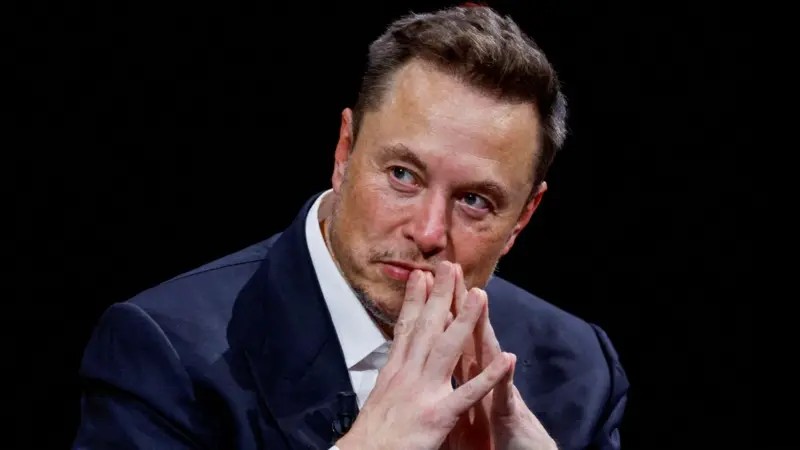
Why SpaceX's entry into the stock market could be Elon Musk's biggest bet yet
⚡ Quick Summary
Trading of company shares will begin on June 12th Getty Images via BBC It's 7:25 am on October 13, 2024 at Starbase, near Boca Chica, on the Texas side of the US-Mexico border.
Trading of company shares will begin on June 12th
Getty Images via BBC
It's 7:25 am on October 13, 2024 at Starbase, near Boca Chica, on the Texas side of the US-Mexico border. On the launch pad is the largest rocket ever built.
Its engines start and the spacecraft soars into the skies over the Gulf of Mexico to cheers and applause in the SpaceX control room.
Download GloboPop to watch short vertical videos from Globo
But the launch is not the main event. What goes up must come down, and the way this rocket returns to Earth will become a landmark in space exploration.
Seven minutes later, the enormous rocket booster that propelled the ship into space begins to fall back to Earth, until its engines reactivate as planned.
See the trending videos on g1
Now on g1
It reduces the speed of its descent and positions itself with millimeter precision to be captured by a structure called Mechazilla, nicknamed "chopsticks" (the "chopsticks" in Japanese cuisine), in an unprecedented operation carried out by engineers.
Amid shouts of celebration and greetings in the SpaceX control room, businessman Elon Musk tells his millions of followers on social media that this is a "big step towards making life multiplanetary", a reusable rocket capable of drastically reducing the costs of launches to Earth's orbit, the Moon and, one day, Mars.
A company with a futuristic vision led by someone many describe as an eccentric and unusual genius, SpaceX and Musk are often compared to Tony Stark, leader of Stark Industries and also known as Iron Man in the Marvel Comics universe.
The launch of Starship in October 2024 marked another step in Elon Musk's ambitions for space exploration
Anadolu via Getty Images/BBC
On June 12, trading will begin for a batch of SpaceX company shares that, until now, could only be controlled or accessed by Elon Musk and a select group of large private investors.
It is not surprising that more than one UK stockbroker told the BBC that there was a "sudden increase" in interest from investors interested in the chance to buy shares in this company surrounded by expectations, led by a figure considered charismatic and who has captured the imagination of the public around the world.
British retail investors are set to receive around £1.5 billion in shares, and one of the UK's leading investment platforms believes the offering could attract a new generation of investors.
Simon Belsham, client relations director at Hargreaves Lansdown, said: "While we recognize that this initial public offering [IPO] may not be suitable for everyone, this is an exciting time for many of our clients. We hope this will be many people's first investment experience."
Even if you don't buy stocks directly, if you have retirement savings invested in the stock market, as with virtually anyone with a pension plan, it's very likely that you'll soon own a small part of a company that sits at the intersection of technology and geopolitics and, as Musk would say, at the center of the future of the human race.
The possibility of ordinary people buying SpaceX shares is one of the most important moments in the history of financial markets and is about to happen, something that will almost certainly turn Musk into the first dollar trillionaire in history. SpaceX's entry into the stock market could transform Elon Musk into the world's first trillionaire
Reuters via BBC
On the first few pages of the SpaceX stock prospectus, this discreet mission statement appears: "To build the systems and technologies needed to make life multiplanetary, understand the true nature of the universe, and carry the light of consciousness to the stars."
But SpaceX isn't just about rockets, and maybe not even primarily about rockets. The company is also a bet on the future of artificial intelligence (AI).
And the success or failure of its imminent partial share sale to the public will be an important test of the hitherto largely unrestrained and, for some, alarming, enthusiasm among investors around the idea that AI will absorb large portions of the world economy.
The continued concentration of power in a few U.S. megacorporations also raises important questions about the way business, economics, and politics work on Earth.
And many see this as Musk's "Icarus moment", when someone flies too close to the Sun. "I think this is a project driven by Elon Musk's ego", says Sinead O'Sullivan, an economist who previously worked for NASA (American space agency).
So should we be pleased that we will probably all embark on their space journey?
An impressive review
SpaceX filed a request for an initial public offering of shares, known as an IPO. Although only part of the company is being offered for sale to ordinary investors, the price of the shares offered by Musk makes it possible to calculate the estimated value of the entire company.
The banks responsible for selling the shares gave the company a market value of US$1.75 trillion (around R$9.45 trillion), which would easily place it among the ten most valuable companies in the world.
This is an impressive figure for a company that lost almost US$5 billion (approximately R$27 billion) last year. So, after all, what is being purchased?
SpaceX is, in practice, several companies within one. It designs rockets, manufactures and launches both its own and third-party satellites. Its launch capacity alone surpasses that of any other company and even that of any country in the world.
The company's own satellites also form the basis of the Starlink communications network, which proved of crucial geopolitical importance during Ukraine's defense against Russian invasion.
This is a profitable business that generates significant revenue. Still, even the most optimistic estimates value this part of SpaceX at around US$300 billion (around R$1.6 trillion) — less than 20% of the market value target of US$1.75 trillion (around R$9.45 trillion) attributed to the company.
Big bet on AI
The real bet is on artificial intelligence (AI) because SpaceX also includes the AI company xAI, which is also controlled by Musk, as well as a more ambitious space program, with plans to create data centers in space capable of providing enormous computing power, powered by solar energy and cooled by the cold of space, while also developing manned bases on the Moon and, in the future, on Mars.
SpaceX's success largely depends on its AI arm. Of the US$28.5 trillion (approximately R$154 trillion) in potential market identified by the company for its services, known as the total addressable market, US$26.5 trillion (approximately R$143 trillion) would be linked to AI.
To believe this, you have to believe that the AI industry will be comparable in size to the entire US or European economy.
SpaceX's prospectus estimates that the space and communications sector represents less than 10% of this total market of US$28 trillion (R$154 trillion), although these are the only businesses in which the company has demonstrated concrete commercial and technical advantages. "If we look at the business itself, it's not clear exactly what sector or industry SpaceX operates in," says O'Sullivan, formerly of NASA.
SpaceX's ambitions go beyond rockets and include artificial intelligence, computing and future missions to Mars
Getty Images via BBC
"The company's brand and identity have been built over two decades around rockets, but most of the investment is going into data centers and an AI company that seems much more tied to social media than space," adds O'Sullivan. "All of this is brought together in a kind of conglomerate under the name Elon Musk."
The company's prospectus admits that SpaceX will need to do things that no company has been able to accomplish before. The document states that it will be necessary to "develop, market and operate products and services (...) on a scale never before achieved."
O'Sullivan expresses skepticism. "When we look at the gigantic value they are trying to attribute to the company, what is being purchased is much more a stake in the Elon Musk brand than in the space industry itself."
Uncontrolled ownership?
But there is no shortage of admirers willing to point out Musk's extraordinary ability to raise funds, challenge consensus and contradict his critics.
Musk faced the combined weight of the global auto industry and, less than 20 years after its founding, his car company, Tesla, was worth more than Toyota, Ford, General Motors and Volkswagen combined.
Another reason why some investors intend to pass up the opportunity to invest in what could be the biggest bet of Musk's career is the objection to the level of control he will exercise over the company.
Musk is listed as founder, chief executive officer, chief technology officer and chairman of the board.
Although he only owns 42% of the company, his shares have additional voting rights, which guarantees him, in practice, control over 85% of the company.
Tesla's market value grew rapidly and, in less than two decades, surpassed the combined value of several traditional automakers
Reuters via BBC
Financial journalist Robert Armstrong asks: "What does it mean to own shares in a company? It's ownership, but what kind of ownership is it? Do you really own something you can't control?"
Armstrong adds that investors should receive a discount for giving up decision-making power: "I want to pay less for a company in which my ownership doesn't include control."
But as one major institutional investor told the BBC, "The cult around Elon Musk demands that his followers pay more for the dubious privilege of having no real say in how the company they own is run. And people seem happy with that."
And that control is in the hands of a man who has already used his power and fortune in controversial ways.
Musk spent almost US$300 million (around R$1.6 billion) on the second presidential campaign of the current American president, Donald Trump.
It has also secured billions of dollars in US government contracts and involved itself in the internal affairs of other countries by supporting right-wing figures in the UK and elsewhere.
The Musk Effect
Still, betting against Musk hasn't been a smart strategy. He did not become the richest man in the world, with a personal fortune exceeding US$700 billion (approximately R$3.8 trillion) and which could soon exceed US$1 trillion (approximately R$5.4 trillion), without repeatedly contradicting his critics.
Since 2020, estimates of SpaceX's value have jumped from US$40 billion (approximately R$216 billion) to US$1.75 trillion (approximately R$9.45 trillion), an increase of more than 40 times. In the same period, Tesla shares increased tenfold.
And this happened even though Tesla car production had plateaued. The resumption of the rise in Tesla's shares, despite the drop in sales, reveals another of Musk's great talents: presenting new and ambitious goals to justify the company's value, in this case, the promise to migrate to the robotics area, with the objective of building 1 billion humanoid robots.
This ability to quickly change direction and adapt led one major investor to tell the BBC that "he looks more like [famous businessman and showman] P. T. Barnum than [John D.] Rockefeller or [Warren] Buffett."
Another dotcom boom?
But Fomo (an acronym for "fear of missing out") is a powerful emotion when it comes to Musk. Tesla's critics ended up getting it wrong and missed out on huge gains.
SpaceX's IPO is the largest offering of its kind in history, but it represents just the first in a series of mega stock sales from companies on the front lines of the AI-driven economy.
This flood of new shares hitting the market has some investors fearing a repeat of the dot-com bubble of the early 2000s, when companies with lofty goals but little or no track record of profits tried to sell as many shares to the public as possible.
For now, SpaceX will initially put up for sale only 5% of the company's shares, equivalent to US$75 billion (around R$405 billion).
And the expectation is that competitors in the AI area, such as Anthropic and OpenAI, will also make similar moves in the open market.
Once a portion of the shares begin selling, new offerings can follow suit, meaning trillions of dollars in new shares could hit the market in the coming months and years.
This can create an excess supply that is difficult for demand to absorb, putting downward pressure on share prices.
An important difference from the dot-com bust is that index funds, which automatically buy shares of companies included in major market indices, may end up absorbing some of that supply over time.
Anthropic and OpenAI are set to join SpaceX among US megacorporations, exerting an as-yet-unseen level of global power and influence and unprecedented dominance over citizens' lives, at least according to these companies' advocates.
Thus, as happened in 2024, the market's eyes are once again focused on the SpaceX launch platform, the stage for what could be the most important share sale in the history of financial markets.
🗞️ 1 sources covered this story

📰 Related Articles

Mourinho says goodbye and thanks for the “honor” of coaching Benfica
Observador
CR7's last dance is the highlight of Group K of the World Cup
Agência Brasil
Brazil, Messi, Klose and more: the teams and players who hold World Cup records
BBC Brasil
Mussolini's reconquest of the World Cup before the Great War
Observador
Web Summit: experts argue that Brazil should create its own model to regulate AI and criticize text under discussion in Congress
G1 Globo