


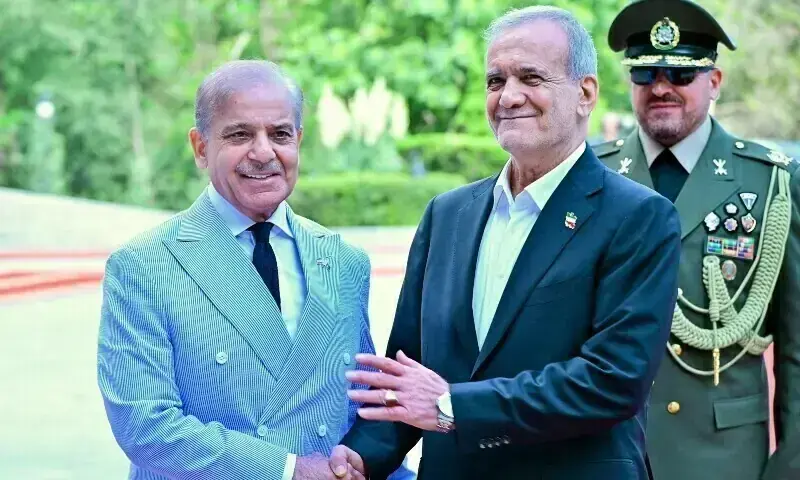
PM Shehbaz calls on Iran, other parties not to jeopardise ‘hard-earned peace gains’
⚡ Quick Summary
Prime Minister Shehbaz Sharif on Friday called on Iran and all other parties involved in the Middle East conflict to exercise restraint following an escalation in tensions between Washington and Tehran.
Prime Minister Shehbaz Sharif on Friday called on Iran and all other parties involved in the Middle East conflict to exercise restraint following an escalation in tensions between Washington and Tehran.
Efforts to end the Middle East war have suffered a setback following an escalation in hostilities after Iranian attacks on ships in the strategic Strait of Hormuz. Iran struck at least three ships in recent days, prompting extensive US strikes on Iranian targets on Tuesday and Wednesday, which were followed by retaliatory attacks by Iran on Gulf countries.
According to the Prime Minister’s Office, the premier issued the call during a telephone conversation with Iranian President Masoud Pezeshkian, during which he expressed “deep concern” over the escalation and “underscored the urgent need to restore regional peace and stability”.
“He called on Iran and all other parties to exercise restraint and refrain from any action that could jeopardise the hard-earned peace gains achieved over the past few months,” the statement added.
The prime minister stressed the importance of upholding the commitments made under the Islamabad Memorandum of Understanding (MoU), describing it as an enduring framework for promoting mutual understanding, respect and shared prosperity in the region and beyond.
Reaffirming Pakistan’s commitment to regional peace, PM Shehbaz assured Pezeshkian of Islamabad’s readiness to continue playing an “honest and sincere role” in facilitating dialogue and supporting all peace efforts between Washington and Tehran.
During the call, the Iranian president thanked the premier, Deputy Prime Minister and Foreign Minister Ishaq Dar, Chief of Defence Forces and Chief of Army Staff Field Marshal Asim Munir and other senior Pakistani leaders for attending the funeral ceremony of late supreme leader Ayatollah Ali Khamenei.
“He also reaffirmed Iran’s commitment to peace and appreciated Pakistan’s constructive support and sincere efforts for regional stability,” the statement read.
The PMO added that both leaders also reviewed the implementation of decisions made during Pezeshkian’s visit to Islamabad last month and agreed to expedite follow-up actions.
PM Shehbaz also conveyed his regards and best wishes to current supreme leader Ayatollah Mojtaba Khamenei, while both leaders agreed to “remain in close contact and continue consultations on matters of mutual interest and regional peace”.
Earlier this week, Pakistan expressed deep concern over escalating tensions in the Middle East and called on the US and Iran to exercise restraint following mutual overnight strikes.
In a statement, the Foreign Office noted that “a renewed conflict is in no one’s interest”.
“Pakistan calls on all parties to exercise restraint and refrain from any actions that may further undermine regional peace and stability. There is no alternative to continued engagement, dialogue and diplomacy to achieve [a] shared goal of peace in the region,” the statement added.
This is not the first time the US and Iran have exchanged strikes despite a ceasefire being in place since April.
Last month, the US carried out attacks in Iran in response to what US President Donald Trump said was the downing of a US Apache helicopter. In retaliation, Iran said it attacked bases and other targets in the Gulf.
Over a week after the strikes, the Islamabad MoU was signed, which gave both sides 60 days to negotiate a comprehensive agreement on Iran’s nuclear programme and related issues. It also mandates a complete halt to military operations on all fronts.
However, at the Nato summit in Ankara on Wednesday, Trump said that the ceasefire was “over”, adding, “It’s just a waste of time dealing with them. I’ll let our wonderful negotiators keep talking if they want, but I don’t see it. I don’t like these people.”
He further warned that the US would hit Iran “hard” that night, and Washington and Tehran traded strikes for a second consecutive day.
US forces said the latest attacks against Iran were aimed at “their ability to threaten the freedom of navigation in the Strait of Hormuz”, citing recent strikes against commerical ships in the waterway.
📰 Related Articles
US insists Iran commit to stopping attacks in Hormuz strait, say US officials
Al-Monitor
Trump says he left instructions to 'bomb' Iran 'at levels' never seen if he is assassinated
Fox NewsUS Demands Iran Declare Strait of Hormuz Open to All Shipping
Bloomberg.com
Pakistan ready to continue mediatory efforts to settle Iran-US conflict — PM
TASSIran admits to Trump advisers "they made a mistake" in shooting at ships in strait
CBS News