PUNJAB BUDGET 2026-27: Punjab eyes Rs910bn surplus in Rs5.9tr budget
Sports17/06/2026Dawn Pakistan
👁 16
Share:
⚡ Quick Summary
• Minister says no additional tax burden placed on public
• Insists budget focuses on welfare, growth, self-reliance
• Govt employees get 7pc salary raise; pensions increased by 3.5pc
• Province targets Rs1.21tr revenue from own sources
• Revenue authority given Rs528.9bn collection target
• Rs546bn grant to Centre included for the first time
• Education gets Rs750bn; health sector allocated Rs500.82bn
• Agriculture, livestock, aquaculture get Rs132.5bn
LAHORE: The Punjab government on Tuesday unveiled a Rs5.903 trillion budget for the next financial year, slashing the province’s Annual Development Programme by about 40 per cent to Rs752 billion from the outgoing year’s estimate of Rs1.24tr, while promising an estimated cash surplus of Rs910bn.
• Minister says no additional tax burden placed on public
• Insists budget focuses on welfare, growth, self-reliance
• Govt employees get 7pc salary raise; pensions increased by 3.5pc
• Province targets Rs1.21tr revenue from own sources
• Revenue authority given Rs528.9bn collection target
• Rs546bn grant to Centre included for the first time
• Education gets Rs750bn; health sector allocated Rs500.82bn
• Agriculture, livestock, aquaculture get Rs132.5bn
LAHORE: The Punjab government on Tuesday unveiled a Rs5.903 trillion budget for the next financial year, slashing the province’s Annual Development Programme by about 40 per cent to Rs752 billion from the outgoing year’s estimate of Rs1.24tr, while promising an estimated cash surplus of Rs910bn.
The government’s total estimated expenditure also went up 9.6pc, or Rs568bn, from the outgoing year’s Rs5.335tr.
The budget documents lack full transparency as they gloss over many things, including a Rs588bn drop in the ADP, while the government promised increased development spending, major investments in education, health, agriculture and infrastructure and maintained that no additional tax burden would be placed on the public.
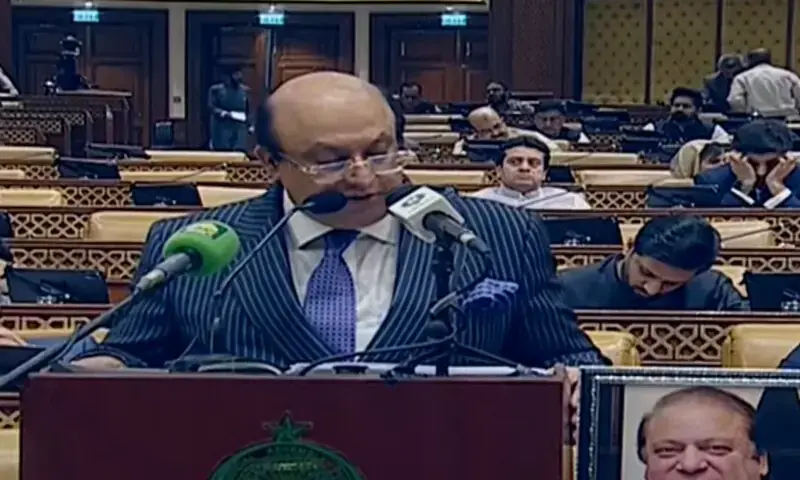
Presenting the budget in the Punjab Assembly, Finance Minister Mujtaba Shujaur Rehman said the government had adopted fiscal discipline and administrative reforms to create room for public welfare and development initiatives despite economic challenges.
The government said its fiscal strategy was anchored in the principles of “prudent financial management, expenditure rationalisation and revenue mobilisation”.
Budget documents show that general revenue receipts are projected to increase from Rs4.74tr in the outgoing fiscal year to Rs5.60tr in the next, supported by growth in federal divisible pool transfers and enhanced provincial own-source revenues.
Revenue reforms, including broadening of the tax base, modernisation of tax administration, digitisation of collection systems and improvements in compliance mechanisms, are expected to contribute significantly towards fiscal sustainability.
The proposed budget is 10.7pc higher than the current fiscal year’s budget. Current expenditures have been estimated at Rs1.963tr, reflecting a 3.1pc decrease attributed to austerity measures. The government has proposed a 7pc increase in salaries for government employees and a 3.5pc increase in pensions. A major feature of the budget is the allocation of Rs752bn for development spending, down 39.3pc from Rs1.24tr in the outgoing year.
The government expects Punjab to receive Rs4.201tr under the NFC Award, against Rs4.622tr last year, while provincial own-source revenue is targeted at Rs1.21tr.
The Punjab Revenue Authority has been given a collection target of Rs528.86bn, or 55.4pc more than the outgoing year. Likewise, the Excise and Taxation Department has been given a target of Rs124bn, 77pc more than the outgoing financial year. Provincial non-tax revenue collection is estimated at Rs461.17bn, 52pc more than last year.
The minister clarified that this increase in revenue generation would come through broadening the tax base instead of increasing the tax burden on existing taxpayers, as revenue from own resources is likely to rise by over 42pc, from Rs524.7bn in the outgoing year to Rs748.7bn in the new fiscal year.
The province will also receive Rs49.84bn under foreign-funded programme loans and Rs140.6bn under foreign project loans. The budget also includes a Rs910bn estimated provincial surplus to comply by the financial framework signed between the federal government and the IMF, while a Rs546bn grant to the federal government, for the first time in the province’s history, is also part of the budget.
The government announced that education would remain a top priority, with Rs750bn earmarked for the sector.
Key initiatives include the continuation of the Chief Minister’s Laptop Programme, under which 110,000 laptops are being provided, and the Honhaar Scholarship Programme, which has benefited more than 108,000 students.
A sum of Rs40bn has been earmarked for the Maryam Centre of Academic Leadership, STEAM laboratories and Nawaz Sharif Centres of Excellence. New autism schools are also planned in every division of the province, while 244 IT labs will be established in colleges at a cost of Rs6.9bn.
For the health sector, Rs500.82bn has been proposed. Major projects include the Nawaz Sharif Institute of Cancer Treatment and Research, new cardiac facilities, upgraded teaching hospitals, expanded dialysis and transplant programmes, and the establishment of a Nawaz Sharif Medical District worth Rs169bn.
The budget also places strong emphasis on economic transformation through the Punjab Innovation for Value, Opportunity and Transformation (PIVOT) initiative.
The three-year plan envisages total investment of nearly Rs1.995tr, including Rs1.09tr in public investment and more than Rs905bn from the private sector.
A sum of Rs193bn will be used for subsidised financial assistance to 463 industrial projects that are likely to generate 29,400 direct jobs and $5.6bn in additional export earnings. The government expects the overall programme to generate additional exports worth $16.5bn and create significant job opportunities.
To support businesses, the government highlighted interest-free financing schemes under the Asaan Karobar Programme, through which more than 110,000 entrepreneurs have received loans.
Agriculture, livestock and aquaculture have been allocated Rs132.54bn. The government plans to expand the Kissan Card Programme, continue subsidised tractor schemes, establish agro-processing parks worth Rs60bn and increase support for climate-resilient agriculture.
Local government, water supply and sanitation projects also received significant attention. The government announced funding for the Saaf Pani Programme, the Punjab Development Programme, the Suthra Punjab initiative and low-income housing schemes under Apni Chhat Apna Ghar.
Published in Dawn, June 17th, 2026